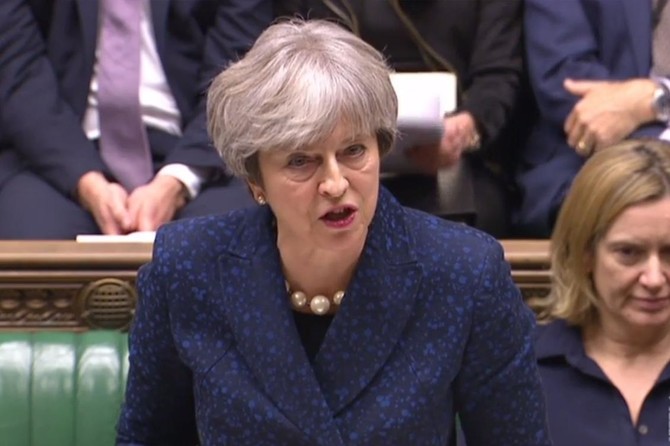
LONDON: Prime Minister Theresa May says there is a new sense of optimism about negotiations over Britain’s departure from the European Union, insisting that a preliminary deal has given fresh impetus to the talks.
May met with her Cabinet on Monday before a scheduled address to the House of Commons, where she will update lawmakers on the agreement reached Friday with the EU that covers the main divorce issues. Those include the rights of citizens affected by Brexit, Britain’s financial obligations to the EU and how to keep open the border between Britain’s Northern Ireland and the Republic of Ireland, an EU member.
Leaders of the other 27 EU members are expected to ratify the agreement later this week, allowing Brexit talks to move on to trade and security cooperation.
“Of course, nothing is agreed until everything is agreed,” May said in a statement. “But there is, I believe, a new sense of optimism now in the talks and I fully hope and expect that we will confirm the arrangements I have set out today in the European Council later this week.”
But weekend comments by the official in charge of the talks have threatened to spoil May’s triumphant moment. In an interview with the BBC on Sunday, Brexit chief David Davis suggested that last week’s agreement was a “statement of intent” that was not legally binding.
The comments caused unease in Ireland, where leaders demanded provisions in the agreement to ensure Brexit won’t restrict travel and trade between the Republic of Ireland and the UK’s Northern Ireland. Officials in both parts of the island say the border must remain open to protect the Irish peace process.
The Irish government branded Davis’ comments “bizarre” and insisted that Britain must live up to the commitments it made last week.
Davis on Monday tried to mitigate the fallout, insisting his words had been “completely twisted.”
“What I actually said yesterday ... was we want to protect the peace process, want to protect Ireland from the impact of Brexit for them, and I said this was a statement of intent which was much more than just legally enforceable,” Davis told LBC Radio.
“In the event that the withdrawal agreement doesn’t happen then we would still be seeking to maintain an invisible border between Northern Ireland and Ireland,” he added. “I was making the point that it was much more than just in the treaty, it’s what we want to do anyway.”
In Brussels, the Europeans were thinking about form as well as substance.
European Commission spokesman Margaritis Schinas said that while the deal was not legally binding, it was regarded as a pact of honor.
“We see the joint report of (EU Brexit negotiator) Michel Barnier and David Davis as a deal between gentlemen and it is the clear understanding that it is fully backed and endorsed by the UK government,” he said. He noted that EU Commission President Jean-Claude Juncker agreed on that with May on Friday. “They shook hands.”


![]()
UK leader says there is new optimism in Brexit talks
UK leader says there is new optimism in Brexit talks
Latest updates





© 2026 SAUDI RESEARCH & PUBLISHING COMPANY, All Rights Reserved And subject to Terms of Use Agreement.