UNCHA AMIRPUR: Subedar Singh bears the scars of India’s painful reliance on dirty power and its struggle to pay for the costly transition to the brave new world of solar and renewable electricity.
Last year, the farmer walked into a field in his village and suffered 70 percent burns to his feet and ankles from an underground coal fire caused by a nearby power plant. Singh said he dragged himself out of the field and then fainted from the searing pain.
The people of Uncha Amirpur in the northern Uttar Pradesh state — east of the smog-afflicted capital New Delhi — discovered that a mix of water and coal used by the nearby NTPC Dadri power plant had accumulated under the field and caught fire. Some cattle died.
Hundreds of millions of people in India are forced to live with the fallout of the dirtiest fuels — with the government blaming a lack of funds to pay for greener power.
Money will be the key issue when about 100 countries meet in Paris on Tuesday for the One Planet Summit organized by French President Emmanuel Macron. The meeting will focus on marshalling public and private funds to speed the move to a low-carbon economy.
Developing countries say barely a tenth of the $100 billion (SR375 billion) promised by the end of the decade under a 2010 deal has come in so far.
“If more money is available, of course the (Indian) government is in a position to push renewable energy faster,” energy analyst Narendra Taneja said.
“The pollutants accumulated over the decades, we didn’t do that. It was the West and they should clear up those dues as soon as possible,” said Taneja, a consultant to the ruling Bharatiya Janata Party.
India needs $140 billion to reach Prime Minister Narendra Modi’s ambitious target of installing 100,000 megawatts of solar power by 2022, according to Arunabha Ghosh, chief executive of the Council on Energy, Environment and Water, a New Delhi think tank.
So far it has just 15,000 MW, less than five percent of the country’s total generation capacity of 331,000 MW.
Developing countries “have stayed committed to the Paris agreement, even after the US decision to exit, but their ability to scale up ambitions is contingent on how much rich countries do at home and how much they support actions outside,” Ghosh said.
“Next year could be a tipping point for their patience.”
As one of the fastest growing major economies, India needs uninterrupted power to keep factories humming and the economy expanding.
Currently, 66 percent of its electricity is generated by coal and gas. The rest comes from nuclear and renewables, including hydro, wind and solar.
India needs renewable energy to meet its 2015 Paris commitment to reduce emissions relative to gross domestic product by up to 35 percent by 2030 from 2005 levels.
A lack of affordable options to store wind and solar energy means cheap coal is India’s mainstay. More than 300 coal power plant units missed a December 7 government deadline to upgrade with emissions reduction technology.
The impact is visible in Uncha Amirpur, where a thick coat of grime and dust covers every surface.
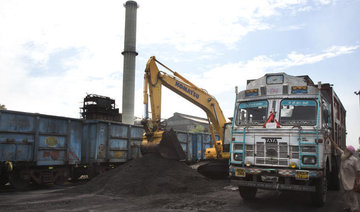
The Dadri power plant provides up to one third of the electricity required for New Delhi, 66 kilometers away by road, but also fuels the smog that envelops the Indian capital each winter.
The severe air pollution in New Delhi — many times the global safe limit — has been linked to asthma, bronchitis and even brain disease in babies.
Mandeep Raghav, a village local trying out for the Uttar Pradesh state cricket team, said there are days when he finds it hard to breathe.
“When I run, it’s okay for a while as I absorb the pollution, but at night when I sleep, I can feel my heartbeat increasing,” the 23-year-old batsman, whose father died of asthma in April, said.
“Sometimes I feel like I’m about to die.”
Ishwar Chand Sharma, who earns about 7,000 rupees a month as a mechanic at the coal plant, said: “For most of this year, I’ve been sick at least 10 days a month and missed work.”
Ash from the coal plant spreads to nearby villages, including Salarpur Kala, which is sandwiched between the plant and two cement factories.
Satbir Singh, a retired soldier who took up farming, said the ash ruins his crops.
“There’s a thick layer on the buds that just kills the wheat,” he said. “At least half of the 200 acres here was wiped out in October.”


![]()
![]()

Pollution conundrum: India faces painful move to cleaner energy

Pollution conundrum: India faces painful move to cleaner energy


Latest updates


© 2026 SAUDI RESEARCH & PUBLISHING COMPANY, All Rights Reserved And subject to Terms of Use Agreement.