BAGHDAD: Despite Iraq’s declaration of victory over Daesh, the terrorists still present a deadly threat and will hide deep in the desert or blend into the civilian population, experts say.
Three years after proclaiming a cross-border “caliphate” stretching into Syria, the insurgents’ brutal rule over a third of Iraqi territory is consigned to history.
There are now fewer than 3,000 Daesh fighters left in Iraq and Syria, but they still pose a danger, according to the US-led coalition against Daesh.
“Daesh was defeated militarily in Iraq but not eliminated,” said Abu Mahdi Al-Mohandis, the number two in the Hashed Al-Shaabi paramilitary force that has fought alongside the army against Daesh.
“It is still present in some places and its members are trying to infiltrate civilians and villages. Daesh has changed its method,” he said.
In a sign of the lingering threat, Iraqi forces said they killed 10 “Daesh suicide bombers” in a tunnel near the city of Kirkuk on Saturday.
After launching a sweeping offensive in 2014, the extremist organization formed a proto-state as large as Italy straddling Iraq and Syria that was home to millions of people.
But now the militants have been forced back into hiding.
“Security is assured in the main cities because we are there, but it will not be complete without full control of the border with Syria,” Mohandis said.
On the Syrian side, the army and Kurdish fighters share control of the frontier.
In Syria, Daesh controls about eight percent of Deir Ezzor province and has a presence in Homs and Hama provinces as well as Yarmuk Palestinian camp near Damascus, according to the Syrian Observatory for Human Rights, a British-based war monitor.
In Iraq, the terrorists are expected to return to earlier tactics, according to the coalition.
“Daesh has been militarily degraded, but (they) are not completely defeated,” said coalition spokesman Ryan Dillon.
“They still pose a threat to Iraq,” he added.
“As ISIS (Daesh) continues to lose land, influence, funding streams and conventional capabilities, we expect them to return to their terrorist roots by conducting high-profile attacks on helpless civilians such as those we’ve already seen in Nasiriyah, Ramadi, and elsewhere over the past weeks.”
On Sept. 15, gunmen and suicide bombers killed 84 people, mostly Shiites, in Nasiriyah in southern Iraq.
The coalition also regularly reports raids in the Taji area north of Baghdad, the Qayyarah region south of Mosul and in the vast western province of Anbar.
The terrorists can also hide in the inhospitable desert south of the Euphrates River, said Hisham Al-Hashemi, an Iraqi expert on Daesh.
“Fighting in the desert is very hard because there are valleys 12 meters deep and hundreds of km long, and Daesh has dug hideouts impossible to detect by aircraft,” he said.
“Every military unit that goes out there needs to be accompanied by an expert in cartography or it risks getting lost,” he said.
The mopping-up operation has not started yet because a huge number of soldiers and Al-Hashd Al-Shaabi fighters must be mobilized.
Among the areas to be combed is Wadi Hauran, the longest valley in Iraq stretching 350 km from the Saudi border up to the Euphrates River.
Daesh has established positions, hideouts, weapons depots and fallback positions in this rugged terrain, where there are gorges up to 200 meters deep.
“Daesh will return to its origins... in the desert, where there are caves that can serve as a refuge,” said Iraqi security expert Fadel Abu Raghif.
“This is where it began.”


![]()
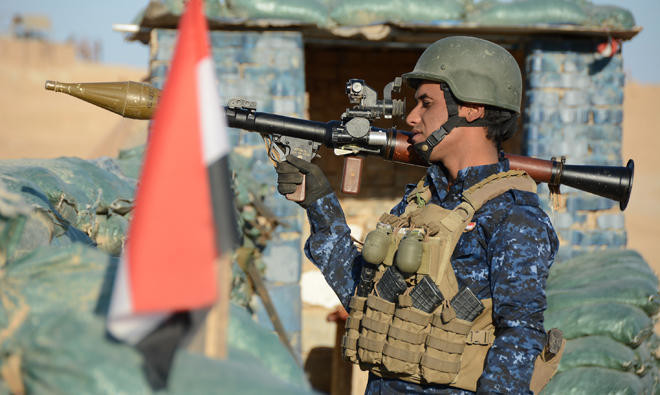
‘Defeated’ Daesh still poses danger in Iraq
‘Defeated’ Daesh still poses danger in Iraq

Latest updates


© 2026 SAUDI RESEARCH & PUBLISHING COMPANY, All Rights Reserved And subject to Terms of Use Agreement.