Archaeologists discover 2 ancient tombs in Egypt's Luxor

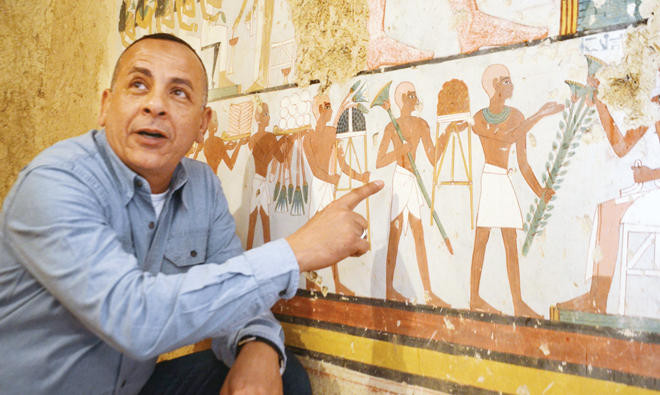
Mustafa Al-Waziri, director general of Luxor’s Antiquities, points at an ancient Egyptian mural found at a newly discovered tomb in Luxor, about 650 km south of Cairo. (AFP)
Updated 09 December 2017
Follow

Archaeologists discover 2 ancient tombs in Egypt's Luxor

LUXOR: Egypt on Saturday announced the discovery of two small ancient tombs in the southern city Luxor dating back some 3,500 years and hoped it will help the country's efforts to revive its ailing tourism sector.
The tombs, located on the west bank of the river Nile in a cemetery for noblemen and top officials, are the latest discovery in the city famed for its temples and tombs spanning different dynasties of ancient Egyptian history.
"It's truly an exceptional day," Antiquities Minister Khaled Al-Anani said. "The 18th dynasty private tombs were already known. But it's the first time to enter the two tombs."
Al-Anani said the discoveries are part of the ministry's efforts to promote Egypt's vital tourism industry, partially driven by antiquities sightseeing, that was hit hard by extremist attacks and political turmoil following the 2011 uprising.
The ministry said one tomb has a courtyard lined with mud-brick and stonewalls and contains a six-meter burial shaft leading to four side chambers. The artifacts found inside were mostly fragments of wooden coffins. Wall inscriptions and paintings suggest it belongs to the era between the reigns King Amenhotep II and King Thutmose IV, both pharaohs of the 18th dynasty.
The other tomb has five entrances leading to a rectangular hall and contains two burial shafts located in the northern and southern sides of the tomb.
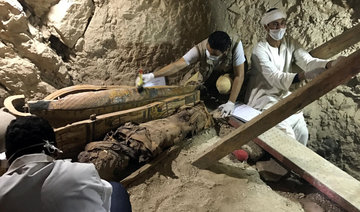
Among the artifacts found inside are funerary cones, painted wooden funerary masks, clay vessels, a collection of some 450 statues and a mummy wrapped in linen who was likely of a top official. A cartouche carved on the ceiling bears the name of King Thutmose I of the early 18th dynasty.
The Antiquities Ministry has made a string of discoveries since the beginning of 2017 in several provinces across Egypt — including the tomb of a royal goldsmith in the same area and belonging to the same dynasty, whose work was dedicated to the ancient Egyptian god Amun.


Lebanon says France to host conference to support army

Updated 3 sec ago
Follow

Lebanon says France to host conference to support army

  • Lebanon said Wednesday that a conference in support of the country’s army as it seeks to disarm militant group Hezbollah would take place in Paris on March 5
BEIRUT: Lebanon said Wednesday that a conference in support of the country’s army as it seeks to disarm militant group Hezbollah would take place in Paris on March 5.
The announcement follows recent promises of support to the military, which lacks funds, equipment and technical expertise.
Presidency spokeswoman Najat Charafeddine said President Joseph Aoun met French envoy Jean-Yves Le Drian, Saudi envoy Yazid bin Farhan and ambassadors including from the US, Egypt and Qatar, discussing preparations for “a conference to support the Lebanese army and internal security forces.”
“It was decided to hold the conference in Paris on March 5, to be opened by French President Emmanuel Macron,” she said at the presidential palace.
Under US pressure and fearing expanded Israeli strikes, Lebanon has committed to disarming the Iran-backed Hezbollah, which was badly weakened in more than a year of hostilities with Israel that largely ended in late 2024.
Last week, Lebanon’s army said it had completed the first phase of its plan to disarm the group, covering the area south of the Litani river, around 30 kilometers (20 miles) from the Israeli border.
A plan for the disarmament north of the Litani is to be presented to cabinet next month.
Israel, which accuses Hezbollah or rearming, has criticized the army’s progress as insufficient, while Hezbollah has rejected calls to surrender its weapons.
Lebanon’s army has dismantled tunnels and other military infrastructure belonging to Hezbollah near the Israeli border in recent months, seizing weapons and ammunition, despite its limited capacities.
Despite the ceasefire, Israel has kept up regular strikes on Lebanon, usually saying it is targeting Hezbollah, and has maintained troops in five south Lebanon areas it deems strategic.
Last month, talks with international envoys in Paris touched on the Lebanese army’s needs, while its chief agreed to document its progress in disarming Hezbollah.