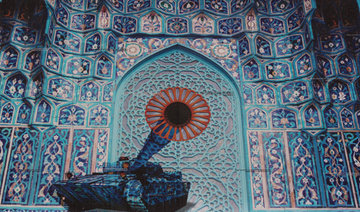
JEDDAH: Al-Qatt Al-Asiri was on Wednesday added to the UNESCO Representative List of the Intangible Cultural Heritage of Humanity.
Al-Qatt Al-Asiri is an art form deeply rooted within the identity of the southern region in the Kingdom, and practiced exclusively by women. It can be seen decorating the interior walls of guest rooms in Asiri homes.
Women draw geometric shapes and tribal symbols and paint them in vibrant colors to make their guests feel welcome. During the creative process, female relatives design masterpieces on the walls, bringing about a sense of solidarity between them.
The Saudi Heritage Preservation Society (SHPS), along with the Kingdom’s permanent UNESCO delegation, were participating in the 12th session of UNESCO’s Intergovernmental Committee for the Safeguarding of Intangible Cultural Heritage on Jeju Island, South Korea, when the news broke.
“We filed Al-Qatt with UNESCO back in 2016 and we continued to strive to provide further information regarding its intricacies until it was inscribed during today’s session,” Rihaf Qasas, SHPS project manager, told Arab News.
“I wouldn’t describe it as a struggle; we just had to collect enough data and fill in the gaps, and we did it.
“This is so important because it keeps this traditional art that’s existed for ages from being buried. It ensures this culture is documented for generations to come, and it acquaints the world with the magnitude of the Kingdom’s heritage,” Qasas added.
On their future endeavors with UNESCO, Qasas said the SHPS could only register one file every two years. The Janadriyah festival will be registered next year, and the Kiswat Al-Ka’aba (the Holy Mosque’s cloth) in 2020.
The most distinguished practitioner of Al-Qatt Al-Asiri, Fatima Abou Gahas, dedicated her life to sustaining and teaching the art until her death in 2010.

Saudi Arabia’s Al-Qatt Al-Asiri added to the UNESCO list

Saudi Arabia says recent STC military movements in Hadramout, Al-Mahra were unilateral, uncoordinated
- Saudi Arabia said the moves harmed the interests of the Yemeni people, as well as the southern cause and the coalition’s efforts.
- The Kingdom said it coordinated with the United Arab Emirates, the president of the Presidential Leadership Council, and the Yemeni government to contain the situation.
RIYADH: Saudi Arabia on Thursday said that recent military movements in the Yemeni governorates of Hadramout and Al-Mahra carried out by the Southern Transitional Council (STC) were conducted unilaterally and without coordination with the Presidential Leadership Council or the coalition leadership.
“These movements resulted in an unjustified escalation that harmed the interests of all segments of Yemeni people, as well as the Southern cause and the coalition’s efforts,” read a statement published by the Saudi Press Agency.
The statement said Saudi Arabia has always prioritized preserving the unity of Yemen throughout recent developments, and that the Kingdom has spared no effort to reach peaceful solutions to resolve the situation in both governorates.
In this context, “the Kingdom worked with the brotherly United Arab Emirates, the president of the Presidential Leadership Council and the brotherly Yemeni government to contain the situation.
“A joint military team was sent from the Kingdom of Saudi Arabia and the United Arab Emirates to put the necessary arrangements in place with the Southern Transitional Council in Aden. These arrangements were made to ensure the return of the Southern Transitional Council forces to their previous positions outside the two governorates and hand over the camps in those areas to the Nation Shield Forces and the local authorities, in accordance with organized procedures under the supervision of the coalition forces.”
The statement said that “these efforts remain in progress to restore the situation to its previous state.”
Saudi Arabia also said it “hopes public interest will prevail through ending the escalation by the Southern Transitional Council and the withdrawal of its forces from the two governorates in an urgent and orderly manner.”
It added: “The kingdom stresses the importance of cooperation among all Yemeni factions and components to exercise restraint and avoid any measures that could destabilize security and stability, which may result in undesirable consequences.”