Palestinian rage over holy city fuels fears of bigger conflict

1 / 3
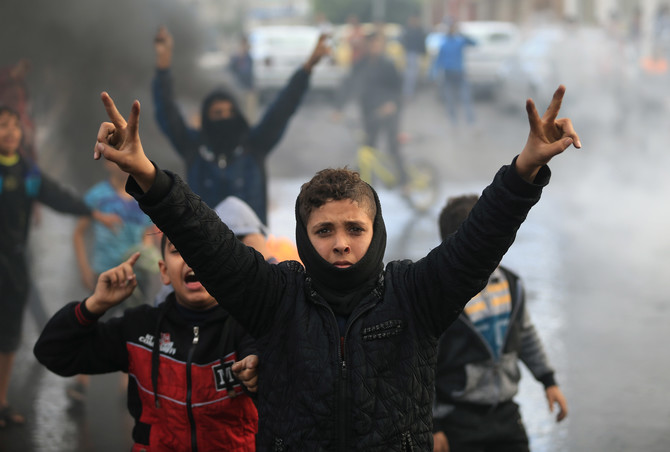
Palestinians take part in a protest against US President Donald Trump’s decision to recognize Jerusalem as the capital of Israel, in Gaza City on December 7. (AFP)
2 / 3
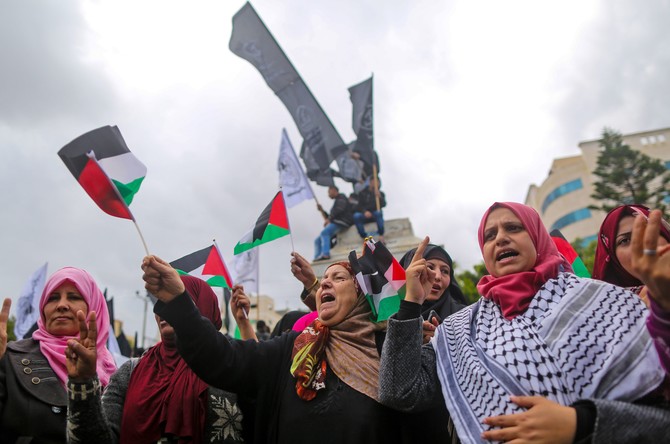
Above, Palestinian women shout slogans during a protest in Gaza City on December 6. (AFP)
3 / 3
A protester waves a Palestinian flag near the words “Free Palestine” spray-painted onto a wall of the US consulate during a demonstration in Istanbul on December 6. (AFP)
Updated 07 December 2017
Follow

Palestinian rage over holy city fuels fears of bigger conflict

LONDON: Palestinians on Wednesday warned that a bloody third “intifada” could follow a decision by US President Donald Trump to recognize Jerusalem as the capital of Israel.
Manuel Hassassian, the Palestinian Ambassador to the UK, branded Trump’s policy shift as a “breach of international conventions” which both trampled on the rights of Palestinians and put Israel at heightened risk of attack.
He told Arab News: “People are going to go into the streets, not only in Palestine but in all capitals across the Arab world. The situation is very risky.”
By changing America’s stance toward Jerusalem, Trump “is opening a can of worms that cannot be controlled.”
Trump’s decision sparked anger across the Middle East and beyond as global leaders warned about the destabilizing repercussions across borders.
Since fielding a phone call from Donald Trump on Tuesday night, Palestinian leader Mahmoud Abbas has been in close contact with regional allies, the UN and the EU, demanding they condemn the move.
Hassassian said that the US policy shift discredited America’s role as a peace broker between Israelis and Palestinians.
“We cannot look at the US as a mediator anymore,” he told Arab News, adding that the new policy showed an undeniable bias toward the Jewish state. Moreover, Hassassian cautioned that altering the status of Jerusalem would spark ire far beyond the borders of Palestine.
“The issue of Jerusalem will carry the weight of a religious conflict, now,” Hassassian said. “1.5 billion Muslims are not going to accept the monopoly of Judaism over the (holy city).”
The American president he said, “is putting the region into real risk.”
The international community considers East Jerusalem to be Palestinian territory illegally occupied by Israel since the 1967 war.
Trump’s statement, Hassassian said, constituted a break with UN resolutions and international norms.
Ben Jamal, director of the Palestine Solidarity Campaign, agreed. “The decision that Donald Trump has made is a flagrant violation of international law and disregards legitimate rights and claims of the Palestinian people,” he told Arab News.
He said that the status of Jerusalem was an unequivocal red line for Palestinians. “There is no possible peaceful resolution to the conflict that does not acknowledge Jerusalem as the capital of the Palestinian state.”
Condemnation of Trump’s new policy was echoed by Omar El-Hamdoon president of the Muslim Association of Britain, who said it was “not just a step in the wrong direction but it’s almost like pouring oil onto the fire.”
Hassassian said the Palestinian leadership was appealing to the international community to stand against Trump’s intransigence.
Jamal agreed: “It is time for the international community to take robust action if it wishes to support a just resolution,” he said. “Donald Trump’s decision needs to be … condemned by all governments, including the UK government that say they support international law.”


Death toll in Iran protests over 3,000, rights group says

Updated 17 January 2026
Follow

Death toll in Iran protests over 3,000, rights group says

  • The protests erupted on December 28 over economic hardship and swelled into widespread demonstrations calling for the end of clerical rule
  • President Donald Trump, who had threatened ‘very strong action’ if Iran executed protesters, said Tehran’s leaders had called off mass hangings

DUBAI: More than 3,000 people have died in Iran’s nationwide protests, rights activists said on Saturday, while a “very slight rise” in Internet activity was reported in the country after an eight-day blackout.

The US-based HRANA ​group said it had verified 3,090 deaths, including 2,885 protesters, after residents said the crackdown appeared to have broadly quelled protests for now and state media reported more arrests.

The capital Tehran has been comparatively quiet for four days, said several residents reached by Reuters. Drones were flying over the city, but there were no signs of major protests on Thursday or Friday, said the residents, who asked not to be identified ‌for their safety.

A ‌resident of a northern city on the ‌Caspian ⁠Sea ​said ‌the streets there also appeared calm.

The protests erupted on December 28 over economic hardship and swelled into widespread demonstrations calling for the end of clerical rule in the Islamic Republic, culminating in mass violence late last week. According to opposition groups and an Iranian official, more than 2,000 people were killed in the worst domestic unrest since Iran’s 1979 Islamic Revolution.

“Metrics show a very ⁠slight rise in Internet connectivity in #Iran this morning” after 200 hours of shutdown, the ‌Internet monitoring group NetBlocks posted on X. Connectivity ‍remained around 2 percent of ordinary levels, ‍it said.

A few Iranians overseas said on social media that ‍they had been able to message users living inside Iran early on Saturday.

US President Donald Trump, who had threatened “very strong action” if Iran executed protesters, said Tehran’s leaders had called off mass hangings.

“I greatly respect the fact that all scheduled ​hangings, which were to take place yesterday (Over 800 of them), have been canceled by the leadership of Iran. Thank you!” he ⁠posted on social media.

Iran had not announced plans for such executions or said it had canceled them.

Indian students and pilgrims returning from Iran said they were largely confined to their accommodations while in the country, unable to communicate with their families back home.

“We only heard stories of violent protests, and one man jumped in front of our car holding a burning baton, shouting something in the local language, with anger visible in his eyes,” said Z Syeda, a third-year medical student at a university in Tehran.

India’s External Affairs Ministry said on Friday that commercial flights were available and that ‌New Delhi would take steps to secure the safety and welfare of Indian nationals.