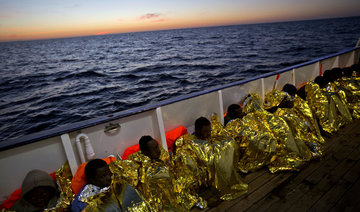
LAGOS: Nigerian migrants expressed relief as they arrived home on Tuesday from Libya, describing the “hell” of harsh conditions in detention camps where they had been held.
African heads of state have condemned the treatment of undocumented migrants in Libya, including widespread violence and apparent slave trading.
The 144 returnees who touched down late Tuesday, and another planeload expected to land shortly after, are part of a repatriation program that Nigeria has stepped up in recent months.
One man who gave his name as Franklin told AFP that he was “very, very happy” to return.
“It’s good to be home, because I’ve been in hell in the land of Libya. I’ll start a new life in my country,” he said as he waited to be given food.
The UN has urged Libya to agree to shut down 30 centers holding 15,000 migrants, whose detention has become a pressing issue after video footage showing African men sold in Libyan slave auctions sparked global outrage.
“Thank God, thank God, thank God,” said one young man as he stood in an orderly line at the airport to be registered first by immigration officers and then by the National Emergency Management Agency (NEMA).
Nigerians make up the majority of undocumented migrants trying to make the treacherous crossing via the Mediterranean Sea to Europe.
Their repatriation began nearly a year ago but numbers have increased recently, with nearly 1,300 brought home in November, according to NEMA.
Another returnee, Omoburo, said he had been held in a Libyan detention camp for nearly nine months before he could return home.
“They used us to do all sort of things, to carry bombs, to carry ammunition, even to ‘pack’ dead bodies,” he said as he stood in front of a large poster of Nigeria’s first lady Aisha Buhari extending a warm “welcome” to the group.
The Nigerian ambassador in Libya has visited the camps for illegal migrants on their way to Europe, said Tiwatope Adeleye Elias-Fatile, spokeman for Abuja’s ministry of foreign affairs.
The visits, made in partnership with the International Organization for Migration, aim to identify detained Nigerians and issue them with emergency travel documents, he said on Monday.
“The embassy has a record of 2,778 registered Nigerians in accessible detention camps and they are ready for repatriation,” the spokesman said, adding that 250 Nigerian migrants were being flown back to Lagos each week.
Once they have landed, they are taken back to their home towns or villages or given a small sum of money to make the journey on their own.
Libya’s UN-backed government has hit back at growing criticism, saying that it was being overwhelmed by illegal immigration.

Returning Nigerians express relief after ‘hell’ of Libya camps
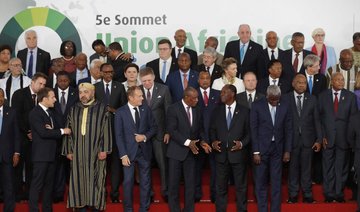
What is Trump’s ‘Board of Peace’?
- The Board of Peace’s charter does not appear to limit its role to the occupied Palestinian territory of Gaza
- Trump will be chairman but also “separately serve as inaugural representative of the United States of America”
BRUSSELS: US President Donald Trump’s government has asked countries to pay $1 billion for a permanent spot on his “Board of Peace” aimed at resolving conflicts, according to its charter seen by AFP.
The board was originally conceived to oversee the rebuilding of war-torn Gaza, but the charter does not appear to limit its role to the occupied Palestinian territory.
What exactly will it do? And who has been invited?
- To what end? -
The Board of Peace will be chaired by Trump, according to its founding charter.
It is “an international organization that seeks to promote stability, restore dependable and lawful governance, and secure enduring peace in areas affected or threatened by conflict,” reads the preamble of the charter sent to countries invited to participate.
It will “undertake such peace-building functions in accordance with international law,” it adds.
- Who’s boss? -
Trump will be chairman but also “separately serve as inaugural representative of the United States of America.”
“The Chairman shall have exclusive authority to create, modify, or dissolve subsidiary entities as necessary or appropriate to fulfill the Board of Peace’s mission,” the document states.
He will pick members of an Executive Board to be “leaders of global stature” to “serve two-year terms, subject to removal by the Chairman.”
He may also, “acting on behalf of the Board of Peace,” “adopt resolutions or other directives.”
The chairman can be replaced only in case of “voluntary resignation or as a result of incapacity.”
- Who can be a member? -
Member states have to be invited by the US president, and will be represented by their head of state or government.
Each member “shall serve a term of no more than three years,” the charter says.
But “the three-year membership term shall not apply to Member States that contribute more than USD $1,000,000,000 in cash funds to the Board of Peace within the first year of the Charter’s entry into force,” it adds.
The board will “convene voting meetings at least annually,” and “each member State shall have one vote.”
But while all decisions require “a majority of Member States present and voting,” they will also be “subject to the approval of the Chairman, who may also cast a vote in his capacity as Chairman in the event of a tie.”
- Who’s already in? -
The White House has said its members will include:
US President Donald Trump, chair
US Secretary of State Marco Rubio
Steve Witkoff, Trump’s special negotiator
Jared Kushner, Trump’s son-in-law
Tony Blair, former UK prime minister
Marc Rowan, billionaire US financier
Ajay Banga, World Bank president
Robert Gabriel, loyal Trump aide on the National Security Council
- Who’s been invited? -
The list of countries and leaders who say they have been invited include, but are not limited to:
Russia’s President Vladimir Putin
Canada’s Prime Minister Mark Carney
Egypt’s President Abdel Fattah El-Sisi
Argentina’s President Javier Milei
Jordan
Brazil
Paraguay
India
Pakistan
Germany
France
Italy
Hungary
Romania
Uzbekistan
Belarus
Greece
Morocco
Slovenia
Poland
- When does it start? -
The charter says it enters into force “upon expression of consent to be bound by three States.”