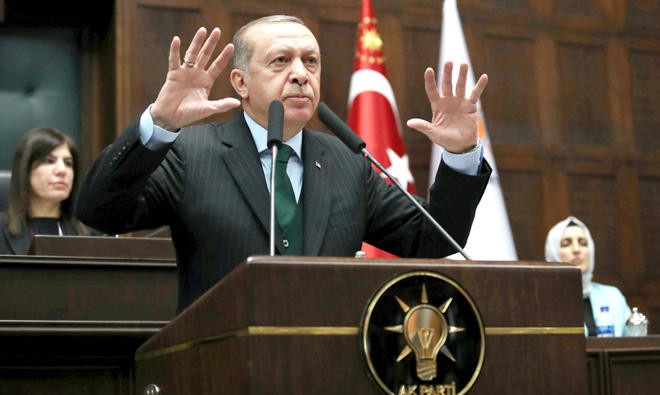
ANKARA: Speaking at a parliamentary group meeting of his ruling Justice and Development Party (AKP) on Tuesday, Turkish President Recep Tayyip Erdogan said Turkey may cut its diplomatic ties with Israel if Washington follows through on its reportedly impending recognition of Jerusalem as Israel’s capital.
“You cannot take such a step. Jerusalem is a red line for Muslims,” he said, adding that such a decision would be the violation of international law, and “a big blow to the conscience of humanity.”
Erdogan also stated that, if US President Donald Trump’s administration does take such a step, Turkey would call for an immediate meeting of the Organization of Islamic Cooperation (OIC), which Turkey currently chairs, to oppose it.
On Monday, Turkish Deputy Prime Minister Bekir Bozdag told reporters that formal recognition of Jerusalem as the Jewish state’s capital would lead to a new conflict in the Middle East and result in a major catastrophe.
“The status of Jerusalem and Temple Mount has been determined by international agreements. It is important to preserve Jerusalem's status for the sake of protecting peace in the region,” he said.
However, these critical statements, echoing the warnings of other regional leaders, come amid a nascent and fragile push for normalization between Turkey and Israel, with the restoration of diplomatic ties at ambassadorial level in 2016 following a serious political crisis when 10 Turkish activists were killed in the 2010 Israeli raid on the Gaza-bound Mavi Marmara flotilla.
Experts think the potential fallout from recognition of Jerusalem will further complicate not only Turkey-Israel relations, by obstructing the ongoing efforts for rapprochement process, but will also have serious repercussions throughout the region.
The status of Jerusalem is one of the most sensitive issues for the Muslim world, including Turkey.
“Such a decision would be ill-timed and controversial in the sense that provoking tension between the Arab world and Israel will not only undermine US efforts to broker an Israeli-Palestinian peace, but also damage the fragile cooperation between Israel and the Gulf countries against Iran,” Selin Nasi, an Istanbul-based analyst of Israel-Turkey relations, told Arab News, while noting that Turkey’s capacity to prevent the US from recognizing Jerusalem is limited.
She added that Turkey’s position on the status of Jerusalem has been a consistent one.
“Turkey opposed Israel’s annexation of East Jerusalem following the 1967 War. In 1980, when Israel’s Knesset passed the Basic Law, Jerusalem, Capital of Israel, which declared Jerusalem as Israel’s complete and united capital, Turkey downgraded diplomatic relations to second secretary status,” Nasi explained.
Trump’s possible recognition of Jerusalem as Israel’s capital “will likely damage efforts to rebuild mutual trust” between Turkey and Israel, she suggested, adding however that since 2016 low-profile relations have continued through issue-based partnerships.
As an immediate reaction to Erdogan’s comments on Tuesday, Israel’s Haaretz quoted a senior Israeli official as saying, “Jerusalem has been the Jewish capital for 3,000 years and the capital of Israel for 70 years, whether Erdogan recognizes it as such or not.”
The Israeli Minister of Intelligence and of Transportation, Yisrael Katz, tweeted, “We don’t take orders or accept threats from the president of Turkey.”
Nimrod Goren, head of Mitvim, the Israeli Institute for Regional Foreign Policies, told Arab News: “The efforts by Arab and Muslim countries make clear to the US administration that they flatly reject an American recognition of Jerusalem as Israel's capital, and that such a move will have negative consequences regarding prospects for peace, are legitimate.”
He added that such efforts “are said to have already influenced Trump's past decisions regarding a possible embassy move to Jerusalem.”
Nevertheless, he added, Turkey’s threat to cut ties with Israel does not make sense in this context, and may derive from a wish to appeal to public opinion in the region.
“The controversies between Israel and Turkey regarding Jerusalem and the Palestinian issue are known and are not new,” Goren said. “They are already making an impact on bilateral ties and are limiting the degree of cooperation between the countries. But, Turkey and Israel have managed — since the signing of their reconciliation agreement — to find ways in which they can develop working relations despite the controversies. It would be a mistake to let a wrong decision by Trump ruin this.”
Trump is expected to announce his final decision on the recognition of Jerusalem on Wednesday.


![]()
Erdogan threatens to cut ties with Israel over Jerusalem controversy
Erdogan threatens to cut ties with Israel over Jerusalem controversy


Latest updates


© 2026 SAUDI RESEARCH & PUBLISHING COMPANY, All Rights Reserved And subject to Terms of Use Agreement.