Trump poised for crucial decision on Jerusalem

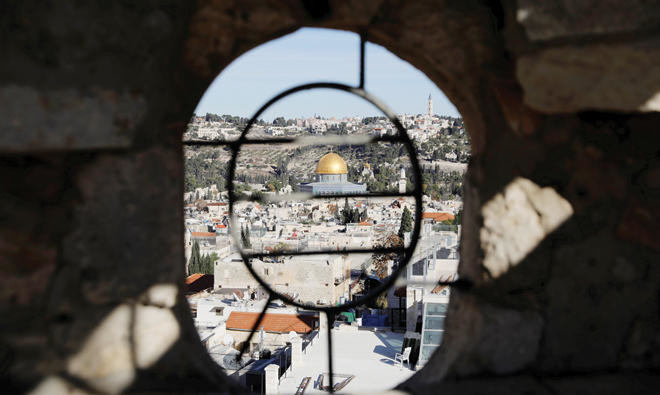
A general view of the city of Jerusalem. (Reuters)
Updated 04 December 2017
Follow

Trump poised for crucial decision on Jerusalem

WASHINGTON: US President Donald Trump faces a key decision this week on whether to recognize Jerusalem as Israel’s capital, prompting a flood of warnings from the Arab world that it could ignite tensions and sink hopes for peace.
“The president’s going to make his decision,” his Middle East peace envoy and son-in-law Jared Kushner said, without denying reports Trump could declare Jerusalem Israel’s capital on Wednesday.
The status of Jerusalem is one of the most contentious issues of the long-running Israeli-Palestinian conflict, and the suggestion Trump could reverse years of US policy has prompted a furious bout of lobbying from the Palestinian leadership.
Most of the international community, including the US, does not formally recognize Jerusalem as Israel’s capital, insisting the issue can only be resolved through final status negotiations. Central to the issue of recognition is the question of the US Embassy.
All foreign embassies are located in Tel Aviv with consular representation in Jerusalem, but Trump will on Monday have to decide whether to sign a legal waiver that would delay by six months plans to move the US Embassy from the Holy City.
The Arab League said it was closely following the matter, with leader Abul Gheit warning any such move would pose a threat “to the stability of the Middle East and the whole world.”
“It will not serve peace or stability, instead it will nourish fanaticism and violence,” he said on Sunday, noting that the League was closely following the issue and would coordinate a joint position with Palestinian and Arab leaders if Trump took the step.
Jordan’s Foreign Minister Ayman Safadi also warned that any change to the status of Jerusalem would have “grave consequences,” in a phone conversation with US Secretary of State Rex Tillerson on Sunday.
It was crucial, he said, “to preserve the historical and legal status of Jerusalem and refrain from any decision that aims to change that status,” the official Petra news agency reported.
In 1995, the US Congress passed the so-called Jerusalem Embassy Act recognizing Jerusalem as Israel’s capital and stating that the US Embassy should be moved there.
But an inbuilt waiver, which allows the president to temporarily postpone the move on grounds of “national security,” has been repeatedly invoked by successive US presidents, from Bill Clinton, George W. Bush and Barak Obama, meaning the law has never taken effect.
Trump is expected to begrudgingly sign the waiver for a second time this week.
But according to diplomats and observers, he is expected to make a speech on Wednesday announcing his support for Israel’s claim on Jerusalem as its capital.
Israel seized the largely-Arab eastern sector of Jerusalem during the 1967 Six-Day War and later annexed it, claims both halves of the city to be its “eternal and undivided capital.”
But the Palestinians want the eastern sector as capital of their promised state and fiercely oppose any Israeli attempt to extend sovereignty there.
Several peace plans have come unstuck over debates on whether, and how, to divide sovereignty or oversee the sites holy to Christians, Jews and Muslims.
In an address to the Saban Forum of Israeli and US policymakers on Sunday, Kushner, who heads a small and tight-knit White House negotiating team, suggested a decision was close.
“He’s still looking at a lot of different facts and when he makes his decision he’ll be the one who wants to tell you. So he’ll make sure he does that at the right time,” he said.
Palestinians have been lobbying regional leaders to oppose the decision and the armed militant movement Hamas has threatened to launch a new “intifada.”
Late on Sunday, Palestinian President Mahmud Abbas spoke to Hamas leader Ismail Haniya, with the two agreeing to oppose any shift in US policy.
Saeb Erakat, secretary general of the Palestine Liberation Organization (PLO), also warned that a change in the US stance on Jerusalem would spell disaster, warning that it would amount to an own goal for US peace efforts in the region.
He said in a statement that Washington would “be disqualifying itself to play any role in any initiative toward achieving a just and lasting peace.”
Trump has said he wants to relaunch frozen peace talks between Israel and the Palestinians in search of the “ultimate deal.”
But analysts warn that any major shift in US policy would make that goal more difficult to achieve.


Palestinian citizens in Israel demand more security from violence

Updated 4 sec ago
Follow

Palestinian citizens in Israel demand more security from violence

  • Protests and strikes are sweeping Israel over record levels of violence targeting the country’s Palestinian citizens
  • At least 26 people were killed in January alone, adding to a record-breaking toll of more than 250 last year
KAFR YASIF, Israel: Nabil Safiya had taken a break from studying for a biology exam to meet a cousin at a pizza parlor when a gunman on a motorcycle rode past and fired, killing the 15-year-old as he sat in a black Renault.
The shooting — which police later said was a case of mistaken identity — stunned his hometown of Kafr Yasif, long besieged, like many Palestinian towns in Israel, by a wave of gang violence and family feuds.
“There is no set time for the gunfire anymore,” said Nabil’s father, Ashraf Safiya. “They can kill you in school, they can kill you in the street, they can kill you in the football stadium.”
The violence plaguing Israel’s Arab minority has become an inescapable part of daily life. Activists have long accused authorities of failing to address the issue and say that sense has deepened under Israel’s current far-right government.
One out of every five citizens in Israel is Palestinian. The rate of crime-related killings among them is more than 22 times higher than that for Jewish Israelis, while arrest and indictment rates for those crimes are far lower. Critics cite the disparities as evidence of entrenched discrimination and neglect.
A growing number of demonstrations are sweeping Israel. Thousands marched in Tel Aviv late Saturday to demand action, while Arab communities have gone on strike, closing shops and schools.
In November, after Nabil was gunned down, residents marched through the streets, students boycotted their classes and the Safiya family turned their home into a shrine with pictures and posters of Nabil.
The outrage had as much to do with what happened as with how often it keeps happening.
“There’s a law for the Jewish society and a different law for Palestinian society,” Ghassan Munayyer, a political activist from Lod, a mixed city with a large Palestinian population, said at a recent protest.
An epidemic of violence
Some Palestinian citizens have reached the highest echelons of business and politics in Israel. Yet many feel forsaken by authorities, with their communities marked by underinvestment and high unemployment that fuels frustration and distrust toward the state.
Nabil was one of a record 252 Palestinian citizens to be killed in Israel last year, according to data from Abraham Initiatives, an Israeli nongovernmental organization that promotes coexistence and safer communities. The toll continues to climb, with at least 26 additional crime-related killings in January.
Walid Haddad, a criminologist who teaches at Ono Academic College and who previously worked in Israel’s national security ministry, said that organized crime thrives off weapons trafficking and loan‑sharking in places where people lack access to credit. Gangs also extort residents and business owners for “protection,” he said.
Based on interviews with gang members in prisons and courts, he said they can earn anywhere from thousands to hundreds of thousands of dollars, depending on whether the job is torching cars, shooting at buildings or assassinating rival leaders.
“If they fire at homes or people once or twice a month, they can buy cars, go on trips. It’s easy money,” Haddad said, noting a widespread sense of impunity.
The violence has stifled the rhythm of life in many Palestinian communities. In Kafr Yasif, a northern Israel town of 10,000, streets empty by nightfall, and it’s not uncommon for those trying to sleep to hear gunshots ringing through their neighborhoods.
Prosecutions lag
Last year, only 8 percent of killings of Palestinian citizens led to charges filed against suspects, compared with 55 percent in Jewish communities, according to Abraham Initiatives.
Lama Yassin, the Abraham Initiatives’ director of shared cities and regions, said strained relations with police long discouraged Palestinian citizens from calling for new police stations or more police officers in their communities.
Not anymore.
“In recent years, because people are so depressed and feel like they’re not able to practice day-to-day life ... Arabs are saying, ‘Do whatever it takes, even if it means more police in our towns,’” Yassin said.
The killings have become a rallying cry for Palestinian-led political parties after successive governments pledged to curb the bloodshed with little results. Politicians and activists see the spate of violence as a reflection of selective enforcement and police apathy.
“We’ve been talking about this for 10 years,” said Knesset member Aida Touma-Suleiman.
She labeled policing in Palestinian communities “collective punishment,” noting that when Jews are victims of violence, police often set up roadblocks in neighboring Palestinian towns, flood areas with officers and arrest suspects en masse.
“The only side that can be able to smash a mafia is the state and the state is doing nothing except letting (organized crime) understand that they are free to do whatever they want,” Touma-Suleiman said.
Many communities feel impunity has gotten worse, she added, under National Security Minister Itamar Ben-Gvir, who with authority over the police has launched aggressive and visible campaigns against other crimes, targeting protests and pushing for tougher operations in east Jerusalem and the occupied West Bank.
Israeli police reject allegations of skewed priorities, saying that killings in these communities are a top priority. Police also have said investigations are challenging because witnesses don’t always cooperate.
“Investigative decisions are guided by evidence, operational considerations, and due process, not by indifference or lack of prioritization,” police said in a statement.
Unanswered demands
In Kafr Yasif, Ashraf Safiya vowed his son wouldn’t become just another statistic.
He had just gotten home from his work as a dentist and off the phone with Nabil when he learned about the shooting. He raced to the scene to find the car window shattered as Nabil was being rushed to the hospital. Doctors there pronounced him dead.
“The idea was that the blood of this boy would not be wasted,” Safiya said of protests he helped organize. “If people stop caring about these cases, we’re going to just have another case and another case.”
Authorities said last month they were preparing to file an indictment against a 23-year-old arrested in a neighboring town in connection with the shooting. They said the intended target was a relative, referring to the cousin with Nabil that night.
And they described Nabil as a victim of what they called “blood feuds within Arab society.”
At a late January demonstration in Kafr Yasif, marchers carried portraits of Nabil and Nidal Mosaedah, another local boy killed in the violence. Police broke up the protest, saying it lasted longer than authorized, and arrested its leaders, including the former head of the town council.
The show of force, residents said, may have quashed one protest, but did nothing to halt the killings.