Saudi oil minister talks of need to strengthen links on Iraq visit

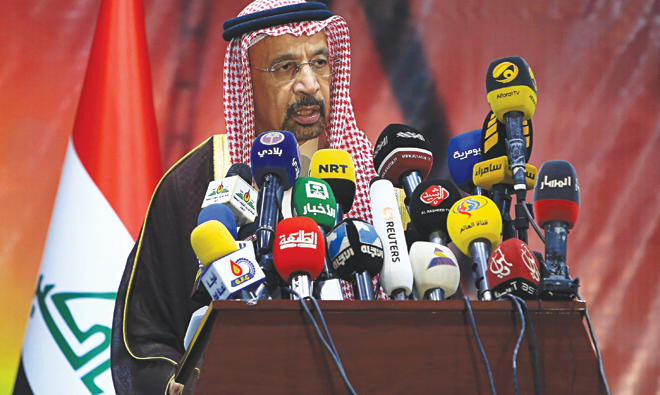
Saudi Energy Minister Khalid Al-Falih speaks to reporters during the 7th Iraq Oil and Gas Show in Basra this week. Saudi Arabia and Iraq are boosting ties. (AP)
Updated 05 December 2017
Follow

Saudi oil minister talks of need to strengthen links on Iraq visit

BASRA: In the latest sign of improving relations between Iraq and Saudi Arabia, the Kingdom’s oil minister attended an energy conference in the southern Iraqi port city of Basra on Tuesday.
Khalid Al-Falih said Saudi Arabia wants to expand investment projects in Iraq to include energy, manufacturing and natural resources.
“These are all considered important steps in bringing Iraq back to the Arab fold as well as to open Iraqi markets for international goods,” Al-Falih said. “We see our cooperation and coordination as very strategic and crucial for both of our countries. It doubles our success, growth and prosperity, again and again.”
Iraq is looking for regional support as the country struggles to rebuild after ousting the Daesh group from major cities and as it deals with an independence movement in its northern Kurdish region.
The US has encouraged Baghdad to improve relations with Saudi Arabia to counter Tehran’s influence in the region. US President Donald Trump’s administration views Iran as a regional menace.
Saudi Arabia’s oil minister visited Baghdad in October, making a high-profile speech in the Iraqi capital calling for greater economic cooperation. That same month a commercial Saudi Arabian airliner landed at Baghdad airport for the first time in 27 years, and in August the two countries announced plans to open the land crossing along their shared border.
Iraq and Saudi Arabia have had strained relations since the Iraqi invasion of Kuwait in 1990. Iran gained wide influence over the Shiite-majority country after the 2003 US-led invasion. Tensions between Riyadh and Baghdad only began to thaw in 2015, when Saudi Arabia reopened its embassy.
Saudi Arabia is the biggest oil producer in OPEC, followed by Iraq.


Saudi POS stays above $4bn as Ramadan spending lifts home goods

Updated 16 sec ago
Follow

Saudi POS stays above $4bn as Ramadan spending lifts home goods

RIYADH: Saudi point-of-sale transactions remained above $4 billion in the week ending Feb. 14, with spending on furniture and home supplies rising ahead of Ramadan, central bank data showed. 

Overall POS activity totaled SR15.34 billion ($4.09 billion), representing a 4.8 percent week-on-week decrease, while the number of transactions dipped 1.6 percent to 252 million, according to the Saudi Central Bank. 

Spending on furniture and home supplies rose 5.9 percent to SR697.35 million, marking the strongest weekly increase among major retail categories. 

Expenditure on electronics increased 2.9 percent, while spending on construction and building materials rose 1.1 percent.

Sectors that saw declines includes freight transport and courier services, which posted a drop of 5 percent to SR64.86 million.

Pharmacy and medical supplies spending fell 8.2 percent to SR223.81 million, but outlays on medical services rose 5.7 percent to SR539.68 million. 

Food and beverage expenditure decreased 4.3 percent, but the total spend of SR2.57 billion meant it retained the largest share of POS activity.

Restaurants and cafes followed with SR1.73 billion, despite a 4.7 percent decline. Apparel and clothing outlays represented the third-largest share of POS spending during the monitored week, up 0.5 percent to SR1.38 billion.

The Kingdom’s major urban centers mirrored the mixed national changes. Riyadh, which accounted for the largest share of total POS spending, saw a 3.4 percent drop to SR5.32 billion. The number of transactions in the capital reached 80.7 million, down 0.8 percent week on week. 

In Jeddah, transaction values decreased 4.4 percent to SR2.12 billion, while Dammam reported a 3.3 percent decrease to SR746.29 million. 

POS data, tracked weekly by SAMA, provides an indicator of consumer spending trends and the ongoing growth of digital payments in Saudi Arabia.  

The data also highlights the expanding reach of POS infrastructure, extending beyond major retail hubs to smaller cities and service sectors, supporting broader digital inclusion initiatives.  

The growth of digital payment technologies aligns with Saudi Arabia’s Vision 2030 objectives, promoting electronic transactions and contributing to the Kingdom’s broader digital economy.