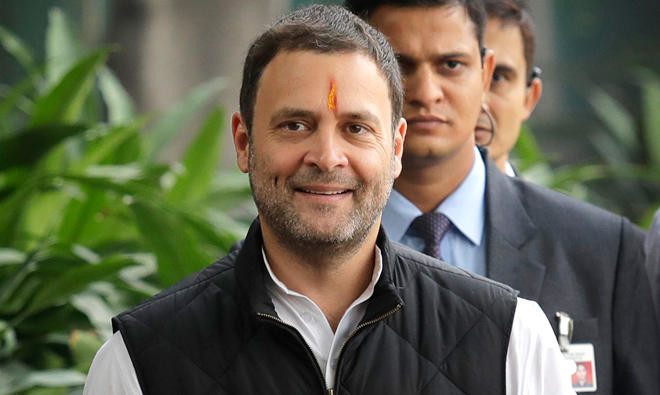
NEW DELHI: Rahul Gandhi is set to be named the new leader of India’s Congress Party — the country’s oldest political party.
Monday was the deadline for nominations for party president, and 47-year-old Gandhi is currently the sole nominee, meaning his elevation to chief of the 132-year-old party seems now to be a formality.
Gandhi will likely inherit the leadership from his mother Sonia, who has led the party since 1998. He will be the sixth leader from the Nehru-Gandhi family to occupy the top party post. His great grandfather, Jawaharlal Nehru, was India’s first prime minister; his grandmother, Indira Gandhi, led India for 11 years; and his father Rajiv Gandhi was the prime minister for five years in the 1980s.
But the Congress Party is in the midst of a crisis. It has its lowest parliamentary presence since India’s independence, with just 44 seats out of 545 in the Lower House, and holds power in only six of India’s 29 states. In major states, including Uttar Pradesh and Bihar, Congress has been pushed to the political margins. And Congress’ dramatic fall has been in direct contrast to the rise of the Bharatiya Janata Party (BJP) under the leadership of Prime Minister Narendra Modi.
“There are multiple challenges before Rahul Gandhi today,” said Sudha Pai, a National Fellow at the Indian Council of Social Science Research and former professor of political science at Jawaharlal Nehru University. “One challenge is to hold the party together, the second is to put forward an alternative vision so that people regain faith in the party, and third is to build up the organization and make it an election-winning machine.
“In terms of his ability to deal with politics,” she continued, “Rahul Gandhi seems to be far more prepared than (he was) a few years ago.”
Author and journalist Aarthi Ramachandran agrees. She stressed, however, that the timing of Gandhi’s promotion to the top leadership position is important.
“The elevation of Rahul was a fait accompli,” she explained. “What is interesting now is that the party has chosen this particular time, just before the crucial regional elections in Gujarat, for his anointment.”
Ramachandran, who wrote “Decoding Rahul Gandhi,” one of the first biographies of the Congress leader-elect, told Arab News that, unlike predecessors from his family when they have taken power, Gandhi is not “comfortably circumstanced.”
“At a time when (his) family, which has been at the center of the party, is weak and its charisma ebbing, it will be an uphill task to revive the party,” she said. “The new leader will have to work hard to prove his credentials and enhance his acceptance among the prospective alliance partners.”
She added, “Rahul Gandhi shares an uncomfortable relationship with politics and how much he is able to embrace the limitations of existing politics will also shape the Congress in coming years.”
The young and vocal Congress leader Tehseen Poonawalla believes that Gandhi is “the voice of an aspiring and progressive India.”
Poonawalla told Arab News, “We are going through an absolute crisis where our democracy and constitution are under threat. Rahul Gandhi’s elevation is important so that he can lead the opposition charge against the subversion of the constitution that is going on.”
The BJP, however, claims Gandhi's promotion is a result of nepotism rather than ability.
“Rahul Gandhi has inherited the elevation. He has not earned it, as leaders in the BJP do,” G.L.V. Narsimha Rao, the BJP’s national spokesperson, told Arab News. “Dynasty and democracy are mutually inconsistent and an anachronistic concept. But for the Congress Party, keeping tight family control is a priority, rather than allowing leadership to emerge on merit.”
The Gujarat election results on Dec. 19 will be Gandhi’s first major test. Modi’s home state is in turmoil after 22 years of BJP dominance there and the Congress Party sees an opportunity for a statement-making victory. A strong showing in the western state would establish Gandhi as a strong challenger for Modi in the 2019 general elections.


![]()

India's Rahul Gandhi set to become Congress Party chief
India's Rahul Gandhi set to become Congress Party chief

Trump to host Colombia’s Petro just weeks after insulting him as a ‘sick man’ fueling drug trade
WASHINGTON: President Donald Trump is set to welcome Colombian President Gustavo Petro to the White House on Tuesday for talks only weeks after threatening military action against the South American country and accusing the leader of pumping cocaine into the United States.
US administration officials say the meeting will focus on regional security cooperation and counternarcotics efforts. And Trump on Monday suggested that Petro — who has continued to criticize Trump and the US operation to capture Venezuela’s Nicolás Maduro — seems more willing to work with his administration to stem the flow of illegal drugs from Colombia.
“Somehow after the Venezuelan raid, he became very nice,” Trump told reporters. “He changed his attitude very much.”
Yet, bad blood between the leaders overshadows the sit-down, even as Trump sought to downplay any friction on the eve of the visit.
The conservative Trump and leftist Petro are ideologically far apart, but both leaders share a tendency for verbal bombast and unpredictability. That sets the stage for a White House visit with an anything-could-happen vibe.
In recent days, Petro has continued poking at the US president, calling Trump an “accomplice to genocide” in the Gaza Strip, while asserting that the capture of Maduro was a kidnapping.
And ahead of his departure for Washington, Petro called on Colombians to take to the streets of Bogotá during the White House meeting.
There’s been a shift in US-Colombia relations
Historically, Colombia has been a US ally. For the past 30 years, the US has worked closely with Colombia, the world’s largest producer of cocaine, to arrest drug traffickers, fend off rebel groups and boost economic development in rural areas.
But relations between the leaders have been strained by Trump’s massing US forces in the region for unprecedented deadly military strikes targeting suspected drug smuggling boats in the Caribbean Sea and eastern Pacific. At least 126 people have been killed in 36 known strikes.
In October, the Trump administration announced it was imposing sanctions on Petro, his family and a member of his government over accusations of involvement in the global drug trade.
The Treasury Department leveled the penalties against Petro; his wife, Veronica del Socorro Alcocer Garcia; his son, Nicolas Fernando Petro Burgos; and Colombian Interior Minister Armando Alberto Benedetti.
The sanctions, which had to be waived to allow Petro to travel to Washington this week, came after the US administration in September announced it was adding Colombia to a list of nations failing to cooperate in the drug war for the first time in three decades.
Then came the audacious military operation last month to capture Maduro and his wife to face federal drug conspiracy charges, a move that Petro has forcefully denounced. Following Maduro’s ouster, Trump put Colombia on notice, and ominously warned Petro he could be next.
Colombia is “run by a sick man who likes making cocaine and selling it to the United States,” Trump said of Petro last month. “And he’s not gonna be doing it very long, let me tell you.”
But a few days later, tensions eased somewhat after a call between the leaders. Trump said Petro in their hourlong conversation explained “the drug situation and other disagreements.” And Trump extended an invitation to Petro for the White House visit.
Trump on a couple of occasions has used the typically scripted leaders’ meetings to deliver stern rebukes to counterparts in front of the press.
Trump and Vice President JD Vance lashed out at Ukrainian President Volodymyr Zelensky in February for showing insufficient gratitude for US support of Ukraine. Trump also used a White House meeting in May to forcefully confront South African President Cyril Ramaphosa,accusing the country, with reporters present, of failing to address Trump’s baseless claim of the systematic killing of white farmers.
It was not clear that the meeting between Trump and Petro would include a portion in front of cameras.
US administration officials say the meeting will focus on regional security cooperation and counternarcotics efforts. And Trump on Monday suggested that Petro — who has continued to criticize Trump and the US operation to capture Venezuela’s Nicolás Maduro — seems more willing to work with his administration to stem the flow of illegal drugs from Colombia.
“Somehow after the Venezuelan raid, he became very nice,” Trump told reporters. “He changed his attitude very much.”
Yet, bad blood between the leaders overshadows the sit-down, even as Trump sought to downplay any friction on the eve of the visit.
The conservative Trump and leftist Petro are ideologically far apart, but both leaders share a tendency for verbal bombast and unpredictability. That sets the stage for a White House visit with an anything-could-happen vibe.
In recent days, Petro has continued poking at the US president, calling Trump an “accomplice to genocide” in the Gaza Strip, while asserting that the capture of Maduro was a kidnapping.
And ahead of his departure for Washington, Petro called on Colombians to take to the streets of Bogotá during the White House meeting.
There’s been a shift in US-Colombia relations
Historically, Colombia has been a US ally. For the past 30 years, the US has worked closely with Colombia, the world’s largest producer of cocaine, to arrest drug traffickers, fend off rebel groups and boost economic development in rural areas.
But relations between the leaders have been strained by Trump’s massing US forces in the region for unprecedented deadly military strikes targeting suspected drug smuggling boats in the Caribbean Sea and eastern Pacific. At least 126 people have been killed in 36 known strikes.
In October, the Trump administration announced it was imposing sanctions on Petro, his family and a member of his government over accusations of involvement in the global drug trade.
The Treasury Department leveled the penalties against Petro; his wife, Veronica del Socorro Alcocer Garcia; his son, Nicolas Fernando Petro Burgos; and Colombian Interior Minister Armando Alberto Benedetti.
The sanctions, which had to be waived to allow Petro to travel to Washington this week, came after the US administration in September announced it was adding Colombia to a list of nations failing to cooperate in the drug war for the first time in three decades.
Then came the audacious military operation last month to capture Maduro and his wife to face federal drug conspiracy charges, a move that Petro has forcefully denounced. Following Maduro’s ouster, Trump put Colombia on notice, and ominously warned Petro he could be next.
Colombia is “run by a sick man who likes making cocaine and selling it to the United States,” Trump said of Petro last month. “And he’s not gonna be doing it very long, let me tell you.”
But a few days later, tensions eased somewhat after a call between the leaders. Trump said Petro in their hourlong conversation explained “the drug situation and other disagreements.” And Trump extended an invitation to Petro for the White House visit.
Trump on a couple of occasions has used the typically scripted leaders’ meetings to deliver stern rebukes to counterparts in front of the press.
Trump and Vice President JD Vance lashed out at Ukrainian President Volodymyr Zelensky in February for showing insufficient gratitude for US support of Ukraine. Trump also used a White House meeting in May to forcefully confront South African President Cyril Ramaphosa,accusing the country, with reporters present, of failing to address Trump’s baseless claim of the systematic killing of white farmers.
It was not clear that the meeting between Trump and Petro would include a portion in front of cameras.
Latest updates


Recommended


© 2026 SAUDI RESEARCH & PUBLISHING COMPANY, All Rights Reserved And subject to Terms of Use Agreement.