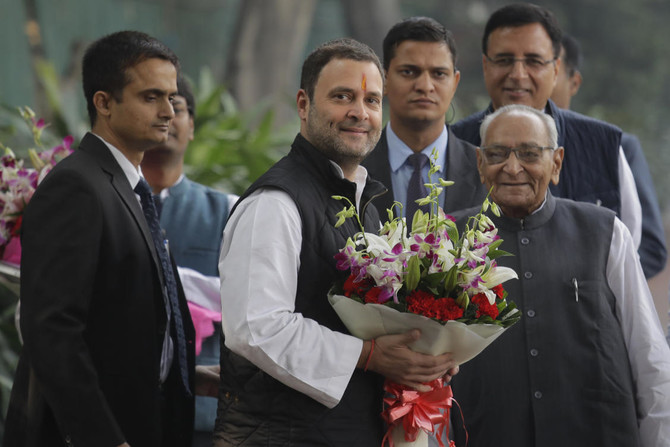
NEW DELHI: Rahul Gandhi, the scion of India’s Nehru-Gandhi political dynasty, submitted nomination papers Monday to succeed his mother as president of main opposition Congress party that has governed the country for decades.
Without a serious rival for the top party post, Gandhi is set to be elected Dec. 16.
He faces a challenging task of reinvigorating his party, which was ousted from power by Prime Minister Narendra Modi’s Hindu nationalist Bharatiya Janata Party in 2014. Modi is expected to seek re-election for a second five-year term in 2019 national elections.
The task is even more formidable with the Congress party suffering humiliating defeats in recent state elections, notably in Uttar Pradesh state, despite Gandhi’s active campaigning to win back people’s support.
Former Prime Minister Manmohan Singh announced Gandhi’s nomination at party headquarters. “This is yet another step in quest for serving the people through the Congress party,” he said.
Gandhi entered politics in 2004, holding a parliamentary seat representing northern Uttar Pradesh state. The seat was held by his mother until she shifted to a neighboring constituency. He was appointed party vice president, a position behind her, in 2013.
Sonia Gandhi has led the party for 19 years. She has had health problems but the family and party have given little information. She had surgery in the United States for an undisclosed reason in 2011, and has returned to the US for regular checkups since then.
Rahul Gandhi will be the sixth member of the Nehru-Gandhi family to lead Congress. His father Rajiv Gandhi, grandmother Indira Gandhi and grandfather Jawaharlal Nehru have served as prime ministers since India’s independence from British colonialists in 1947.
Party workers have been demanding Rahul Gandhi’s elevation since 2013, but he shied away from holding a top position until now.
His supporters argued he was rebuilding the party at the grassroots level and has taken a lead in the Congress’ campaigns in state elections in Uttar Pradesh and in Bihar in recent years. The party performed poorly in both states’ elections last year.

Rahul Gandhi set to be opposition Congress party chief
Families mourn those killed in a Congo mine landslide as some survivors prepare to return
GOMA, Congo: After a landslide last week killed at least 200 people in eastern Congo at a rebel-controlled coltan mine, families of the deceased and survivors are mourning their lost loved ones, and some survivors prepared to head back to the reopened mines.
On Wednesday, following heavy rains in eastern Congo, a network of hand-dug tunnels at the Rubaya mining complex collapsed, killing at least 200 artisanal miners and trapping an unknown number who remain missing. The mine, located around 25 miles (40 kilometers) to the west of the regional capital of Goma, has been under the control of Rwandan-backed M23 rebels since early 2024 and employs thousands of miners who work largely by hand.
Family members grieve
In the Mugunga neighborhood in Goma, the family of Bosco Nguvumali Kalabosh, 39, mourned his death Monday.
Since last Thursday, relatives, neighbors and loved ones have been gathering at the family home, sitting around a photograph of him placed up against a wall.
“He was supposed to return to Goma on Thursday,” said his older brother, Thimothée Kalabosh Nzanga.
Kalabosh had been a miner for more than 10 years. He owned his own mines on the site and came from a family where artisanal mining — mining for minerals using basic hand tools — had been passed down from generation to generation. He leaves behind a widow and four children, the eldest of whom is 5 years old.
Survivors head back to Rubaya
For survivors trickling back into town, the pressure to return to the mines is clear — despite the constant danger.
Tumaini Munguiko, a survivor of the collapse, came to offer his condolences to Kalabosh’s family. “Seeing our peers die is very painful. But despite the pain, we are forced to return to the mines to survive,” he said.
Munguiko calmly explained that he had already experienced several similar disasters. “It has almost become normal. We accept it because it is our means of survival. I was saved this time, but I lost five friends and my older brother.”
According to him, landslides are common in Rubaya, especially during the rainy season. “When it rains, the clay soils become unstable. Some take shelter, others perish, others survive, and others watch from afar,” he said.
Miners dig long tunnels, often parallel to one another, with limited support and no safe evacuation route in case of a collapse.
A former miner at the site told The Associated Press that there have been repeated landslides because the tunnels are dug by hand, poorly constructed and not maintained.
“People dig everywhere, without control or safety measures. In a single pit, there can be as many as 500 miners, and because the tunnels run parallel, one collapse can affect many pits at once,” former miner Clovis Mafare said.
“The diggers don’t have insurance,” said Mafare. Of potential compensation for families, he said: “It’s a whole legal process, and it’s very long. They might receive some money for the funerals, but that small amount isn’t compensation.”
Kalabosh’s family has not received compensation for their loss.
However, both Munguiko and Nzanga say they will return to the mines soon despite the risks.
“I have no choice. Our whole life is there,” said Munguiko.
Rare earth minerals
The Rubaya mines have been at the center of the recent fighting in eastern Congo, changing hands between the Congolese government and rebel groups. For over a year now, the site has been controlled by the M23 rebels.
The mines produce coltan — short for columbite-tantalite — an ore from which the metals tantalum and niobium are extracted. Both are considered critical raw materials by the United States, the European Union, China and Japan. Tantalum is used in mobile phones, computers and automotive electronics, as well as in aircraft engines, missile components and GPS systems. Niobium is used in pipelines, rockets and jet engines.
The mines at Rubaya are massive and attract people from across the region. Artisanal miners and workers have been flocking there for years, drawn to the site to earn a steady income in a region plagued by poverty and chronic insecurity. A disaster like this affects people across eastern Congo and the grief has spread to regional hubs like Goma.
For the last two weeks, Rubaya has been virtually cut off from the world. The mining town has no mobile network or Internet connection. Poor infrastructure, coupled with persistent conflict, means cellular service and electricity are unreliable. To communicate with the outside world, residents must pay around 5,000 Congolese francs — just over $2 — for 30 minutes of connection via a private Starlink system.
Congo’s government, in a statement on X, expressed solidarity with the victims’ families and accused the rebels of illegally and unsafely exploiting the region’s natural resources while blaming Rwanda. An M23 spokesperson accused the government of politicizing the tragedy and listed other collapses at government-controlled mines.