One dead in Corsica airport shooting

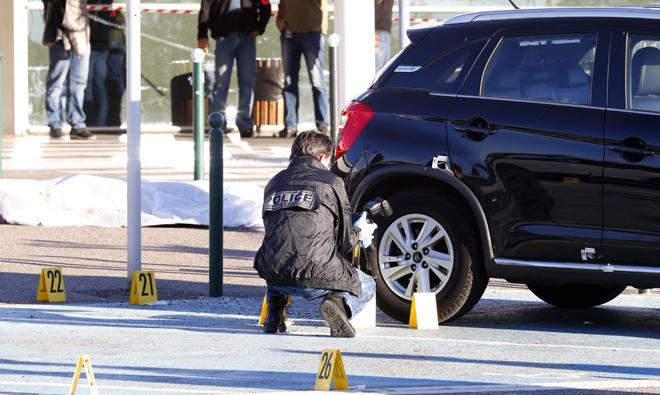
Forensic police work at the scene of a deadly shooting near the body of Antoine Quilichini, aka Tony le boucher (Tony the butcher), who is on police record for organised crime, outside the airport of Bastia, on the French Mediterranean island of Corsica, on Tuesday, December 5, 2017. (AFP)
Updated 05 December 2017
Follow

One dead in Corsica airport shooting

BASTIA: One man was killed and two people were injured on Tuesday morning in a shooting at an airport on the French island of Corsica, emergency service workers told AFP.
The shooting took place in a car park near the entrance of Bastia airport in the north of the Mediterranean island, leaving one man dead with a gunshot to the head, another with several bullet wounds and a third with minor injuries.
Corsica was once plagued by separatist violence, but the main militant group seeking independence for Corsicans declared a cease-fire in 2014.
About a dozen assassinations of public figures have taken place on the island in the last 20 years, while murders linked to gang violence and drug trafficking have also claimed lives.
The motive for Tuesday’s killings remains unclear and police are hunting for a getaway car used by the shooter.
Corsicans went to the polls last Sunday to elect a new regional assembly, which saw a triumph for nationalists seeking greater autonomy for the mountainous island.
A second round next Sunday is expected to see the nationalists confirm their victory and claim a mandate for greater local powers for Corsica, which is home to about 300,000 people and famed for being the birthplace of Napoleon.
The nationalists have vowed not to mount a bid for independence from France in the short term, unlike their counterparts in Catalonia who have provoked a political crisis by seeking to break away from Spain.


Philippines struggles to evacuate nationals from Middle East as attacks escalate across region

Philippine President Ferdinand Marcos Jr. leads a Special Cabinet Meeting to discuss the situation in the Middle East.
Updated 6 sec ago
Follow

Philippines struggles to evacuate nationals from Middle East as attacks escalate across region

  • Over 1,400 Philippine nationals in Middle East have requested for repatriation
  • Filipinos are told to shelter in place, follow host government’s advice on situation

MANILA: The Philippines is in talks to evacuate its nationals from across the Middle East, President Ferdinand Marcos Jr. said on Tuesday, as an increasing number of Filipinos are seeking to leave amid growing destruction from US-Israeli strikes on Iran and Tehran’s counterstrikes against US bases in Gulf countries.

More than 2.4 million Filipinos live and work in the Middle East, where tensions have been high since Saturday, after coordinated US-Israel strikes killed Iran’s Supreme Leader Ali Khamenei and senior Iranian officials.

Tehran responded by targeting US military bases in Gulf countries, and violence has been widening across the region. 

Evacuating Philippine nationals across the region is not yet possible, Marcos said, as countries closed their airspace, leading to airport shutdowns and the cancellation of thousands of flights throughout the Middle East.

“For now, we are depending on the advice that will be given to us by the local authorities in the place where our nationals — where our people — are,” Marcos told reporters in Manila on Tuesday.

The Philippine government has received requests for repatriation from more than 1,400 Filipino nationals in various Middle Eastern countries, including 872 from the UAE and almost 300 from Israel. Similar requests have also been made by Filipinos in Iran, Bahrain and Jordan.

“Right now, the most dangerous area for our people right now would be Israel as attacks there are continuous,” Marcos said.

“The problem now is that no planes are flying and airports are being hit. That’s why the situation is very fluid, our assessment is that it may be too dangerous to mount flights.

“Even if we could charter an aircraft, we cannot do anything because number one, the airports are closed. They are all no-fly zones.”

As the Philippine government prepares for multiple scenarios, officials have secured buses and other vehicles for possible evacuation by land.

Filipinos in “danger areas” have been moved to a safer place, Marcos said, citing the targeting of Saudi Arabia’s Ras Tanura oil refinery by Iranian drones on Monday morning.

“But essentially our advice to them is shelter in place and follow the host government’s advice … For now it’s extremely difficult to enter or exit the region because the only aircraft flying are fighter jets and drones, and missiles.

“That’s why it is not a place that you would want to put in a civilian aircraft to take out our nationals,” he said.

“But again, as I said, the situation is changing by the minute, by the hour. We just have to be in very good and close contact with the local authorities.”