WASHINGTON: US President Donald Trump faces a key decision this week on whether to recognize Jerusalem as Israel’s capital, prompting a flood of warnings from the Arab world that it could ignite tensions and sink hopes for peace.
“The president’s going to make his decision,” his Middle East peace envoy and son-in-law Jared Kushner said, without denying reports Trump could declare Jerusalem Israel’s capital on Wednesday.
The status of Jerusalem is one of the most contentious issues of the long-running Israeli-Palestinian conflict, and the suggestion Trump could reverse years of US policy has prompted a furious bout of lobbying from the Palestinian leadership.
Most of the international community, including the US, does not formally recognize Jerusalem as Israel’s capital, insisting the issue can only be resolved through final status negotiations. Central to the issue of recognition is the question of the US Embassy.
All foreign embassies are located in Tel Aviv with consular representation in Jerusalem, but Trump will on Monday have to decide whether to sign a legal waiver that would delay by six months plans to move the US Embassy from the Holy City.
The Arab League said it was closely following the matter, with leader Abul Gheit warning any such move would pose a threat “to the stability of the Middle East and the whole world.”
“It will not serve peace or stability, instead it will nourish fanaticism and violence,” he said on Sunday, noting that the League was closely following the issue and would coordinate a joint position with Palestinian and Arab leaders if Trump took the step.
Jordan’s Foreign Minister Ayman Safadi also warned that any change to the status of Jerusalem would have “grave consequences,” in a phone conversation with US Secretary of State Rex Tillerson on Sunday.
It was crucial, he said, “to preserve the historical and legal status of Jerusalem and refrain from any decision that aims to change that status,” the official Petra news agency reported.
In 1995, the US Congress passed the so-called Jerusalem Embassy Act recognizing Jerusalem as Israel’s capital and stating that the US Embassy should be moved there.
But an inbuilt waiver, which allows the president to temporarily postpone the move on grounds of “national security,” has been repeatedly invoked by successive US presidents, from Bill Clinton, George W. Bush and Barak Obama, meaning the law has never taken effect.
Trump is expected to begrudgingly sign the waiver for a second time this week.
But according to diplomats and observers, he is expected to make a speech on Wednesday announcing his support for Israel’s claim on Jerusalem as its capital.
Israel seized the largely-Arab eastern sector of Jerusalem during the 1967 Six-Day War and later annexed it, claims both halves of the city to be its “eternal and undivided capital.”
But the Palestinians want the eastern sector as capital of their promised state and fiercely oppose any Israeli attempt to extend sovereignty there.
Several peace plans have come unstuck over debates on whether, and how, to divide sovereignty or oversee the sites holy to Christians, Jews and Muslims.
In an address to the Saban Forum of Israeli and US policymakers on Sunday, Kushner, who heads a small and tight-knit White House negotiating team, suggested a decision was close.
“He’s still looking at a lot of different facts and when he makes his decision he’ll be the one who wants to tell you. So he’ll make sure he does that at the right time,” he said.
Palestinians have been lobbying regional leaders to oppose the decision and the armed militant movement Hamas has threatened to launch a new “intifada.”
Late on Sunday, Palestinian President Mahmud Abbas spoke to Hamas leader Ismail Haniya, with the two agreeing to oppose any shift in US policy.
Saeb Erakat, secretary general of the Palestine Liberation Organization (PLO), also warned that a change in the US stance on Jerusalem would spell disaster, warning that it would amount to an own goal for US peace efforts in the region.
He said in a statement that Washington would “be disqualifying itself to play any role in any initiative toward achieving a just and lasting peace.”
Trump has said he wants to relaunch frozen peace talks between Israel and the Palestinians in search of the “ultimate deal.”
But analysts warn that any major shift in US policy would make that goal more difficult to achieve.


![]()
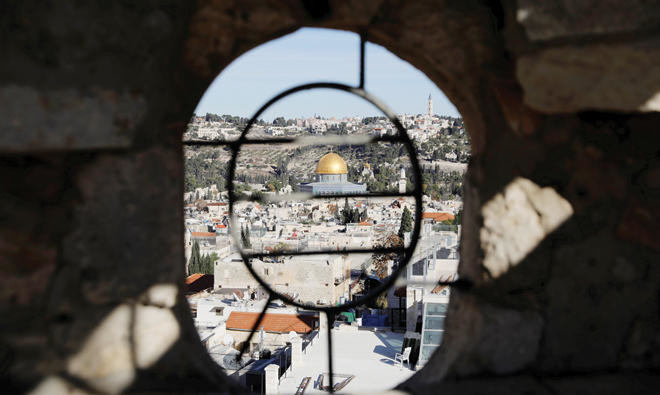
Trump poised for crucial decision on Jerusalem
Trump poised for crucial decision on Jerusalem


Latest updates


© 2026 SAUDI RESEARCH & PUBLISHING COMPANY, All Rights Reserved And subject to Terms of Use Agreement.