COLORADO SPRINGS, Colorado: Edwin Moses turned the corner, saw the blue police lights in the distance and, immediately, started spinning.
His senses overwhelmed by the strength of the strobing lights, Moses fell to the ground and crawled to the sidewalk, then used every ounce of energy to stand up and stagger back to his car.
Somehow, he made it home safely that night. Within a week, he was lying in a hospital bed, losing feeling in his legs, wondering if he would ever walk again.
The incident on the streets of Atlanta came shortly after Moses suffered his second traumatic brain injury in the span of two months — one from a tumble down the stairs, the second when he banged his head hard on the doorjamb of his car.
After the second accident, Moses suffered bleeding beneath his skull, and stayed in the hospital for about a week. Moses rejected “traditional” physical therapy for concussions that would have involved relearning how to walk and instead chose a more aggressive approach offered by his friend, physical therapist and former track star Rene Felton Bessozi.
Three months after that scary night on the street, Moses is nearing 100 percent — a credit to the talent and tenacity of one of the world’s best athletes, combined with a therapy he says put him on the fast track to recovery.
“The first thing I said was, ‘Nobody’s going to believe this story,’” Moses said. “It was the worst possible scenario and I was able to walk again. It really didn’t look like it would go that way when they were lifting my legs into the bed and I couldn’t control my upper body.”
The 62-year-old Moses began making the impossible seem possible starting in the 1970s, when he set a world record and won the gold medal in the 400-meter hurdles at the Montreal Olympics. He took another Olympic gold in 1984, and to this day, holds four of the 10 top times in the event, including a mark of 47.02 that remains the second-best of all time. His streak of 122 straight races without a loss still stands as one of the most remarkable feats in sports.
He fought for athletes’ rights during his career, helping develop an out-of-competition drug-testing program, and has doubled down on his fight for clean sports since retirement.
He currently serves as chairman of the US Anti-Doping Agency, a job that puts him on the front lines of a fight that currently is centered on allegations that Russia’s government ran a program to help its Olympic athletes evade positive tests. Moses has been a featured speaker for years at meetings to discuss the Russia case and others.
But this summer, it was more mundane pursuits — carrying a full load of household items down the stairs on July 2 — that sent him tumbling and triggered a spiral that landed him in the hospital, unable to walk and wondering if he might be paralyzed for life.
“I needed someone to take me upstairs at night, bring me back down, bring in food and all that,” Moses said. “Some days, it might take me 20 minutes to get up off the couch or out of the bed.”
After a few weeks, he was feeling better, and when he hit his head on the car door, he thought nothing of it, mainly because there was no bruise or outward sign of swelling. Turns out, that accident started a slow leak of blood underneath the surface, and not until a visit to the hospital shortly after that night on the street did Moses realize the severity of the impact.
“They did a CT scan and said, ‘Some of this blood is brand new,’” Moses said. “The doctor said something had to happen for something like this to be there.”
He turned down the option of a slow rehab process and instead turned to Felton Bessozi, an old friend who now lives in Italy, where she coaches track and does therapy.
Moses’ son, Julian, is a volleyball player. He worked with Felton Bessozi to overcome a knee injury, and with her help, he returned quickly back to the court. When Moses himself was given the option of using a walker to relearn how to move, he chose to check out of the hospital and called his friend, who has traveled with him and put him through two-a-day workouts that involve, among other things, pool work, stimulation using electromagnetic currents, weights and more weights.
“I started working with him on Sept. 26, and on Oct. 26, he was able to fly over to Switzerland by himself” for an anti-doping conference, Felton Bessozi said. “I know how fast the body can recover. The human body is the most phenominal machine on the planet.”
And Moses’ is one of the best machines ever made.
Not many are aware that he ran the latter part of his career, from 1986 through 1988, with a ruptured disc. He won an Olympic bronze and world gold medal during that span. Because MRIs were few and far between at the time, he wasn’t diagnosed until 1993.
“It was the equivalent of what would happen if you were in an automobile and got rear-ended while you were twisted around,” Moses said.
But the real accident in the car — when he banged his head against the door jamb — occurred decades later, and when it happened, Moses didn’t recognize it for what it was.
Now that he’s on the mend, Moses views Felton Bessozi’s therapy as a potential answer for the thousands of concussions diagnoses that have made so many headlines other sports.
“When I first saw him, I teared up because of the condition he was in,” Felton Bessozi said, “and I told him I’d stay here with him until he could run again.”


![]()
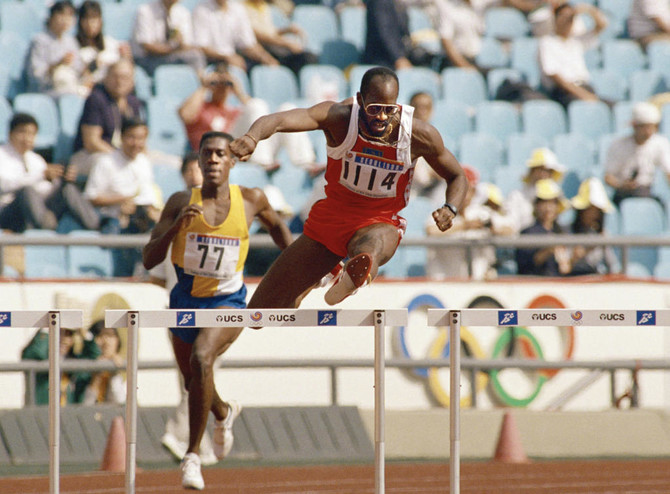
Olympic star Moses remarkably recovers from head injuries
Olympic star Moses remarkably recovers from head injuries

Latest updates




Recommended


© 2026 SAUDI RESEARCH & PUBLISHING COMPANY, All Rights Reserved And subject to Terms of Use Agreement.