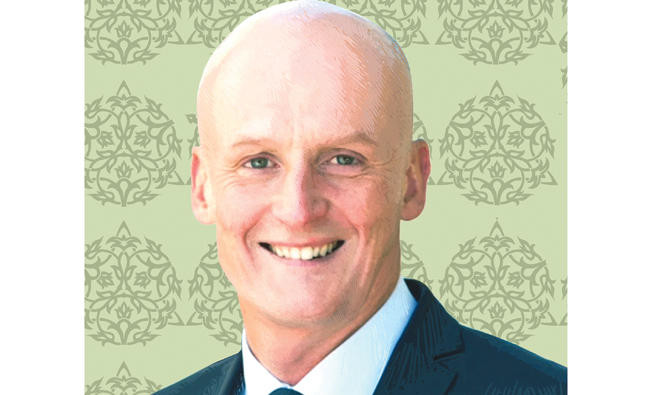
I suppose it is a bit unfair to grill an executive just a few hours after he has got off an airplane on his first ever trip to the Middle East, but Peter Bodin was happy to meet and to give his views of the region, from the point of view of the global chief executive of one of the top-10 biggest accounting and professional advisory firms in the world — Grant Thornton International (GTI).
Or rather, as his card insisted, CEO-elect, because Bodin does not formally take up his duties until January, after an election process last May chose him over other contenders for the role as head of the international umbrella organization that covers more than 2,500 member partners in 130 countries across the world.
GTI’s 16-member board elects its CEO in a process that involves a manifesto, hustings and presentation by existing and external candidates. “But I was not exactly unknown to them, having been CEO of Grant Thornton’s Swedish business for 16 years and global chairman between 2010 to 2015,” said Bodin.
He has not had the opportunity to sit back and celebrate his election victory, however. “I’ve been using the transition period to get to know the global business, meeting firms and clients and getting a fresh view of the business,” he said.
He was speaking on the latest leg of a global tour that has taken in his native Sweden, London, France, Germany, China, Canada and the US.
“And now Dubai. I’ve only been off the plane for a few hours, but I see a vibrant, opportunistic, entrepreneurial business environment, open and energetic,” he said.
What has emerged as the common theme on his travels around the upper echelons of the global business community?
“All clients are going through a period of disruption, inspired by technology, and even small businesses have to have an agenda to deal with it. I know there has been a lot of talk about it, but it is real. I think the way it’s been described — the Fourth Industrial Revolution — is the right way to talk about it. It is a revolution,” Bodin explained.
The Fourth Industrial Revolution (4IR) is the term coined by Klaus Schwab, founder of the World Economic Forum, and describes the fusion of technologies in the physical, digital and biological spheres that is in the process of radically altering everyday life and business, leading to the increased use of computer power, robotics and artificial intelligence in society and economies.
GTI finds itself advising on the long-term business effects of the 4IR, but also having to respond to the transformations itself as a business that is in the grip of rapid change.
The trend among the global advisory firms — most of which grew out of big accounting practices — is toward higher-end value-added advisory work, rather than relatively simple accounting and audit functions. Clients want top-level strategic advice — “human intelligence” — as well as bean-counting services, and are willing to pay more for it. But even here the 4IR will have a profound effect.
“A lot of ‘commodity’ work in future will be done by automated processes, like accounting and audit functions. Our clients of course are going through this too, but it affects our firm just as much, and we’ve got to keep pace with it. Even consulting, which you might see as the ultimate in human intelligence processes, will be affected,” he said.
“Information processing, analyzing markets and trends for example, can all be done automatically. For example, corporate valuations are normally done by a human, but automated processes will make them cheaper and faster.
“There will still be a role for human intelligence in final decision-making, but a lot of the functions that lead to that stage will be automated in the future.
“Advisory skills will always be needed, and it is part of our culture and model to give business advice.”
Does this all mean that in future robots will be consulted before business decisions are taken? “The people side of the business is all-important for us, and we will continue to invest in that. Our strong brand makes it easier to recruit top talent and hire top expertise and talent. People and leaders change organizations,” Bodin said.
The transformation underway presents opportunities as well as challenges, be believes, and his global tour is proving to him that there is real economic growth to be tapped into around the world.
“There are a lot of good things going on, potential growth in all markets. In Asia, our Chinese firm is growing very fast, but I also see growth in the US market, for example.
“In Europe, there is an increasing amount of entrepreneurial activity in Sweden and Germany. One of GTI’s strengths over the years has traditionally been as a provider of services to middle-ranking and family businesses, and this is a strong part of the European business environment, especially in Germany. The ‘mittelstand’ (the German term for the small- to medium-sized businesses that have traditionally made up a large part of the economy) is alive and well, and they are great manufacturers and exporters,” he said.
But there is a shadow looming over European business in the shape of Britain’s referendum decision to leave the EU — Brexit — which threatens to have serious repercussions for continental economies as well as the more obvious effect on the UK.
GTI is London-based, so Bodin is in a good position to judge the potential threat to the British and European economies as the UK’s departure from the EU gets closer and messier.
“I can see signs of stress in the UK economy, where people are worried about what will happen in the future. A lot of businesses are just waiting to see exactly what will happen, what kind of regulations they will have to live with in the future. I know the UK government is trying to provide a good environment for business when it leaves the EU, but there is still a lot of uncertainty,” he said.
But, so far, GTI is sticking to its British roots. “We have no plans to move from London. We have a really strong firm in the UK, with 2,500 in London and 6,000 nationally, and we have confidence in London,” Bodin said.
“The City of London has been able to adapt to changing financial and economic circumstances for 500 years, and I don’t see why it should not be able to do that now. But our model in any case is to have lots of strong offices around the world, all working together. That will continue to be the case no matter what happens with Brexit.”
Focus on MENA region
The Middle East and North Africa region has been assuming greater importance for GTI for some time. It is involved in the long-running saga in Saudi Arabia involving the Al-Gosaibi family and Maan Al-Sanea, and is contesting a multibillion-dollar lawsuit in the Cayman Islands as part of its role as liquidator to Al-Sanea’s companies there.
GTI recently appointed Hisham Farouk, its Dubai-based UAE chief executive, to the full board, with Farouk the first Arab to hold that position.
Farouk “brings a lot of experience to the global board and has personally enthused me about the Middle East. I decided, mainly because of talking to Hisham, that I wanted to come to the Gulf early on, and that’s why I’m here,” Bodin said.
The firm has been active in the region since the 1970s, when it also first got involved in Saudi Arabia. It now has three offices in the Kingdom — in Riyadh, Jeddah and Dammam. It looks well-placed to exploit an opportunity in the region to expand its valuable tax advisory business, as Arabian Gulf economies move toward next year’s introduction of value-added tax.
“We have some big government-related clients in Riyadh, and we do accounting and consulting for them, including due diligence and compliance work. In Jeddah the focus of the work is with family businesses.
“In addition, we service the Saudi clients also through the Dubai office, where there is a strong capital markets team. The UAE and Saudi practices almost operate like a joint venture, coming together frequently to provide growth opportunities to families and other clients,” Bodin said.
He had only been in the region a few hours, but was able to paint some broad-brush impressions of how he saw it.
“Of course, there has been a lot of noise around the world about (Saudi) Aramco, so I’m hoping to find out more about that. I see the anti-corruption campaign in Saudi Arabia as a positive step forward and a sign the government is targeting corruption and going for transparency, and that is a good thing. It’s an accelerative, radical approach, and maybe that is what is required to open up the economy, build new business and modernize.
“On privatization and stock market flotations, there has been a long-running trend in the region, as I understand it, for family businesses to want to go public, and we of course want to encourage that,” he said.
His and GTI’s interest in the region looks certain to lead to a new commitment to help train the next generation of Emirati and Saudi finance professionals, he explained. “We’re firm believers in hiring local talent wherever possible. In the UAE business we have a number of full-time Emirati employees who are also being trained and qualified for higher executive roles.
“In Saudi Arabia, it is all run by Saudi nationals. There is a greater economic need for local employment in the Kingdom because of the big population and strong youthful demographic,” he added.
“I live in Sweden and work in London and all over the world, but Saudi Arabia will be my next visit here,” he said as we parted.