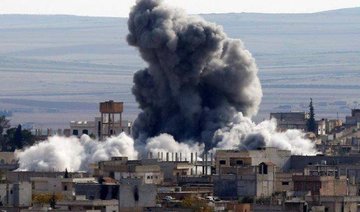
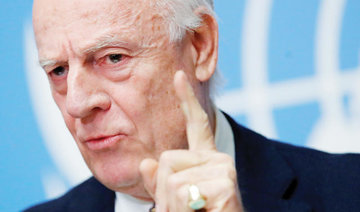
BEIRUT: A powerful Syrian Kurdish militia announced on Sunday it had cleared Daesh group fighters from key territory east of the winding Euphrates River.
In a surprising announcement, the People’s Protection Units (YPG) also said the victory in Syria’s Deir Ezzor province came with logistical and air support from Russia, as well as the US-led coalition, its traditional backer.
The YPG was spearheading a US-backed offensive to oust Daesh from territory east of the Euphrates River, which cuts diagonally across Deir Ezzor, while rival Russian-backed Syrian troops battled Daesh on the western bank.
It appears to the first time Syria’s Kurds acknowledge receiving direct Russian support.
On Sunday, YPG officials met with a Russian military delegation in a town on the eastern bank of Deir Ezzor province, according to the Kurdish-run ANHA news agency.
“The eastern countryside of the city has been fully liberated from Islamic State... with the international coalition and Russia’s support,” YPG spokesman Nuri Mahmoud said in a statement referring to Daesh.
“We thank the international coalition and the Russian forces for their air, logistical, advisory support and coordination on the ground.”
Mahmoud said the YPG “hoped for an increase in support and the provision of air defense and required cover.”
Daesh jihadists once held most of oil-rich Deir Ezzor, but now control only a tiny sliver of the province, according to the Britain-based Syrian Observatory for Human Rights monitor.
On Sunday, Observatory head Rami Abdel Rahman said Daesh still held several villages in the province, on both banks of the Euphrates River.
The YPG formed the bulk of the Syrian Democratic Forces, an Arab-Kurdish alliance that ousted Daesh from swathes of northern and eastern Syria, with help from the US-led coalition.
In September, the SDF began its assault on Daesh positions in the eastern half of Deir Ezzor province, as Russian-backed government troops squeezed Daesh in the western half.
The SDF accused Moscow of striking its forces several times during the drive, which makes Sunday’s announcement of Russian support all the more surprising.
Last week, the White House said it would be making “adjustments” to its military support of militia in Syria.
The US-led coalition has provided air support, weapons, and advice to the YPG and SDF in their push against Daesh.

Kurds announce Daesh losses in east Syria with US, Russia help
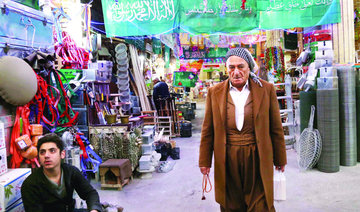
Last Christians gather in ruins of Turkiye’s quake-hit Antakya
- Saint Peter’s, one of the world’s oldest rock churches, is a sacred rallying point for the isolated Christians still left in quake-hit Antakya in southeastern Turkiye
ANTAKYA: Saint Peter’s, one of the world’s oldest rock churches, is a sacred rallying point for the isolated Christians still left in quake-hit Antakya in southeastern Turkiye, the city known in ancient times as Antioch.
“Since the earthquake, our community has scattered,” said worshipper Mari Ibri.
“Those who remain are trying to regroup. We each had our own church but, like mine, they have been destroyed.”
The landscape around the cave remains scarred by the disaster nearly three years ago, when two earthquakes devastated Hatay province on February 6, 2023 and its jewel, Antakya, the gateway to Syria.
Sad fields of rubble and the silhouettes of cracked, abandoned buildings still scar the city — all enveloped in the ever-present grey dust.
Since the earthquakes, Antakya city has emptied and the Christian community has shrunk from 350 families to fewer than 90, Father Dimitri Dogum told AFP.
“Before, Christmas at our house was grandiose,” Ibri recalled.
“Our churches were full. People came from everywhere.”
Ibri’s own church in the city center was rendered inaccessible by the earthquakes.
Now she and other worshippers gather at the cave on December 24 — Christmas Eve in some Christian calendars.
It is here, they believe, that Peter, the disciple Jesus assigned to found the Christian church, held his first religious service in the 1st century.
The rock church was later enlarged and 11th-century crusaders added a pale stone facade.
It is now a museum, opened to the faithful only on rare occasions.
Christmas Eve is one.
The morning sun was still glowing red in the sky when Fadi Hurigil, leader of Antakya’s Orthodox Christian community, and his assistants prepared the service.
They draped the stone altar and unpacked candles, holy oil, chalices and plastic chairs.
Out in front they placed figurines of Christ and three saints near a bottle of rough red wine, bread baskets and presents for the children.
The sound system played a recording of the bells of Saint Peter and Paul church, which now stands empty in Antakya city center.
“That was my church,” said Ibri, crossing herself. “They recorded the peals.”
Around one hundred worshippers soon squeezed into the incense-filled cave and at least as many congregated outside.
A large police contingent looked on. Sniffer dogs had already inspected the cave and esplanade.
“It’s normal,” said Iliye, a 72-year-old from Iskenderun, 60 kilometers (40 miles) further north. “We’re a minority. It’s to protect us.”
The slow chanting of Orthodox hymns heralded the start of the two-hour service, conducted entirely in chants sung in Arabic and Turkish by Dogum and another cleric.
“It’s very moving for us to be here in the world’s first cave church, where the first disciples gathered,” the priest said.
“There used to be crowds here,” he added.
“In 2022, there were at least 750 people outside, Christians and non-Christians alike.”
Since the earthquakes, the gathering has been much smaller, although it is now starting to grow again.
At the end of the service, when Christmas carols fill the air, Dogum and Hurigil cut a huge rectangular cake.
The Nativity scene at its center — Mary, baby Jesus, the ox and the ass — was edged with whipped cream.
“There’s the religious dimension but it’s also important that people can gather here again,” a worshipper said.
“After February 6, our fellow citizens scattered. But they’re starting to come back. We’re happy about that.”