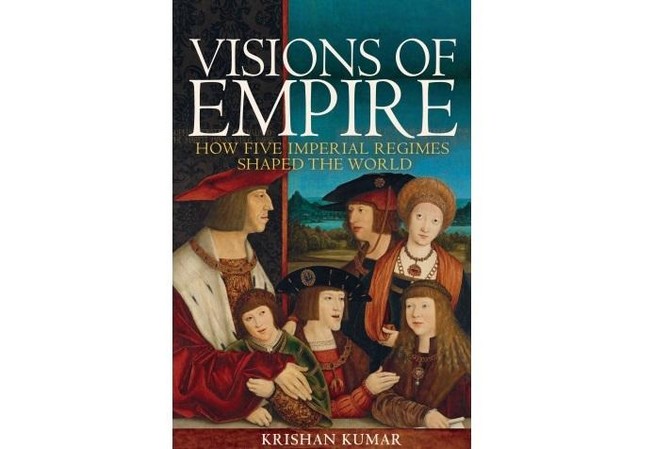
In the very first sentence of his newly-released book, author Krishan Kumar reveals that the study of empires has never been so popular. This revelation might come as a surprise for those of us who believed that with the demise of European empires — the British, French, Dutch, Belgian and Portuguese — after World War II, imperialism had become an outmoded concept.
Empires were large-scale, multinational and multicultural entities and this book examines the ideas and ideologies that shape not only our thinking on those entities, but also the policies of imperial rulers themselves.
According to the book, most Europe-based empires were inspired by the Roman Empire. They learned from it — especially its decline in the 15th century.
The Roman Empire inspired so many others but itself looked further back in history — to the Ancient Greek leader Alexander the Great — for inspiration. In fact, when Chandragupta Maurya, the founder of the 3rd century BCE Maurya Empire, was asked how he built up his power, he is said to have replied: “I watched Alexander when I was still a young man.” Alexander the Great, he claimed, could have gone on to conquer all of India because his model of rule was superior to that of all the Indian princes.
Fast forward to the Roman Empire and thinkers such as Cicero were of the opinion that “the extension of citizenship to all of Rome’s subjects was of the essence of Rome’s empire, expressing its highest and most characteristic principle. It was the thing that made it distinctive in the world, setting it off from all other states and empires, past and present,” according to the book.
In his book, Kumar has selected five empires: The Ottoman, Habsburg, Russian, British and French. “At least I can say that the empires I have chosen represent, by any standard, size, power (and) impact, the most important of the modern empires and that all of them would have to be included in any account of the role of empires in the world.”
The first empire Kumar tackles is the Ottoman Empire. European writer have often wrongly confused Turks with the Ottomans and the latter has often been described as being savage and cruel.
The Ottoman Empire can be defined as a dynastic, multinational empire, ruling over a variety of peoples. In writer Colin Imber’s words, “the Ottoman Empire was not…exclusively Islamic, nor was it exclusively Turkish. Rather it was a dynastic empire in which the only loyalty demanded of all its multifarious inhabitants was allegiance to the sultan… It was, in the end, the person of the sultan and (religious), ethnic, or other identities that held the empire together.”
Ottomans were not exclusively Turks. The term Turk refers to an ethnic group that includes members from the Balkans, Anatolia and Arab countries. The Ottomans had a mission to protect all Muslims and to spread the cause of Islam in the world. The Ottoman Empire was a Muslim empire. Throughout its history, Islam was an indelible part of its identity. Ottoman rule was characterized by a pragmatism and realism that created “a remarkable model of how different communities can live under the mantle of a supranational power. However, when Turkish nationalism emerged in the 19th century, its ideas entirely opposed to the Ottoman tradition, (it) would lead eventually to the dissolution of the empire itself.
The Habsburg Empire is probably the least known among the empires chosen by Kumar. He describes it as “tortuous, treacherous and protean.” Indeed, the Habsburg Empire ruled a disparate group of countries that included Spain, Italy, Burgundy, the Netherlands, Austria, Bohemia, Hungary, Croatia and parts of Germany. The Habsburg Empire also ruled over territories in Africa, Asia and the New World. Germans were the largest single group within the Habsburg Empire, which was founded in the 1520s, and the German language and German culture became dominant at its imperial court.
The Habsburg Empire lasted for 600 years, however, it did not fall because of any economic miscalculations. In fact, historian Michael Mann believes “the Habsburg economy was a capitalist success and Kumar adds that the empire’s downfall happened when it lost World War I.
The three remaining empires — the British, the French and the Russian — fell after World War II. It is in Russia where the loss of its imperial past is felt so strongly. Vladimir Putin himself declared that the dismantlement of the Soviet Union was “the greatest geopolitical catastrophe of the 20th century” and “a genuine tragedy for the Russian people.”
Europe no longer runs the world. Its empires have disappeared. However, Russia under Putin is still showing a strong affinity toward imperialism. Look toward the east and it is clear that China is a new superpower. After centuries of neglect, China has recovered and it is on the verge of becoming the world’s largest economy. Could it be the new face of imperialism? Empires may have vanished but is the nation state that claims sovereignty and tends toward ethnic uniformity a viable alternative? Only time and academic study will tell.
“Empires, for all their faults, show us another way, a way of managing the diversity and differences that are now the inescapable fate of practically all so-called nation-states,” Kumar concludes.


Book Review: Exploring the world’s powerhouses throughout time
Book Review: Exploring the world’s powerhouses throughout time


Book Review: ‘Gut: the inside story of our body’s most underrated organ’
The New York Times bestseller “Gut: the inside story of our body’s most underrated organ” by Dr. Giulia Enders is an eye-opener.
Originally published in German in 2014 as “Darm mit Charme,” the English version, “Gut,” translated by David Shaw, has gone through several revisions, the most recent of which was published in January 2026.
Layering her medical knowledge with lived human experience, Enders shapes the material at hand into a tangible map of digestion, metabolism and immunity while weaving in real life stories to tie it all in.
She begins with her own personal story, before providing additional context as an expert who specializes in internal medicine and gastroenterology, with a focus on gut health, microbiology and the gut-brain connection.
While some parts might seem like an oversimplification, I like her storytelling style — she makes the dense science accessible for the masses.
Viewers of Netflix might have seen her animated antidotes more recently as one of the main experts in the 2024 documentary, “Hack your Health: The Secrets of Your Gut.”
Similarly, in this book, she expressively explores the microbiome’s connection to the brain and delves into psychobiotics — the microbes that influence mood, stress and even depression.
Enders showcases how and why the gut is powerful; it is not just background machinery within the human body, or even an organ often oddly used as a punchline in a joke.
She highlights how digestion, immunity, metabolism, and mental health are all intertwined and that the gut might arguably be the most vital and predictable organ we could use as a metric to predict overall imminent and immune health.
Some of the things she mentions at the beginning of the book hit me in the gut, as they say. She touches on some key things that are intricately linked and might unlock some of the digestive issues one might develop throughout one’s life. I feel seen.
Nodding along with nearly each page flip, I found my stomach flipping with excitement too, finally finding the parallels between her early experiences and connecting it to my own eventual gut issues.
By the last page, “Gut” will leave you aware that everything does happen for a reason.
You feel those butterflies in your stomach? It is not merely poetic — it signals much more than a seemingly fleeting feeling. It is central to how your whole body works. The “gut feeling” is not just a feeling but also a fact.
“Seen under the microscope, bacteria look like nothing but little, bright spots. But taken together, their sum is much greater than their parts,” she writes.
“Most sit in our mucus membrane, training our immune system, soothing our villi, and producing vitamins. If the good and the bad are in equilibrium, the bad ones can make us stronger and the good ones can keep us healthy.”
When the science parts get slightly too heavy, the whimsy illustrations scattered throughout the book will make you feel grounded. Illustrated by her older sister, Jill Enders, the playful drawings make the complex concepts even easier to digest.


