Too cold for a theme park, Disney looks to toy market in Russia

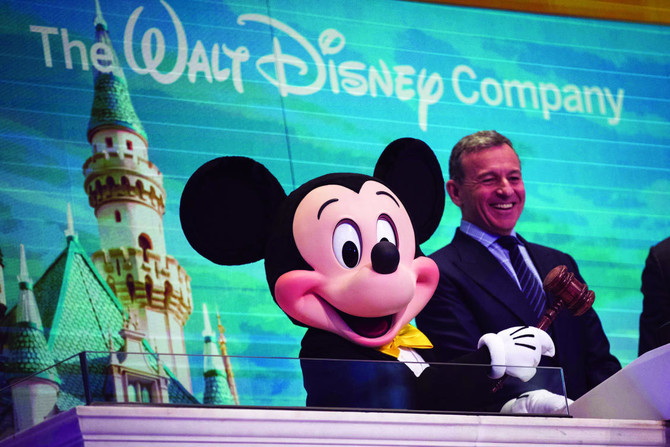
Mickey Mouse and CEO of The Walt Disney Company Bob Iger prepare to ring the opening bell at the New York Stock Exchange. The company is adding outlets in Russia, where the climate remains a challenge for theme park development. (Reuters)
Updated 02 December 2017
Follow

Too cold for a theme park, Disney looks to toy market in Russia

MOSCOW: Though too cold for a theme park, Russia’s underserved toy market makes it an attractive business prospect for Walt Disney Co, the head of its Russian operations said on Friday.
Opening the US group’s first toy store in the country, Marina Zhigalova-Ozkan said it planned at least five more, and was working with local manufacturers to keep prices competitive.
“We think that in Russia there aren’t too many toy shops ... and we thought it would be interesting and complementary to what already exists in the market to open our own branded stores together with partners,” she said in an interview.
The new outlet occupies around 300 square meters in the central Moscow children’s department store, alongside British toy retailer Hamleys, which opened two years ago.
Three more Disney stores are planned for Moscow, one in St. Petersburg and one in Russia’s south this and next year, Zhigalova-Ozkan said.
Disney has teamed up with Russian company Ideas4Retail, which will run the stores and pay a royalty fee to Disney, with the two working together on product range and pricing.
Ideas4Retail also works with Hamleys as well as children-focused brands Imaginarium and Mamas & Papas in Russia.
Unlike Disney stores elsewhere, which also sell clothing and decor, shops in Russia will only sell toys and will represent the Disney, Star Wars, and Marvel franchises. Disney’s current Russian business focuses on distributing and producing cartoons and movies, and licensing its brands for use on a wide range of consumer goods and in digital content.
It also has a joint venture with Russian company UTH, which owns Disney Channel in the country.
Merchandise for the stores will be supplied by local manufacturers with licensing agreements with Disney, while some will be imported from other countries.
Disney has around 300 licensees in Russia, of which 136 manufacture goods in Russia.
Zhigalova-Ozkan said the company had been focusing on localizing production in recent years, and had stepped this up after the rouble fell sharply at the end of 2014. “Because of the (exchange) rate differences many of the products that we were bringing in became out of reach for the Russian consumer,” she said.
“We have expanded the number of goods we sell at mid prices. We realize that the average spent may be lower but demand for children’s goods does not decline. Children want toys anyway.”
However, Disney has no plans for a theme park in Russia.
“Sadly, it’s cold in Russia. A theme park should work 12 months in a year. And in terms of number of people in Russia unfortunately it’s not very efficient,” Zhigalova-Ozkan said.
Disney does not break down its business figures by countries.


 

Kuwait to boost Islamic finance with sukuk regulation

Updated 11 min 26 sec ago
Follow

Kuwait to boost Islamic finance with sukuk regulation

  • The move supports sustainable financing and is part of Kuwait’s efforts to diversify its oil-dependent economy

RIYADH: Kuwait is planning to introduce legislation to regulate the issuance of sukuk, or Islamic bonds, both domestically and internationally, as part of efforts to support more sustainable financing for the oil-rich Gulf nation, Prime Minister Sheikh Ahmad Abdullah Al-Ahmad Al-Sabah said on Wednesday.

Speaking at the World Governments Summit in Dubai, Al-Sabah highlighted that Kuwait is exploring a variety of debt instruments to diversify its economy. The country has been implementing fiscal reforms aimed at stimulating growth and controlling its budget deficit amid persistently low oil prices. Hydrocarbons continue to dominate Kuwait’s revenue stream, accounting for nearly 90 percent of government income in 2024.

The Gulf Cooperation Council’s debt capital market is projected to exceed $1.25 trillion by 2026, driven by project funding and government initiatives, representing a 13.6 percent expansion, according to Fitch Ratings.

The region is expected to remain one of the largest sources of US dollar-denominated debt and sukuk issuance among emerging markets. Fitch also noted that cross-sector economic diversification, refinancing needs, and deficit funding are key factors behind this growth.

“We are about to approve the first legislation regulating issuance of government sukuk locally and internationally, in accordance with Islamic laws,” Al-Sabah said.

“This enables us to deal with financial challenges flexibly and responsibly, and to plan for medium and long-term finances.”

Kuwait returned to global debt markets last year with strong results, raising $11.25 billion through a three-part bond sale — the country’s first US dollar issuance since 2017 — drawing substantial investor demand. In March, a new public debt law raised the borrowing ceiling to 30 billion dinars ($98 billion) from 10 billion dinars, enabling longer-term borrowing.

The Gulf’s debt capital markets, which totaled $1.1 trillion at the end of the third quarter of 2025, have evolved from primarily sovereign funding tools into increasingly sophisticated instruments serving governments, banks, and corporates alike. As diversification efforts accelerate and refinancing cycles intensify, regional issuers have become regular participants in global debt markets, reinforcing the GCC’s role in emerging-market capital flows.

In 2025, GCC countries accounted for 35 percent of all emerging-market US dollar debt issuance, excluding China, with growth in US dollar sukuk issuance notably outpacing conventional bonds. The region’s total outstanding debt capital markets grew more than 14 percent year on year, reaching $1.1 trillion.