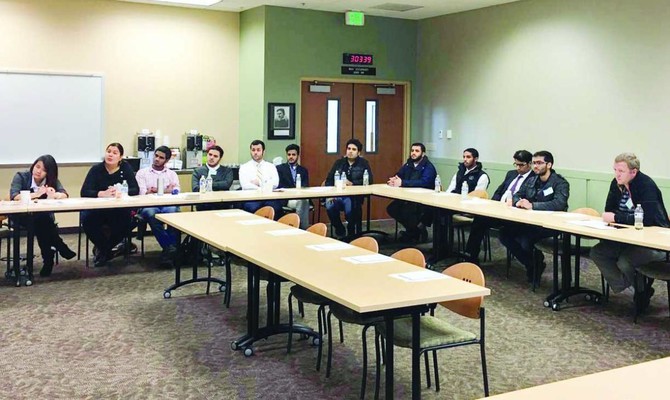
The National Grid SA, a subsidiary of the Saudi Electricity Company (SEC), has signed a memorandum of understanding (MoU) on the Strategic Partnerships Project with Schweitzer Engineering Laboratories (SEL), an American corporation. Under the agreement, SEL will provide training programs and courses to Saudi scholarship grantees in Washington, especially those specialized in engineering, energy, IT and electricity. The move is part of the company’s social responsibility program to serve Saudi society and citizens inside the country and abroad.
Laith Al-Bassam, CEO of National Grid SA, said a large number of Saudi scholarship grantees in Washington University have benefited from such advanced courses and programs in the past 18 months. He said the training courses are conducted at centers and headquarters of SEL that are equipped with the latest technologies according to each field. Experiential training is conducted at the labs of the company and attended by students and researchers from different nationalities to exchange experience.
“Through the Strategic Partnerships Project, these programs are developed to provide more specialized technical and technological training to Saudi scholarship grantees with the aim to transfer modern technologies and sciences in various fields to Saudi Arabia through its citizens as part of the Vision 2030 of the Kingdom. They seek to take advantage of the presence of the scholarship grantees in these countries and in close proximity to such international corporations to apply academic sciences and conduct hands-on training at specialized centers and sites,” he added.
Al-Bassam said the training programs include general courses in the field of electricity and engineering, as well as specialized courses such as the 35-hour course in power-system protection. An intensive course will be launched for scholarship grantees at the beginning of next January, which will last for 15 weeks.
Al-Bassam said that the agreement concluded with the American company is among a number of strategic partnership agreements signed with global corporations and institutions in numerous countries in the electricity sector. He said the project will expand soon to include other states in the US and European countries such as Germany and France, in addition to Asian countries such as China, South Korea and Japan.

National Grid SA inks deal with US company to train Saudi students
New energy vehicles drive next phase of mobility in Saudi Arabia
Saudi Arabia stands at a defining moment in its mobility transformation. Under Vision 2030, the Kingdom is accelerating its transition toward cleaner, smarter and more connected transport systems.
New energy vehicles are at the center of this shift, offering a pathway to a more sustainable automotive ecosystem. Yet while consumer interest is rising rapidly, converting intent into everyday adoption will depend on how effectively the wider mobility system evolves alongside electric vehicles.
Recent nationwide research by Al-Futtaim highlights the strength of this momentum. More than 70 percent of Saudi residents surveyed are already familiar with NEVs, while nearly eight in 10 say they would consider purchasing one as their next vehicle. Most notably, 80 percent expect to buy an electric vehicle within the next three years, signaling that the transition is moving from aspiration to reality.
Despite this optimism, important barriers remain. Range anxiety continues to be the most frequently cited concern, alongside high purchase prices and long charging times. Practical considerations dominate purchasing decisions, with affordability and access to charging infrastructure outweighing environmental motivations. These findings underline a pressing reality: consumers will embrace NEVs at scale only when electric mobility feels as convenient, reliable and accessible as conventional driving.
For industry leaders, this represents both an opportunity and a responsibility. Jerome Saigot, managing director of Al-Futtaim BYD KSA, said: “Saudi Arabia is building the foundations for a future-ready mobility system under Vision 2030. The opportunity now is to connect the dots, bringing together vehicles, charging infrastructure, consumer education and service capability to unlock confident, large-scale adoption of new energy vehicles.”
Charging networks therefore play a central role in supporting adoption, but they are not the only requirement. NEV uptake is closely linked to how cities are planned, how people commute and how transport systems connect.
Emerging mobility models also point to a more connected future. High levels of openness to mobility-as-a-service, autonomous vehicles and shared transport indicate that Saudi consumers are receptive to innovation. However, these technologies will succeed only if they are embedded within systems that link vehicles, infrastructure, data and urban design.
Successful electric mobility ecosystems need to be built around coordinated rather than isolated initiatives. Electric vehicles perform best when supported by reliable charging, smart traffic management, efficient public transport and well-designed urban environments. In this context, NEVs benefit directly from parallel investment in rail, bus networks, digital platforms and active mobility infrastructure.
Encouragingly, public confidence in Saudi Arabia’s long-term mobility vision remains strong. More than 85 percent of respondents surveyed by Al-Futtaim believe the Kingdom is on track to lead in future mobility. Consumers also clearly identify priorities for continued progress, including expanding charging infrastructure, improving mass transportation and strengthening regulatory frameworks.
For policymakers, investors and industry players, the message is clear. The next phase of mobility transformation must focus on alignment: aligning infrastructure with consumer expectations, aligning innovation with everyday needs, and aligning public and private investment around shared outcomes.
Saudi Arabia’s mobility transition is no longer a distant ambition. It is unfolding now, shaped by confident consumers, ambitious institutions and accelerating technological change. By building connected systems that place people at their center, the Kingdom can ensure that electric mobility becomes a lasting part of its sustainable future.
To explore these insights and recommendations in more detail, download The Future of Mobility in Saudi Arabia.