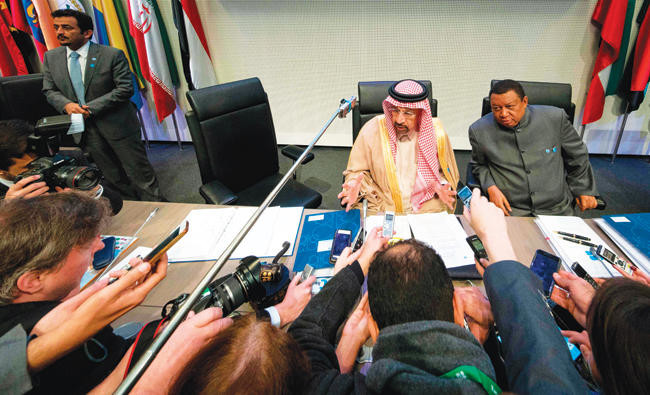
LONDON: OPEC and non-OPEC countries, including Russia, patched up their differences yesterday and agreed to a nine month extension to oil output cuts first agreed in December 2016 after the price fell as low as $30 per barrel.
The current deal, under which producers agreed to cut supply by about 1.8 million barrels per day, was due to expire in March 2018, but will now be extended till the end of next year following a meeting in Vienna.
Markets breathed a sigh of relief as the current tariff of about $62 per barrel was viewed as factoring in an extension of production curbs that have helped the price recover by around 38 percent since last December’s $45 per barrel.
Robust global economic growth has also been a major factor, and there has been a significant reduction in global inventories as producer countries combined forces in a bid to bring supply and demand back into balance.
There will be wriggle room for the agreed cuts to lapse in the event of the market overheating. Additionally, there remains uncertainty as to the “trigger” price that could see US shale operators suddenly ramp up supply, raising the spectre of another glut.
The new agreement seeks to involve Opec members Nigeria and Libya, which were not signatories to the earlier accords.
The Vienna accord is a geopolitical and diplomatic win for Saudi Arabia, by far Opec’s largest supplier, as its leaders would appear to have persuaded Russia to go along with an extension even though some Russian suppliers have lobbied for the agreement to be scrapped as Russia needs lower oil prices to balance its budget than KSA.
But last month’s visit to Moscow by King Salman who met Vladimir Putin underlined the development of a more positive relationship between the two countries. Both have an interest in maintaining a balanced oil market.
The state visit was the first by a reigning Saudi monarch and came despite Russian support for Iranian-backed forces in Syria.
In Austria yesterday, Saudi Energy Minister Khalid Al-Falih told the gathering that in May the OECD stock overhang was 280 million barrels above the moving five-year average, but it had since fallen by almost half to 140 million barrels for the month of October.
He said: “All in all, market stability has improved and sentiment is generally upbeat. The rebalancing trend (towards the five year average) has accelerated and inventories are on a generally declining trend.”
Compliance with the production targets by the combined OPEC 12 was around 100 percent and OPEC’s credibility had been enhanced, although a couple of members had “lagged” behind, he said.
He added: “To succeed going forward, it is essential that we continue to maintain unity within OPEC. But let me hasten to add that without the support of our non-OPEC partners, the encouraging situation we see today would not have been achieved. So, we should seek to institutionalize the OPEC and non-OPEC cooperation framework, and further build on the healthy foundation we have laid.”


![]()
OPEC and Russia agree extension to oil output cuts
OPEC and Russia agree extension to oil output cuts

Latest updates




© 2026 SAUDI RESEARCH & PUBLISHING COMPANY, All Rights Reserved And subject to Terms of Use Agreement.