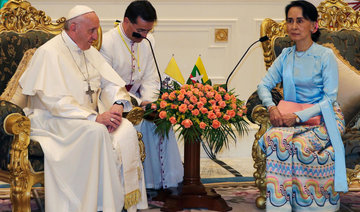
Pope Francis arrives in Bangladesh; to meet Rohingya refugees

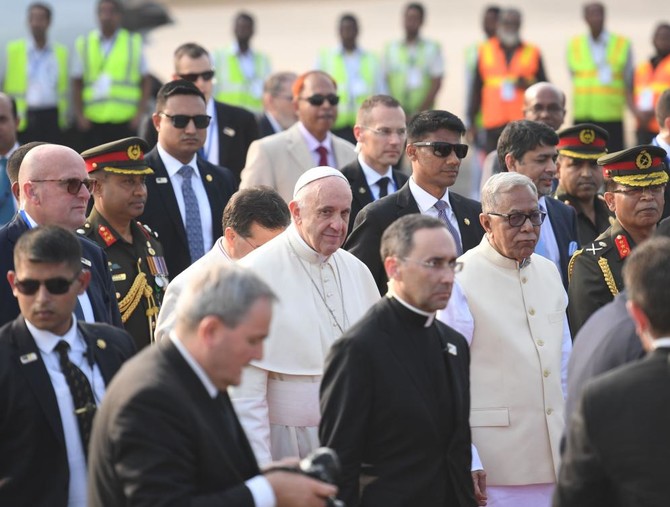
Pope Francis arrives at the airport in the Bangladeshi capital Dhaka on November 30, 2017. (AFP)
Updated 01 December 2017
Follow

Pope Francis arrives in Bangladesh; to meet Rohingya refugees

DHAKA: Bangladeshi President Abdul Hamid received Pope Francis on Thursday following the latter’s visit to Myanmar.

“Pope Francis’ visit to Myanmar and Bangladesh gave rise to great expectations from the international community, especially among the forcibly displaced people from Myanmar who came to Bangladesh and identify themselves as Rohingya,” said Anup Kumar Chakma, a former Bangladeshi ambassador to Myanmar.

But the pope’s visit to Dhaka is clouded by the fact that during his visit to Myanmar, he did not refer to the ongoing Rohingya crisis, use the term “Rohingya” or condemn operations carried out against the community in Rakhine state that led to their mass exodus into Bangladesh.

“It reflects how effectively Myanmar has been dealing with this issue diplomatically,” said Chakma.

The pope’s visit to Bangladesh is significant in that it may give momentum to the implementation of a repatriation accord recently signed by Bangladesh and Myanmar.

“This visit will draw more international attention and maintain pressure on the Myanmar government to ensure the sustainable repatriation of refugees,” said Dr. Delwar Hossain, a professor of international relations at Dhaka University.

The pope is scheduled to meet a group of Rohingya on Friday in Dhaka. “It has indirect value and impact on world leaders,” said Hossain.

But former Bangladeshi Foreign Secretary Shomsher Mobin Chowdhury told Arab News: “I don’t think Pope Francis will play any diplomatic role in devising a solution to the Rohingya crisis. We’ve signed a bilateral memorandum of understanding with Myanmar, and we should concentrate on moving forward with this diplomatic approach.”

The pope concluded his first of three days in Bangladesh at a dinner hosted by the president, where he met politicians, diplomats and civil society leaders.


US not expanding military objectives in Iran, Hegseth says

Updated 3 sec ago
Follow

US not expanding military objectives in Iran, Hegseth says

  • Iran’s regional retaliation strengthen US alliances, Hegseth says
  • US forces destroy 30 ‌Iranian warships, including drone carrier
TAMPA, Florida: US Defense Secretary Pete Hegseth said on Thursday the United States ​was not expanding its military objectives in Iran, after President Donald Trump told Reuters the United States must be involved in choosing the next leader of Iran.
The Pentagon earlier this week said the military campaign, known as Operation Epic Fury, is focused on destroying Iran’s offensive missiles, missile production and navy, while not allowing Tehran to have a nuclear weapon.
“There’s no expansion in our objectives. We know exactly what we’re trying to achieve,” Hegseth said.
He added that Trump was “having a heck of a ‌say in who ‌runs Iran given the ongoing operation.”
In a telephone interview ​with ‌Reuters ⁠on Thursday, ​Trump said ⁠the United States would have to help pick the next person to lead the country. The US and Israeli military campaign that started on Saturday has hit targets across the country and triggered Iranian retaliatory strikes in the region as Tehran seeks to impose a high cost on the United States, Israel and their allies.
Iran has attacked countries including Israel, the United Arab Emirates and Qatar. Fire crews in Bahrain extinguished a blaze at a ⁠refinery following a missile strike.
Azerbaijan became the latest country ‌drawn in, as it accused Iran of firing ‌drones at its territory and ordered its southern airspace closed ​for 12 hours.
Hegseth said by striking ‌countries in the region, Iran would only bring them closer to the United ‌States.
“It’s actually firming up the unity of the resistance in order to focus exactly where we need to,” Hegseth said.

Next phase of operations
The United States has hit more than 2,000 targets in Iran, including Iranian warships. Admiral Brad Cooper, the head of US Central Command, said ‌US forces had destroyed 30 Iranian warships, including an Iranian drone carrier ship earlier on Thursday.
Cooper said the United States ⁠was hitting Iran’s ⁠ability to rebuild.
“As we transition to the next phase of this operation, we will systematically dismantle Iran’s missile production capability for the future, and that’s absolutely in progress,” Cooper said, adding that it would take some time.
The US military has identified the six US Army Reserve soldiers killed when a drone slammed into a US military facility in Port Shuaiba, Kuwait.
Trump and other senior officials have warned the Iran conflict will result in more US military deaths.
Hegseth, during the press conference, said Iran was making a mistake if it believed that the United States could not sustain the ongoing war, adding that Washington had just begun to fight.
“Iran is hoping that we ​cannot sustain this, which is a really ​bad miscalculation,” Hegseth said. “We set the timeline.”