

Pope meets Myanmar’s Suu Kyi as Rohingya crisis looms large

1 / 6
Pope Francis, left, speaks with Myanmar’s civilian leader Aung San Suu Kyi during their meeting in Naypyidaw on November 28, 2017. (AFP)
2 / 6
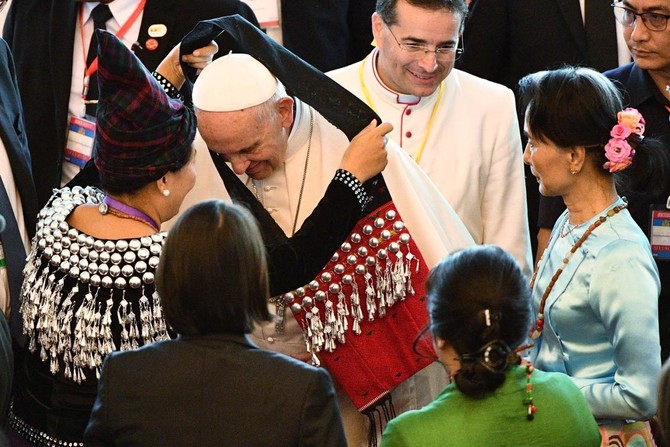
Pope Francis, center, is presented with a gift, as Myanmar’s civilian leader Aung San Suu Kyi, right, looks on, in Naypyidaw on November 28, 2017. (AFP)
3 / 6
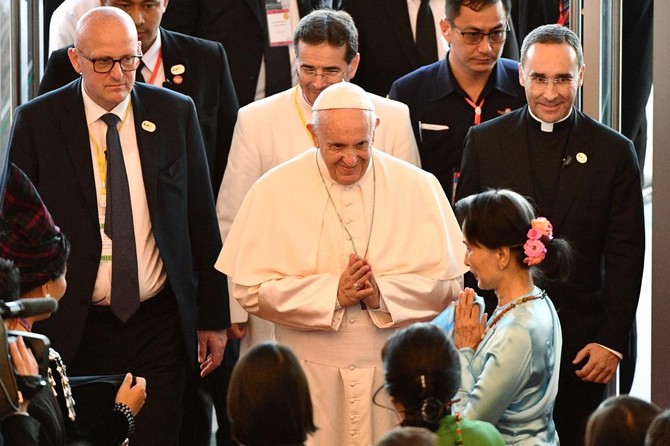
Pope Francis, center, is greeted by Myanmar’s civilian leader Aung San Suu Kyi, front right, in Naypyidaw on November 28, 2017. (AFP)
4 / 6
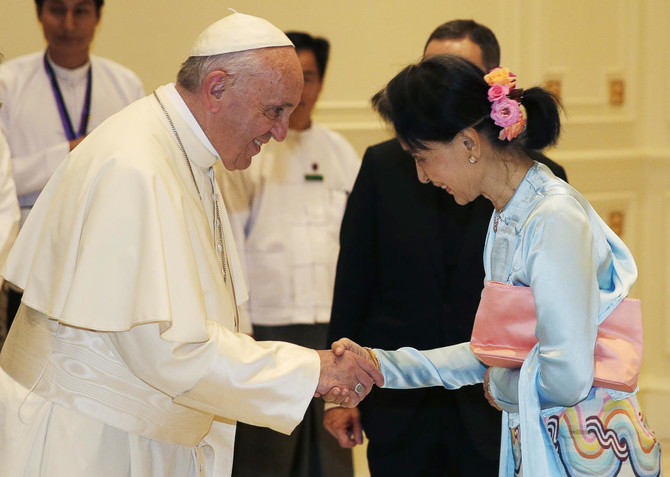
Pope Francis shakes hands with Myanmar’s leader Aung San Suu Kyi in Naypyitaw, Myanmar, Tuesday on November 28, 2017. (Pool Photo via AP)
5 / 6
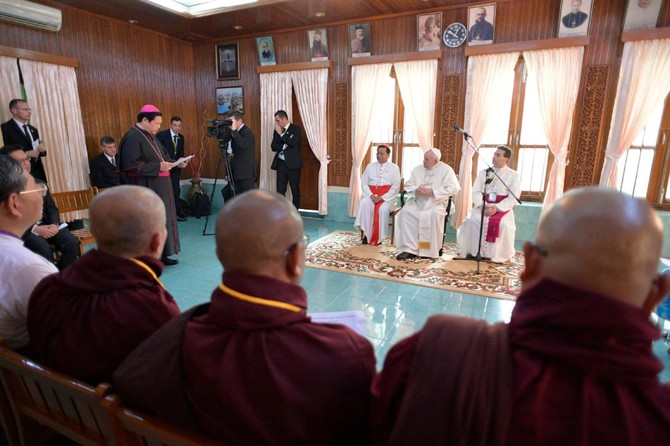
This handout picture taken and released by the Vatican press office (Osservatore Romano) shows Pope Francis (back 2nd R) attending a meeting with religious leaders from various faiths in Yangon on November 28, 2017. (OSSERVATORE ROMANO via AFP)
6 / 6
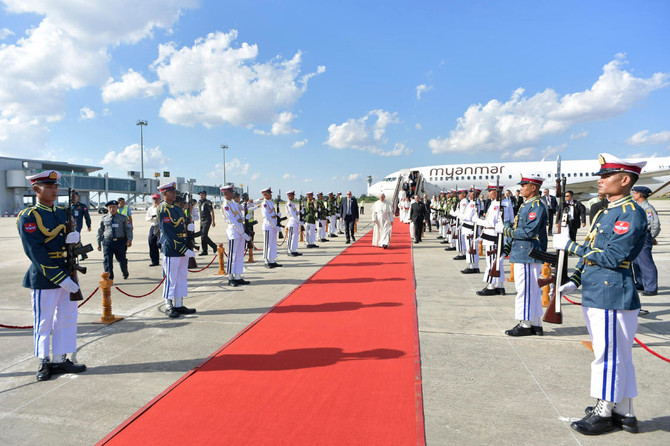
This handout picture taken and released by the Vatican press office (Osservatore Romano) shows Pope Francis, center, walking past an honor guard as he arrives at the airport in Naypyidaw on November 28, 2017. (OSSERVATORE ROMANO via AFP)
Updated 28 November 2017
Follow

Pope meets Myanmar’s Suu Kyi as Rohingya crisis looms large

NAYPYIDAW, Myanmar: Pope Francis held talks with Myanmar’s leader Aung San Suu Kyi on Tuesday, a pivotal moment in a visit aimed at alleviating religious and ethnic hatreds that have driven huge numbers of Muslim Rohingya from the country.
After meeting Suu Kyi in the capital Naypyidaw, the pontiff will deliver a keenly-awaited address — his first opportunity to speak publicly about a refugee crisis that hangs heavy over his four-day trip.
His words will be scrutinized for references to the “Rohingya,” an incendiary term in a mainly Buddhist country where the Muslim minority are denied citizenship and branded illegal “Bengali” immigrants.
Francis has repeatedly defended the group, some 620,000 of whom have fled to Bangladesh since August.
Suu Kyi, a Nobel Peace Prize winner, has been ostracized by a global rights community that once adored her but is now outraged at her tepid reaction to the plight of the Rohingya.
She is due to deliver remarks after the pope, who signed a guestbook at the presidential palace on Tuesday afternoon delivering “the divine blessings of justice, peace and unity” to Myanmar’s people.
The pope’s peace mission is studded with pitfalls in Myanmar, where a monk-led Buddhist nationalist movement has fostered widespread loathing for the Rohingya.
Late on Monday the 80-year-old pontiff received a “courtesy visit” from Myanmar’s powerful army chief — whose troops, according to the UN and US, have waged a campaign of ethnic cleansing against the Rohingya from Rakhine state.
Senior General Min Aung Hlaing has firmly denied allegations of widespread brutality by his forces, despite the flight of Rohingya who have recounted widespread cases of rape, murder and arson.
His office said he told the pope there was “no discrimination” in Myanmar, and feted his military for maintaining “the peace and stability of the country.”
Early Tuesday — day two of his visit — the pontiff met leaders from Buddhist, Muslim, Baptist and Jewish faiths in Yangon.
The conversation centered around themes of unity and diversity, with the pope sharing a prayer and giving a “very, very beautiful speech,” according to Sammy Samuels, a representative from the small Jewish community.
The Lady, as she is fondly known in Myanmar, finally came to power after elections in 2015 but has fallen from grace internationally for not doing more to stand up to the army in defense of the Rohingya — whose name she will not publicly utter.

Rights groups have clamored for Suu Kyi to be stripped of her peace prize. Oxford, the English city she once called home, on Monday removed her Freedom of the City award for her “inaction” in the face of oppression of the Rohingya.
Just days before the papal visit, Myanmar and Bangladesh signed a deal to start repatriating Rohingya refugees within two months.
But details of the agreement — including the use of temporary shelters for returnees, many of whose homes have been burned to the ground — raise questions for Rohingya fearful of returning without guarantees of basic rights.
Francis will travel on to Bangladesh on Thursday.
So far, the pontiff has received a warm welcome in Myanmar, whose Catholic community numbers just over one percent of the country’s 51 million people.
But some 200,000 Catholics are pouring into the commercial capital Yangon from all corners of the country ahead of a huge, open-air mass on Wednesday morning.
Zaw Sai, 52, from Kachin state, found space for himself and his family to camp out in a churchyard.
“We feel very pleased because we are from different ethnicities but are one in our religion,” he told AFP.
Winter pierces Kyiv homes after Russia knocks out heat

Updated 4 sec ago
Follow

Winter pierces Kyiv homes after Russia knocks out heat

  • The war’s fourth winter could be the coldest and darkest yet
  • On Saturday, Kyiv’s heat, power and water, hit hard by a strike two nights earlier, were shut down again

KYIV: Kyiv residents huddled against bitter winter cold inside their unheated apartments on Saturday as engineers struggled to restore power, water and heat knocked out in the latest salvo of Russian strikes.
Russia has regularly conducted intense bombardments of Ukraine’s energy system since it invaded its neighbor in 2022.
The war’s fourth winter could be the coldest and darkest yet, with the accumulated damage to the grid bringing utilities to the brink, and temperatures already below minus 10 degrees Celsius (14 F) and set to plunge further this week.
On Saturday, Kyiv’s heat, power and water, hit hard by a strike two nights earlier, were shut down again as engineers tried to repair the ruined power grid.
Galina Turchin, a 71-year-old pensioner living on Kyiv’s badly affected eastern ⁠bank, had a window covered by plastic sheeting after it was blown out when drone debris hit another part of her building during the last overnight attack.
She said she had not cooked food for two days, eating whatever had been left in their kitchen before the power, water and heat went out, and would now try to cook on a gas camping stove.
“We hope they will give us heat. If not power, then at least ⁠heat,” she said, standing wrapped in layers of jumpers in her kitchen.
The city administration said around noon local time (1000 GMT) on Saturday that the state grid operator Ukrenergo had ordered the city’s power system to be shut down, and that the water and heating systems, as well as electrified public transport, would also stop working as a result.
Less than an hour later, Ukrenergo said engineers had managed to remedy the immediate issue, which had been caused by damage from previous Russian strikes, and that power was coming back online in parts of Kyiv.
Prime Minister Yulia Svyrydenko said the heating system, which in Ukrainian cities is centralized and pumps hot water to homes in pipes, was ⁠also coming back on, and that she expected heat supply to be fully restored on Saturday.
However, she said that the power situation in the capital was still difficult, as the grid was badly damaged and people were using more electric heaters because of the cold.
On Friday, with about half of Kyiv’s apartment blocks left without heating after the latest Russian missile and drone attack, Mayor Vitali Klitschko urged residents who had a warm place to go to temporarily leave the city.
Turchin, the pensioner in her cold apartment, said she had a village cottage in another region but it was unheated and would take three days to warm up with logs.
“The neighbor wrote. She said it was already minus 17 (Celsius) there last night.”