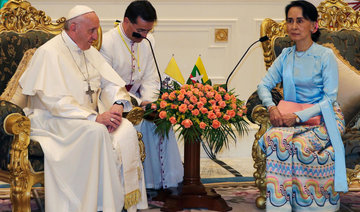
YANGON: Pope Francis wrapped up his visit to Myanmar on Thursday with a Mass for young people before heading to neighboring Bangladesh where the Muslim Rohingya refugee crisis was expected to take center stage.
Francis has so far refrained from speaking out about Asia’s worst humanitarian crisis in decades out of diplomatic deference to his hosts in Myanmar, who consider the Rohingya as having illegally migrated from Bangladesh and don’t recognize them as their own ethnic group.
The Vatican has defended Francis’ silence, saying the pope wants to “build bridges” with the predominantly Buddhist nation. But human rights groups and Rohingya themselves have expressed disappointment that Francis, an advocate for refugees and the world’s most marginal, refrained from condemning what the UN has said is a textbook case of ethnic cleansing.
Vatican spokesman Greg Burke said Francis took seriously the advice given to him by the local Catholic Church, which urged him to toe a cautious line and not even refer to the “Rohingya” by name during his trip.
“You can criticize what’s said, what’s not said, but the pope is not going to lose moral authority on this question here,” Burke told reporters on Wednesday.
Rohingya have faced persecution and discrimination in Myanmar for decades and are denied citizenship, even though many families have lived there for generations. The situation grew worse in August when the army began what it called clearance operations in northern Rakhine state following attacks on security positions by Rohingya militants.
More than 620,000 Rohingya have since poured into refugee camps in neighboring Bangladesh, where they have described indiscriminate attacks by Myanmar security forces and Buddhist mobs, including killings, rapes and the torching of entire villages.
Burke stressed that Francis’ diplomatic stance in public in Myanmar didn’t negate what he had said in the past, or what he might be saying in private.
In the past, Francis has strongly condemned the “persecution of our Rohingya brothers,” denounced their suffering because of their faith and called for them to receive “full rights.”
While he called in his first major speech on Tuesday for all of Myanmar’s ethnic groups to have their human rights respected, his failure to specify the Rohingya crisis on Myanmar soil drew criticism from Amnesty International, Human Rights Watch and Rohingya themselves.
On Wednesday, Myanmar Bishop John Hsane Hgyi suggested that reports of atrocities being committed against the Rohingya were not “reliable” or “authoritative,” and that those who criticized Myanmar’s response to a complex situation should “go into the field to study the reality and history” to obtain “true news.”
The government has barred independent groups from traveling to northern Rakhine state.
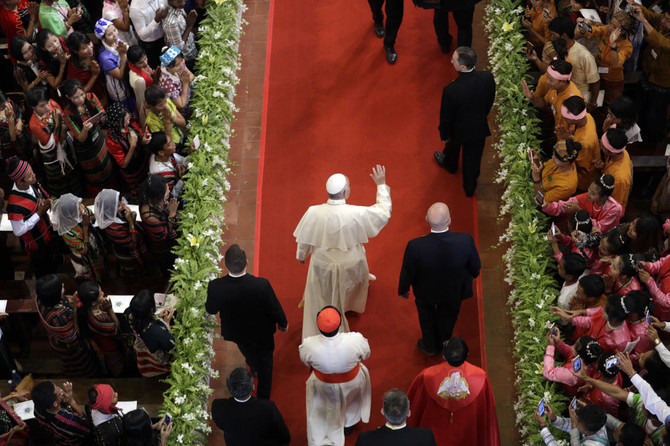
In his final event in Myanmar, Francis celebrated Mass in Yangon’s St. Mary’s Cathedral for young Catholics. The young worshippers, many dressed in the traditional clothing of their ethnic groups, leaned out to touch or kiss Francis’ hand as he slowly walked by.
During the Mass, Francis told them to not be afraid to make their voices heard.
“Do not be afraid to make a ruckus, to ask questions that make people think,” he told them. “Make yourselves heard.”

Pope Francis heads to Bangladesh with Rohingya crisis looming large
Paraguay lawmakers approve defense agreement allowing an increased US military presence
ASUNCIÓN: Paraguay’s Chamber of Deputies on Tuesday approved a defense agreement allowing the temporary presence of US military and civilian personnel inside its borders, widely seen as a victory for the Trump administration, which has sought to strengthen its presence in Latin America.
The Status of Forces Agreement, or SOFA, was approved by a large majority of lawmakers and now awaits the signature of President Santiago Peña to take effect. Peña, one of Trump’s closest allies in the region, is expected to sign the deal in the coming days.
The agreement passed with 53 votes in favor and eight against, and four abstentions out of a total 80 lawmakers. Fifteen were not present for the vote.
Signed by both countries in Washington in December, the agreement establishes a legal framework for the presence of US security forces in Paraguay for training, joint exercises, and humanitarian assistance. It also authorizes the United States to have criminal jurisdiction over its personnel while in the country.
The treaty, praised as “historic” by both the US State Department and Paraguayan Foreign Minister Rubén Ramírez Lezcano, was approved by the Paraguayan Senate last week, where debate was more polarized due to concerns over potential violations of sovereignty.
Some legislators argued against the agreement, citing a controversial provision to grant foreign troops immunity from prosecution, equivalent to that handed to diplomatic personnel.
“We believe in international cooperation, but we also believe in strong states, respected institutions and real democratic sovereignty,” said independent congressman Raúl Benítez.
Despite criticisms, Paraguay’s foreign minister backed the agreement, arguing in December that its main purpose is to strengthen cooperation between the United States and Paraguay in fighting transnational organized crime and “terrorism.” He also clarified that “there is no possibility of the installation of US military bases” in Paraguay.
Washington has also praised SOFA, with US Secretary of State Marco Rubio calling it a “historic agreement” that would help facilitate bilateral and multinational training, humanitarian assistance, disaster response, and other shared security interests.
The approval of SOFA comes as Washington seeks to expand its influence in Latin America under the Trump administration’s national security strategy and as a sector of civil society in Paraguay continues to raise its voice against it.
“The security of a country is not built by importing troops or shielding foreign agents with diplomatic immunities,” said Peace and Justice Service, a civil organization which has a presence across Latin America, in a statement released days before the final vote. The treaty, it added, “does not represent progress in security, but rather the formalization of a geopolitics of impunity that undermines the pillars of our national dignity.”
The Status of Forces Agreement, or SOFA, was approved by a large majority of lawmakers and now awaits the signature of President Santiago Peña to take effect. Peña, one of Trump’s closest allies in the region, is expected to sign the deal in the coming days.
The agreement passed with 53 votes in favor and eight against, and four abstentions out of a total 80 lawmakers. Fifteen were not present for the vote.
Signed by both countries in Washington in December, the agreement establishes a legal framework for the presence of US security forces in Paraguay for training, joint exercises, and humanitarian assistance. It also authorizes the United States to have criminal jurisdiction over its personnel while in the country.
The treaty, praised as “historic” by both the US State Department and Paraguayan Foreign Minister Rubén Ramírez Lezcano, was approved by the Paraguayan Senate last week, where debate was more polarized due to concerns over potential violations of sovereignty.
Some legislators argued against the agreement, citing a controversial provision to grant foreign troops immunity from prosecution, equivalent to that handed to diplomatic personnel.
“We believe in international cooperation, but we also believe in strong states, respected institutions and real democratic sovereignty,” said independent congressman Raúl Benítez.
Despite criticisms, Paraguay’s foreign minister backed the agreement, arguing in December that its main purpose is to strengthen cooperation between the United States and Paraguay in fighting transnational organized crime and “terrorism.” He also clarified that “there is no possibility of the installation of US military bases” in Paraguay.
Washington has also praised SOFA, with US Secretary of State Marco Rubio calling it a “historic agreement” that would help facilitate bilateral and multinational training, humanitarian assistance, disaster response, and other shared security interests.
The approval of SOFA comes as Washington seeks to expand its influence in Latin America under the Trump administration’s national security strategy and as a sector of civil society in Paraguay continues to raise its voice against it.
“The security of a country is not built by importing troops or shielding foreign agents with diplomatic immunities,” said Peace and Justice Service, a civil organization which has a presence across Latin America, in a statement released days before the final vote. The treaty, it added, “does not represent progress in security, but rather the formalization of a geopolitics of impunity that undermines the pillars of our national dignity.”
© 2026 SAUDI RESEARCH & PUBLISHING COMPANY, All Rights Reserved And subject to Terms of Use Agreement.