Kebabs face grilling in Brussels

The European Parliament is looking into whether phosphates should be allowed in kebab meat. (Reuters)
Updated 06 December 2017
Follow

Kebabs face grilling in Brussels

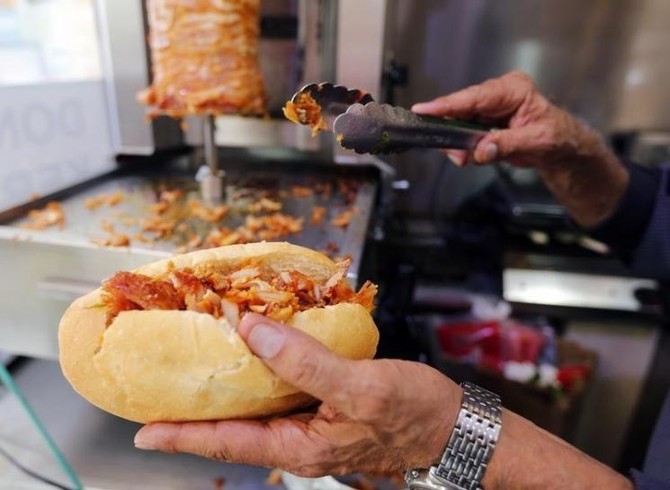
LONDON: The kebab has come under scrutiny in the European Parliament, where MEP’s are worried about phosphates in the food that has grown to become a fast food staple across Europe.
Spanning cultural divides, kebabs enjoy widespread popularity in countries across the continent, where serving styles vary from the hearty kapsalon kebab favored in Holland to the classic döner kebab beloved of the British.
Now, they could become the latest foodstuff to fall prey to the EU’s comprehensive food regulations, which have been criticized in the past for laying down strict laws on factors such as the shape of fruit and vegetables and the serving of olive oil in communal table jugs by restaurants.
Turning its attention to kebabs, the Parliament’s Health Committee has raised objections to a proposal by the European Commission to allow the use of phosphates, including phosphoric acid, di and tri phosphates and polyphosphates, in kebab meat.

The move comes amid concerns raised in a 2012 scientific review over the possible link between phosphates when used as food additives and heart disease – but the evidence remains inconclusive.
EU rules normally prohibit the use of phosphate additives in meat preparation, where they are used to protect flavour and retain water, however there are exceptions.
Kebab eaters in Europe will now have to wait for the vote, due to take place during the Parliament’s Dec. 11 to 14 plenary session in Strasbourg, to find out whether their favorite kebab shops will be serving up sandwiches with the same juicy texture and flavor that keeps them coming back for more.

Where We Are Going Today: Orenda Coffee Hub in Dhahran

Updated 14 January 2026
Follow

Where We Are Going Today: Orenda Coffee Hub in Dhahran

  • The Hasawi cookie was the highlight of my visit, and definitely something I would order again

In search of a hot beverage that you can hold like a hug for your hand as the winter weather cools? Try Orenda in Dhahran.

According to Dictionary.com, Orenda is defined as “an invisible magic power believed by the Iroquois people of North America to pervade all natural objects as a spiritual energy.”

While geographically far away from the land in which the word originated, the cafe has plenty of inspiration from local and global lands.

Their Hasawi cookies—caked with dates and a tiny bit of nuts and cardamom tucked within to give it texture and an elevated taste of neighboring Al-Ahsa—goes for SR 12. This was the highlight of my visit and I would definitely order again.

I tried it with a satisfying SR 16 cappuccino in a ceramic mug. Soft jazz played on the day of our visit. Plenty of natural light bathed the space with the giant windows and many people were typing on their laptops or scrolling on their phones in silence.

 It has a perfectly quiet, perhaps even an orenda atmosphere.

While the weather is still pleasant, you can find many options for outdoor seating. There’s also an upstairs section, up a fun, winding green spiral staircase. Though no elevator was in sight, the bottom floor interior seems wide enough for a wheelchair.

If you do find yourself wandering up the second floor, you’ll find even more seating with an even cozier feel with decor reminiscent of a warm home.

Restrooms are situated on the next and final floor, up even more steps.

A prayer area can be found on the third floor too, along with a massive glass door leading into an outdoor space with tables and chairs aplenty.

Opened eight months ago, it remains the first and only branch in the Kingdom.

Because it seemed very popular, I ordered an iced Orenda matcha for the road, at SR 24. It was decent.

It is open from 6 a.m. until midnight daily, aside from Thursdays and Fridays when it closes at 1 a.m.

Follow them on @orendacoffee.sa.