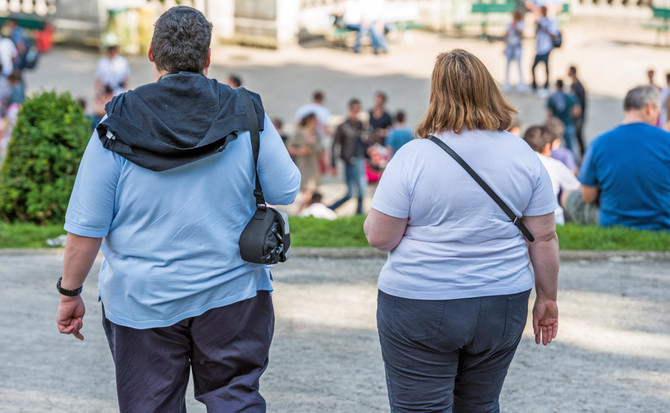
PARIS: Nearly six percent of new cancers diagnosed worldwide in 2012 — some 800,000 cases — were caused by diabetes and excess weight, according to a study published Tuesday.
Among the 12 types of cancer examined, the proportion of cases chalked up to these factors was as high as a third, researchers reported in The Lancet Diabetes & Endocrinology, a leading medical journal.
Cancers stemming from diabetes and obesity combined was almost twice as common among women than men, they found.
And of the two cancer-causing agents, being overweight or obese — above 25 on the body-mass index, or BMI — was responsible for twice as many cancers as diabetes.
The conditions, in reality, are often found together, as obesity is itself a leading risk factor for diabetes.
“While obesity has been associated with cancer for some time, the link between diabetes and cancer has only been established quite recently,” said lead author Jonathan Pearson-Stuttard, a clinical research fellow at Imperial College London’s Faculty of Medicine.
“Our study shows that diabetes — either on its own or combined with being overweight — is responsible for hundreds of thousands of cancer cases each year across the world.”
A surge in both conditions over the last four decades has made the tally significantly worse, the study showed.
The global increase in diabetes between 1980 and 2002 accounted for a quarter of the 800,000 cases, while the obesity epidemic over the same period resulted in an additional 30 percent of cases.
On current trends, the share of cancers attributable to the two conditions will increase by 30 percent for women and 20 percent for men in less than 20 years, the researchers warned.
“In the past, smoking was by far the major risk factor for cancer, but now health care professionals should also be aware that patients who have diabetes or are overweight also have an increased risk,” Pearson-Stuttard said.
For men, obesity and diabetes accounted for more than 40 percent of liver cancers, while for women they were responsible for a third of uterine cancers, and nearly as many cases of breast cancer.
The threshold for obesity is a BMI — one’s weight in kilos divided by one’s height (in centimeters) squared — of 30.
To conduct the study, researchers gathered data on cases of 12 types of cancer from 175 countries in 2012, and matched it with data on weight and diabetes.
People with a BMI of 25 to 29.9 are considered to be overweight.

Diabetes, obesity behind 800,000 cases of cancer worldwide

Recipes for Success: Chef Aljawharah Al-Salem offers advice and a cereal bar recipe
DUBAI: At Kimpton KAFD Riyadh, pastry chef and chocolatier Aljawharah Al-Salem is hoping to contribute to a new chapter in Saudi Arabia’s evolving culinary story. One of the Kingdom’s most promising pastry talents, Al-Salem studied at Ecole Ducasse — Ecole Nationale Superieure de Patisserie in France and George Brown College in Toronto.
She has honed her expertise in French pastry and chocolate in kitchens including Le Meurice in Paris, Hotel X Toronto, and Richmond Station. Today, Al-Salem channels that experience into innovative chocolate creations at Kimpton KAFD Riyadh.
“Our menus are designed to celebrate Saudi flavors while presenting them in a modern, refined way,” Al-Salem tells Arab News. “We wanted to create dishes that feel familiar to locals but also surprise international guests. You’ll find traditional ingredients like dates, saffron, cardamom, and local honey, but paired with global techniques and presentations. It’s a balance between heritage and innovation.”
When asked about her favorite dish on the menu, she said: “My favorite is the Saudi Tiramisu. It’s close to my heart because it tells the story of Saudi hospitality on a plate. Every time I prepare it, I feel I’m honoring my roots but also pushing boundaries in how Saudi cuisine can be presented.”
Here, she discusses her love for olive oil and fatty burgers, and shares a recipe for nut and spice cereal bars.
When you started out, what was the most common mistake you made?
Rushing the process. In the beginning, I wanted everything to be perfect and fast, but great food takes patience. Whether it’s proofing dough or tempering chocolate, time is often the secret ingredient.
What’s your top tip for amateur chefs?
Don’t be afraid to experiment. Recipes are guidelines, not rules. Start with fresh ingredients, taste as you go, and enjoy the process rather than worrying about the result — especially if you have tiny hands helping you in the kitchen. Cooking together makes the food taste even better.
What one ingredient can instantly improve any dish?
Good quality olive oil. It adds depth, richness, and balance whether you’re cooking or finishing a dish. For us, in the region, olive oil carries cultural as well as nutritional value.
When you go out to eat, do you find yourself critiquing the food?
It’s impossible not to notice details, but I try to focus on the overall experience rather than just picking faults.
And what’s the most common issue you find in other restaurants?
The most common issue I notice isn’t about flavor; it's about consistency. A dish might be great one day and average the next. Consistency is the true test of a kitchen.
What’s your favorite cuisine or dish to order?
As much as I admire fine cuisine, after a long shift nothing hits the spot like a fatty smash burger. It’s the kind of food that doesn’t require perfection, it just delivers pure comfort, and that’s exactly what a chef craves after hours of precision in the kitchen.
What’s your go-to dish if you have to cook something quickly at home?
If I need a quick meal, I go for a one-pot pasta — sorry, Italians! It’s fast, comforting, and feeds the whole family.
What customer request or behavior most annoys you?
I wouldn’t say it annoys me, but sometimes people come in with a closed mindset — wanting things only the way they know them. I believe part of dining out is trusting the chef and being open to new flavors and experiences. Life is too short to only stick to what you know.
What’s your favorite dish to cook and why?
I love cooking saleeq. It’s comforting, deeply flavorful, and brings people together. In Saudi culture, saleeq is often served at big gatherings, so it also feels symbolic of our hospitality.
What’s the most difficult dish for you to get right?
Pastry is always humbling. It requires absolute precision and patience. You can’t improvise with baking the way you can with savory cooking, so it keeps me sharp.
As a leader, what are you like?
I believe in discipline, but not in shouting. A kitchen should be built on respect and teamwork. I lead by example. If my team sees me as focused, organized and calm, they mirror that energy. At the end of the day, food tastes better when it’s prepared in a positive environment.
Chef Aljawharah’s nut and spice cereal bars
Yield: 10 bars (30 × 40 cm tray, 1 cm thick)
Ingredients
• 180 g Rolled oats, lightly toasted
• 100 g Puffed rice (or puffed wheat)
• 60 g Puffed quinoa (or toasted quinoa)
• 40 g Almonds, roasted & chopped
• 40 g Pistachios, roasted & chopped
• 30 g Pumpkin seeds, toasted
• 30 g Sunflower seeds, toasted
• 30 g Dried cranberries
• 20 g Candied orange peel, finely diced
• 2 g Ground cinnamon
• 1 g Ground cardamom
• 1 g Fine sea salt
Binding syrup:
• 80 g Brown sugar
• 80 g Local Honey (or date Molasses)
• 40 g Water
• 25 g clarified butter
• 10 g Cocoa powder
Finishing:
• 100 g Dark chocolate 64–70%
⸻
Method
1. Toast cereals & seeds: Spread oats, puffed quinoa, pumpkin seeds, and sunflower seeds on a tray. Toast at 150°C for 10–12 min until lightly golden.
2. Prepare syrup: Cook sugar, honey, and water together to 113°C. Off the heat, stir in butter paste and cocoa powder.
3. Combine: In a mixing bowl, combine toasted cereals, puffed rice, nuts, seeds, dried fruit, candied peel, and spices. Pour in the hot syrup and mix well to coat.
4. Mold: Spread mixture evenly into a 30 × 40 cm tray, 1 cm thick lined with silicone mat/parchment. Press firmly to compact.
5. Bake: Bake briefly at 160°C for 6–8 min to stabilize the bar. Cool completely at room temperature.
6. Cut & finish: For home cooks, Cut into 10 bars. Dip bases in melted dark or drizzle across the top then refrigerate to set the chocolate. For professional use, dip in tempered chocolate or place in molds then top it with tempered chocolate. Crystallize at 17°C before unmolding.