Efforts hailed in preserving moderate Islam

Updated 28 November 2017
Follow

Efforts hailed in preserving moderate Islam

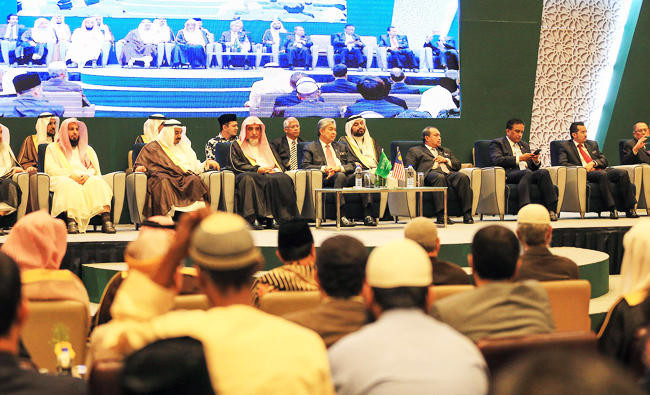
KUALA LUMPUR: Attendees of the first Conference of ASEAN (Association of South Eastern Nations) Muslims hailed King Salman’s directives to cooperate with these countries and organize an annual conference under the slogan “A Moderate Nation.”
They also hailed the efforts of Saudi Arabia and Malaysia in preserving moderate Islam, promoting moderation, fighting extremism, spreading religious teachings based on the Qur’an and the Sunnah, and activating the role of fiqh and fatwa councils in achieving a conscious, moderate understanding of Islam.
They stressed that extremism, terrorism and violence are a global phenomenon that should not be associated with a certain religion or country.
This came in the final statement and the participants’ recommendations during the conference, which concluded on Monday in the Malaysian capital Kuala Lumpur, under the patronage of Malaysian Prime Minister Mohammad Najib, and Sheikh Salih Al-Shaykh, the Saudi minister of Islamic affairs, endowments, call, and guidance.
The closing ceremony was attended by the Deputy Prime Minister of Malaysia Ahmad Zahid Hamidi.
The attendees pledged their support for Rohingya Muslims, who are enduring hostility, murder, forced displacement and racial discrimination, and called upon the international community to take immediate measures to protect them, and upon the Organization of Islamic Cooperation (OIC) and ASEAN to resolve this crisis.
Participants highlighted the importance of holding such conferences in Malaysia and other ASEAN countries because of their significant role in encouraging communication and exchange of experiences, as well as finding solutions for new challenges facing Muslims, instilling moderation, and facing security and stability threats.
In their recommendations, the participants also called for the promotion of a culture of peace and dialogue, stressing the need to respect human rights and international conventions and treaties, and the importance of treating non-Muslims well to achieve social stability.
Moreover, they highlighted the importance of cooperation between parties concerned with the Sunnah, such as the King Salman Complex for the Prophet’s Hadith and the National Committee for Correcting the Hadith in Malaysia.
The conference was organized by several official and civil bodies in Malaysia, including the Special Affairs Department, the Ministry of Communications and Multimedia, Al-Khaadem Organization, the Malaysian Scientific Association, and the University of Technology, with the support of the Religious Affairs Division of the Prime Minister’s Office, and in cooperation and coordination with the Saudi Ministry of Islamic Affairs, Endowments, Dawah and Guidance.
The conference was attended by more than 1,200 academic and religious figures from ASEAN and other Asian countries. Saleh bin Mohammed Al Talib, imam of Masjid Al-Haram in Makkah, and a number of Saudi scholars and researchers were also present.


SR 4.5bn raised from 135m donations through the Saudi Ehsan charity platform in 2025

Updated 4 sec ago
Follow

SR 4.5bn raised from 135m donations through the Saudi Ehsan charity platform in 2025

  • More than 330m donations made on the platform over past 5 years worth a total of SR14bn, officials reveal in run-up to 6th National Campaign for Charitable Work
  • In addition, the Jood Eskan platform that helps low-income families secure housing has raised SR5bn from 4.5m donors since its launch in 2019

RIYADH: Ahead of the launch on March 3 of the sixth National Campaign for Charitable Work on the Ehsan platform, officials on Monday revealed that more than SR4.5 billion ($1.2 billion) was donated through the platform in 2025 alone.

Abdullah Alghamdi, president of the Saudi Data and Artificial Intelligence Authority, said there were 135 million donations last year worth a total daily average of SR12.45 million, compared with about SR2.8 million during the platform’s first campaign in 2021.

Over the past five years, he added, more than 330 million donations have been made through Ehsan, worth a total of SR14 billion.

The platform was built on three main pillars, Alghamdi said: reliability, transparency and ease of use. It uses advanced data analytics and artificial intelligence to verify beneficiary eligibility and prevent duplication of support, he added, and a donation can be completed in less than five seconds.

It was built to “humanize the donation journey,” he said, by ensuring donors can see the direct effects of their contributions, and operates under a framework of governance that includes 13 supervisory entities and five subcommittees.

The Ehsan Waqf Fund, which was introduced to ensure long-term sustainability, so far has collected SR2.2 billion of a SR5 billion target, Alghamdi said.

Majed Al-Hogail, the minister of municipalities and housing, highlighted the expanding role of nonprofit organizations in the housing sector in particular. More than 313 nonprofits now operate within the system, he said, supported by more than 345,000 volunteers working alongside public and private organizations.

Housing initiatives have helped support more than 106,000 families eligible for assistance, he added, and prevented more than 200,000 households from losing their homes. In addition, a rent-support program is assisting about 6,600 families this year, “expanding the reach of support to more households.”

The Jood Eskan housing platform, which enables donors to help people on low incomes secure housing, began by supporting 100 families and now serves more than 50,000 across the Kingdom, Al-Hogail said. Since its launch in 2019, more than 4.5 million donors have contributed more than SR5 billion to housing initiatives, he added.

“This transformation is the result of cumulative efforts built on clear governance, precise eligibility criteria, and electronic integration with relevant entities,” Al-Hogail said.

He also highlighted digital-transformation efforts designed to accelerate the provision of assistance, including the linking of a debt defaulters support platform to the Ministry of Justice, which has reduced processing times for cases from a month to 19 days. Meanwhile an electronic signature service cut the processing time for property-ownership procedures from 14 days to just two.

“In 2025, more than 150,000 digital operations were implemented and the needs of over 400,000 beneficiary families were studied through the integration of national databases,” Al-Hogail said.