ISLAMABAD: The Pakistani government has called on the powerful military to deploy in the capital Islamabad after violence broke out Saturday when security forces attempted to disperse a weeks-long sit-in, the Interior Ministry said, according to an AFP report.
The request was made by Islamabad Capital Territory authorities, according to an Interior Ministry order, which said the federal government had authorized the deployment of “sufficient troops” to “control law and order” in the city until further notice.
There was no immediate comment from military officials.
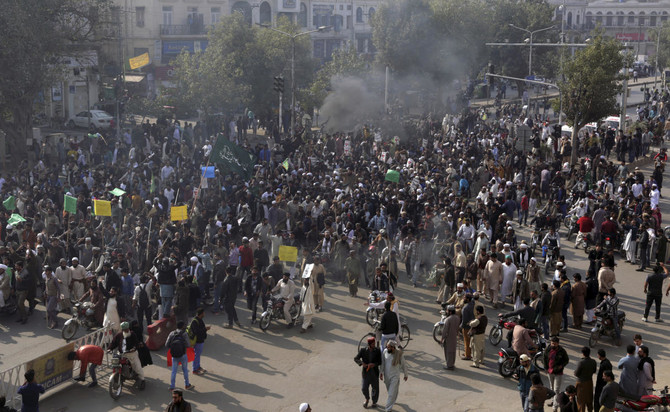
The order came after Pakistani police clashed violently with hardline religious protesters in Islamabad Saturday, leaving at least one person dead and more than 130 injured.
Law enforcement agencies failed to break up a three-week sit-in in Islamabad
The police used tear gas and rubber bullets in an attempt to disperse over 2,000 protesters at the Faizabad interchange, the main gateway between Islamabad and Rawalpindi. But the operation failed to shift the protesters, even though, according to a police spokesman, around 9,000 police and paramilitary troops took part in the operation and arrested around 200 protesters.
The government had declared a state of emergency in all hospitals in the federal capital and Rawalpindi, and reports stated that over 200 people were injured — from both sides — during the clashes.
The mass protests have been ongoing since Nov. 8, with hard-line extremists demanding the resignation of Minister of Law Zahid Hamid for his alleged involvement in a change in the wording of an oath for lawmakers that declares Prophet Muhammad as God’s final prophet, by omitting the clauses pertaining to the official status of Ahmadis.
The government quickly restored the oath to its original wording, and have announced that the change occurred because of a “clerical error” which had nothing to do with Hamid, but the right-wing protesters are still demanding that the law minister be forced to step down for what they claim amounts to blasphemy.
Saturday’s operation continued for at least four hours. Protesters, who disabled nearby CCTV cameras, reportedly fought back with rocks, iron rods and clubs against law enforcement personnel, and set at least four police vehicles on fire.
The stiff resistance meant the police were unable to reach the stage from which the leaders of the sit-in — including the wheelchair-bound hard-line cleric Khadim Hussain Rizvi, leader of the Tehreek Labbaik Ya Rasool Allah party (TLYR) — were directing their followers to attack the security forces.
Shortly after the police launched their operation in Islamabad, thousands of TLYR followers took to the streets in other parts of Pakistan, including Karachi, Faisalabad, Lahore, Narowal and Multan, and blocked several of the country’s main highways.
In an attempt to regain control the situation, the government has taken all private television channels off the air and has blocked social media platforms including Facebook, Twitter and YouTube.
Chief of Army Staff Gen. Qamar Javed Bajwa telephoned Prime Minister Shahid Khaqan Abbasi and suggested the Islamabad sit-in should be handled peacefully, according to Inter-Services Public Relations, the media wing of the Pakistan Armed Forces.
“COAS telephoned PM. Suggested to handle Isb Dharna peacefully avoiding violence from both sides as it is not in national interest & cohesion,” Maj. Gen. Asif Ghafoor, director general of the PR wing, tweeted, after the operation had been called off.
Dr. Rasul Bakhsh Rais, a renowned political analyst, told Arab News that the situation could spiral out of control if the protesters succeeded in sustaining their demonstrations across the country for another week.
“If political parties like Pakistan Tehreek-e-Insaf and Pakistan People’s Party jump in to exploit the situation, then definitely the government will be left with no option but to announce early elections,” he predicted.
Regarding the suspension of television channels and social media platforms, he said the government is simply making the situation worse for itself, and that it could be paving the way for its own ouster.
Minister of State for Interior Muhammad Tallal Chaudhry told Arab News that his ministry has written separate letters to all provincial governments saying they should ensure security for members of the ruling party, ministers and their families.
“I myself have been a target of hate speech by mullahs and I definitely feared for my life,” he said, adding that the extremists have been inciting their followers against ministers, ruling party members, and their families through hate speech. Chaudhry explained that Hamid and his family have been told to restrict their movement “and be extra-careful until the situation calms down.”
The minister added that the government sees its refusal to bow to the protesters’ demands as “a national cause, while fully understanding the consequences of resisting them.”


![]()
Pakistan protests: Army called in to ‘control law and order’
Pakistan protests: Army called in to ‘control law and order’
Latest updates


Recommended


© 2026 SAUDI RESEARCH & PUBLISHING COMPANY, All Rights Reserved And subject to Terms of Use Agreement.