

‘There was no time to think about death’, Jeddah flood hero says

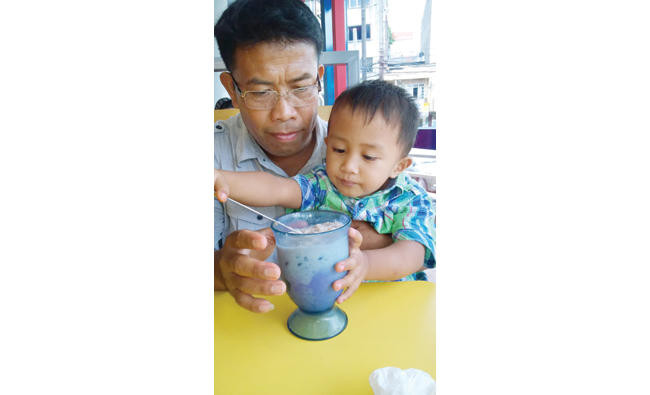
Daud Saripada Balindong with his little son in the Philippines. (Photo courtesy: Daud S. Balindong)
Updated 24 November 2017
Follow

‘There was no time to think about death’, Jeddah flood hero says

JEDDAH: Daud Saripada Balindong, a family driver, did not think twice about jumping into the water when he saw an elderly Saudi man trapped inside his car in the Abruq AR Rughamah neighborhood during last Tuesday’s floods.
The rescue, which was filmed and went viral on social media, echoes the heroic efforts of the Pakistani construction worker Farman Ali Khan, who died after saving the lives of 14 Saudis during Jeddah’s 2009 floods.
Balindong told Arab News that the trapped man was in his sixties and looked unable to leave the car. “There were many people around who tried to prevent me from swimming to reach the man. They were waiting for the Civil Defense to arrive,” he said.
Balindong added that the only thing he remembered at that moment was the Qur’anic instruction that says: “... and he who saved someone’s life, it will be as equally rewarding as if he had saved all mankind,” he said.


When he reached the man, he handed him a lifejacket and helped him to get out of the car and jump into the water. The two swam to the dry side of the road, where the Saudi man thanked Balindong and asked Allah to reward him.
“There was no time to think about death and I could not just watch a person dying or about to die. This does not mean I want to say I am a hero. It was a spontaneous response dictated by humanity, and I am so happy to have been able to save the man’s life,” he said. He said that he did not deserve to be awarded for what he had done.
The 39-year-old Filipino family driver, a father of seven children, has been working in Saudi Arabia for about seven years, six of which were in Jubail. He said he had received a number of calls from his family in the Philippines saying they were proud of the bravery he had shown.


Razan is a geotourism gem carved by time’s patient hands

Updated 6 min 21 sec ago
Follow

Razan is a geotourism gem carved by time’s patient hands

  • In antiquity Razan sustained life in arid environment
  • Strategic landmark, vital in ancient Yemeni Hajj Road

AL-LITH: Sixty kilometers north of Al-Lith governorate in the Kingdom’s west, rising above the shifting sands and valleys of the Makkah region, lies a place where the earth itself tells a story.

This is Razan, a geological wonder where history is not written in ink but etched into the stone by the patient hands of wind, water and time, the Saudi Press Agency reported recently.

Perched atop a high rocky mass and flanked by valleys to the northwest and southeast, Razan stands in natural isolation. This geographic solitude has acted as a guardian, preserving a landscape that feels almost otherworldly — a pristine stage set by nature over millennia.

The place is defined by its striking rock formations: dense clusters of stone, stepped ridges that resemble ancient staircases, and natural ceilings sculpted by the relentless flow of seasonal torrents.

The visual impact is one of dramatic contrast — the heaviness of solid rock balanced against open, airy spaces carved by erosion.

Fine channels and intricate flow patterns mark the stone, serving as fossilized evidence of the water that once rushed through these corridors, shaping the land into a rugged work of art.


In the quiet majesty of Razan, the past is preserved. (SPA)

Nature’s infrastructure 

But Razan is more than just a scenic marvel; for centuries, it served as a lifeline. The same forces that sculpted the cliffs also hollowed out natural rock basins.

These geological depressions acted as seasonal reservoirs, catching rainwater and supplementing nearby wells. Long before modern engineering, the geology of Razan functioned as effective natural infrastructure, sustaining life in an arid environment.

This utility made Razan a strategic landmark, playing a vital role in the ancient Yemeni Hajj Road. The sturdy, elevated terrain provided a natural pathway for pilgrims, offering stability and protection on their spiritual journey toward Makkah.

Today, Razan stands at the intersection of heritage and opportunity. No longer just a passage for pilgrims, it is emerging as a valuable asset for geotourism. Its unique topography offers a visual feast for travelers and a treasure trove for scientists studying geological history.

As Saudi Arabia moves toward the goals of Vision 2030, sites such as Razan are finding new purpose. By transforming this geological narrative into a tourism destination, the region aims to preserve its natural heritage while breathing new life into the local economy.