Zimbabwe’s next leader Emmerson Mnangagwa prepares to take power

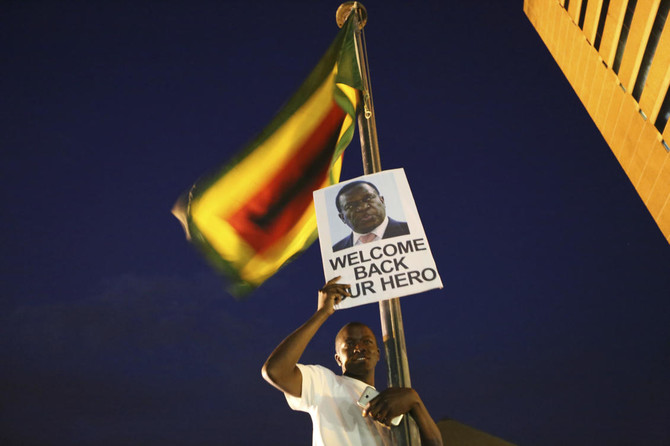
A supporter of Zimbabwe’s incoming leader Emmerson Mnangagwa holds his portrait while waiting for him to arrive at the Zanu PF Headquarters in Harare on Wednesday. Mnangagwa will be sworn in as president at an inauguration ceremony on Friday. (AP)
Updated 23 November 2017
Follow

Zimbabwe’s next leader Emmerson Mnangagwa prepares to take power

HARARE: Zimbabwe’s incoming president Emmerson Mnangagwa was preparing Thursday to take power after the shock resignation of Robert Mugabe brought 37 years of authoritarian rule to an end.
Mnangagwa, who has close ties to the army and the security establishment, returned to the country on Wednesday to take the reins and told adoring crowds in Harare that they were witnessing “unfolding full democracy.”
He will be sworn in as president at an inauguration ceremony on Friday, officials said.
The speech was his first since Mugabe fired him as vice president on November 6 over a succession tussle with the former first lady, a move that prompted the military’s intervention to force Mugabe from power, leading to his resignation on Tuesday.
“Today we are witnessing the beginning of a new and unfolding full democracy in our country,” he said in front of hundreds of supporters, some wearing shirts emblazoned with images of the 75-year-old leader.
“We want to grow our economy, we want jobs ... all patriotic Zimbabweans (should) come together, work together,” he said.
He was surrounded by a large security detail and arrived at the headquarters of the ruling ZANU-PF party in a presidential-style motorcade.
Two young men held a stuffed crocodile above their heads, a reference to Mnangagwas’s nickname, earned for his reputation for stealth and ruthlessness.
He had flown in earlier to Harare’s Manyame air base from South Africa, and met key ZANU-PF officials before heading to the State House, the nerve center of Zimbabwe’s political establishment, for a briefing.
“Great speech all round, can’t describe how I felt seeing him after what he went through. All I want is job creation,” said Remigio Mutero, 30, an unemployed IT graduate.
Mugabe’s iron grip ended Tuesday in a shock announcement to parliament, where MPs had convened to impeach the 93-year-old leader who dominated every aspect of Zimbabwean public life for decades.

He had last been seen in public on Friday and had given a televised address on Sunday, but neither he nor his wife Grace have been seen since, with their whereabouts unknown.
On the streets, the news that his long and often brutal leadership was over sparked wild celebrations which lasted late into the night, with crowds dancing and cheering amid a cacophony of car horns.
A former key Mugabe ally, Mnangagwa had fled the country after his dismissal, saying he would not return without guarantees for his safety.
His sacking was the result of an increasingly bitter succession battle with first lady Grace, who had been pushing to take over from her aging husband.
But critics describe Mnangagwa as a ruthless hard-liner who was behind years of state-sponsored violence, warning that he could prove just as authoritarian as his mentor.
Rinaldo Depagne of the International Crisis Group said Mugabe’s departure “does not necessarily mean more democracy.”
Mugabe’s resignation capped a chaotic week in which the military seized control and tens of thousands of Zimbabweans took to the streets in an unprecedented show of dissent against Mugabe, who left behind an economy in ruins.
“We hope to be able to access our money from the bank come December and the US dollar must come back,” said Talent Chamunorwa, 37, a brick seller.
He was referring to Zimbabwe’s chronic shortage of cash and a mistrusted scheme for “bond notes” whose value is supposed to be linked to the US currency, but which trade at a much lower rate in reality.
State-run newspaper The Herald said Zimbabweans would “never again go back into a box of silence.”
“All future Zimbabwean leaders are going to have to be accustomed to plain speaking, to listening and then explaining what they are doing and why,” it said in a comment piece Wednesday.
Mugabe had ruled Zimbabwe almost unopposed since independence, and eventually became the world’s oldest serving head of state.
But efforts to position his 52-year-old wife Grace as his successor were his undoing.
Although Mugabe’s fate remains unknown, the ZANU-PF has said he deserves to be treated with respect after leading the country for nearly four decades.
Last week’s military takeover had all the hallmarks of a coup, but the generals stopped short of forcing Mugabe out, and Mnangagwa thanked army chief General Constantino Chiwenga during his speech on Wednesday.
As the crisis grew, the ZANU-PF, an instrument of Mugabe’s brutal reign, removed him as party leader and began parliamentary proceedings to have him impeached.

Ex-CNN journalist Don Lemon pleads not guilty to Minnesota protest charges

Updated 7 sec ago
Follow

Ex-CNN journalist Don Lemon pleads not guilty to Minnesota protest charges

  • A magistrate judge ordered Lemon released to await trial, after a night in custody following his arrest late on Thursday by the FBI

LOS ANGELES: Former CNN news anchor Don Lemon entered a not guilty plea on Friday to federal charges over his role covering a protest at a Minnesota church against President Donald Trump’s immigration crackdown, the Republican administration’s ​latest move against a critic.
Lemon, now an independent journalist, livestreamed a protest against Trump’s deployment of thousands of armed immigration agents into Democratic-governed Minnesota’s biggest cities. The protest disrupted a January 18 service at Cities Church in St. Paul.
A magistrate judge ordered Lemon released to await trial, after a night in custody following his arrest late on Thursday by the FBI.
Dressed in a cream-colored double-breasted suit, Lemon spoke only to say “yes, your honor” when asked if he understood the proceedings. One of his attorneys said that he pleaded not guilty.
“He is committed to fighting this. He’s not going anywhere,” said Lemon attorney Marilyn Bednarski.
“I have spent my entire career covering the news. I will not stop now,” Lemon told reporters after the hearing. “I will not be silenced. I look forward to my day in court.”
A grand jury indictment charged Lemon, who is Black, with conspiring to deprive others of ‌their civil rights and violating ‌a law that has been used to crack down on demonstrations at abortion clinics but ‌also ⁠forbids obstructing access ​to houses ‌of worship. Six other people who were at the protest, including another journalist, are facing the same charges.
Thousands of protesters took to the streets of Minneapolis and other US cities on Friday to denounce an immigration crackdown in which federal agents fatally shot two US citizens, sparking one of the most serious political crises Trump has faced.

PRESS ADVOCATES ALARMED
Free press advocates voiced alarm over the arrests. Actor and activist Jane Fonda went to show support for Lemon, telling journalists the president was violating the Constitution. “They arrested the wrong Don,” Fonda said.
Trump, who has castigated the protesters in Minnesota, blamed the Cities Church protest on “agitators and insurrectionists” who he said wanted to intimidate Christian worshippers.
Organizers told Lemon they focused on the church because they believed a pastor there was also a senior US Immigration and Customs ⁠Enforcement employee.
More than a week ago, the government arrested three people it said organized the protests. But the magistrate judge in St. Paul who approved those arrests ruled that, without a grand jury indictment, ‌there was not probable cause to issue arrest warrants for Lemon and several others ‍the Justice Department also wanted to prosecute.
“This unprecedented attack on the First ‍Amendment and transparent attempt to distract attention from the many crises facing this administration will not stand,” Abbe Lowell, Lemon’s lawyer, said in a statement, ‍invoking constitutional free speech protections.
In the livestream archived on his YouTube channel, Lemon can be seen meeting with and interviewing the activists before they go to the church, and later chronicling the disruption inside, interviewing congregants, protesters and a pastor, who asks Lemon and the protesters to leave.
Independent local journalist Georgia Fort and two others who had been at the church were also arrested and charged with the same crimes.
US Magistrate Judge Dulce Foster on Friday ordered Fort’s release, denying prosecutors’ request to hold ​her in custody, according to court documents.

TRUMP CRITICS TARGETED
The Justice Department over the past year has tried to prosecute a succession of Trump’s critics and perceived enemies. Its charges against former FBI Director James Comey and New York Attorney General Letitia ⁠James, who both led investigations into Trump, were thrown out by a judge.
Lemon spent 17 years at CNN, becoming one of its most recognizable personalities, and frequently criticizes Trump in his YouTube broadcasts. Lemon was fired by CNN in 2023 after making sexist on-air comments for which he later apologized.
Trump frequently lambastes journalists and news outlets, going further than his predecessors by sometimes suing them for damages or stripping them of access-granting credentials.
FBI agents with a search warrant seized laptops and other devices this month from the home of a Washington Post reporter who has covered Trump’s firing of federal workers, saying it was investigating leaks of government secrets.
Press advocates called the FBI search involving the Post reporter and the arrests of Lemon and Fort an escalation of attacks on press freedom.
“Reporting on protests isn’t a crime,” said Jameel Jaffer, executive director of Columbia University’s Knight First Amendment Institute. Jaffer called the arrests alarming, and said Trump sought “to tighten the vise around press freedom.”
Trump has said his attacks are because he is tired of “fake news” and hostile coverage.
Legal experts said they were unaware of any US precedent for journalists being arrested after the fact, or under the two laws used to charge Lemon and Fort. They include the Freedom ‌of Access to Clinic Entrances Act, a 1994 measure that prevents obstructing access to abortion clinics and places of worship.