Algeria stops almost 300 would-be migrants at sea

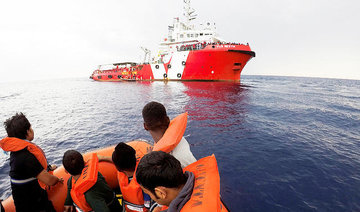
A migrant tries to board a boat of the German NGO Sea-Watch in the Mediterranean Sea on November 6, 2017. Algeria's coast guard has picked up 286 illegal migrants heading across the Mediterranean to Europe by boat, the Defense Ministry said on Sunday, Nov. 19, 2017. (AFP / Alessio Paduano)
Updated 19 November 2017
Follow

Algeria stops almost 300 would-be migrants at sea

ALGIERS: Algeria’s coast guard has intercepted almost 300 Algerians off the North African nation’s coast as they tried to reach Europe on several boats, the Defense Ministry said.
From Thursday to Saturday, the coast guard “intercepted and rescued a total of 286 Algerian citizens” attempting the perilous crossing on flimsy vessels, it said in a statement.
Media reports said 200 of the Algerians were stopped at sea off the western coastal city of Oran.
A 2009 law provides for up to six months in jail for those who attempt to leave the Algerian territory illegally. People smugglers can face up to 20 years in jail, according to the law. But the law has done little to deter would-be migrants.
According to press reports, the Italian coast guard stopped 165 Algerian migrants to the south of Sardinia in late September.
Apart from the migrant crisis, the country is also facing a growing threat from radical elements in the region.
On Wednesday, Algerian Foreign Minister Abdelkader Messahel said that North Africa is under threat from foreign fighters escaping Daesh’s defeats in Iraq and Syria.
Messahel spoke at a news conference in Cairo after a meeting with his Egyptian and Tunisian counterparts, Sameh Shoukry and Khemaies Jhinaoui, over Libya.
“The region is threatened... with the return of foreign fighters,” said Messahel. “The signs and reports say the return will be in our region.”
The ministers also met to discuss Libya in February in Tunisia and again in June in Algeria, as the three countries push for a solution in Libya.
The priority is “preserving Libya’s unity and stability and territorial integrity, and maintaining dialogue and Libyan political agreement as the sole basis for settling the Libyan crisis,” Egypt’s Foreign Ministry said in a statement.
Libya has been rocked by chaos since the 2011 fall and killing of former Muammar Qaddafi, with rival administrations and militias vying for power.
Militants, arms dealers and people traffickers have since taken advantage of the chaos to gain a foothold in the oil-rich North African country.
“What is happening in Libya threatens its security and stability and it has become a refuge for a number of terrorist groups,” Tunisia’s Jhinaoui said.


UN force says Israeli tank fired near peacekeepers in Lebanon

Updated 5 sec ago
Follow

UN force says Israeli tank fired near peacekeepers in Lebanon

  • Under the November 2024 truce, Israel was to withdraw its forces from southern Lebanon, but it has kept them in five areas it deems strategic and carries out regular strikes on Lebanon, usually saying it is targeting Hezbollah sites and operatives

BEIRUT: The UN Interim Force in Lebanon said an Israeli tank fired near its peacekeepers on Monday, and warned that such attacks were becoming “disturbingly common.”
UNIFIL has repeatedly reported Israeli fire near or toward its personnel in recent months, and less than two weeks ago, said gunfire from an Israeli position hit close to peacekeepers twice.
“UNIFIL peacekeepers observed two Merkava tanks move” from an Israeli army position inside Lebanese territory “further into Lebanon” on Monday, the force said in a statement.
UNIFIL has acted as a buffer between Israel and Lebanon for decades, and recently has been working with Lebanon’s army to support a year-old ceasefire between Israel and Hezbollah.
Under the November 2024 truce, Israel was to withdraw its forces from southern Lebanon, but it has kept them in five areas it deems strategic and carries out regular strikes on Lebanon, usually saying it is targeting Hezbollah sites and operatives.
“The peacekeepers requested through liaison channels that the tanks stop their activity,” the statement said.
Later, “one of the tanks fired three shells from its main gun, with two impacts approximately 150 meters away from the peacekeepers,” UNIFIL said, adding that “as the peacekeepers moved away for safety, they were continuously tracked with a laser from the tanks.”
The statement reported no casualties but noted UNIFIL had informed the Israeli army of its activities in the area in advance.
“Attacks like these on identifiable peacekeepers ... are becoming disturbingly common,” the statement said, urging a stop to such incidents.
It called them “a serious violation” of UN Security Council Resolution 1701, which ended a 2006 war between Israel and Hezbollah and forms the basis of the current truce.
Under heavy US pressure and fears of expanded Israeli strikes, Beirut has committed to disarming Hezbollah, and last week, Lebanon’s army said it had finished doing so in the area near the border.
UNIFIL’s final mandate ends this year, and the force is to leave Lebanon in 2027.