

Ruling party sets meeting to discuss Mugabe's exit; elated Zimbabweans celebrate

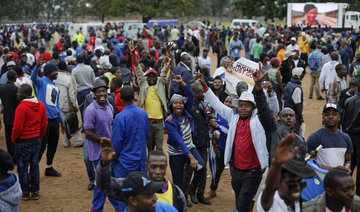
Zimbabweans hold an anti-Grace Mugabe placard during a demonstration demanding the resignation of Robert Mugabe as president on November 18, 2017 in Harare. (AFP / ZINYANGE AUNTONY)
Updated 18 November 2017
Follow

Ruling party sets meeting to discuss Mugabe's exit; elated Zimbabweans celebrate

HARARE: Tens of thousands of overjoyed protesters flooded Zimbabwe’s streets Saturday celebrating the crumbling of President Robert Mugabe’s ruthless regime, which had controlled the country for nearly 40 years.
In scenes of public euphoria not seen since independence in 1980, huge crowds marched, danced and sang their way through the capital Harare and other cities, demanding that Mugabe, 93, finally step down.
Following the mass demonstrations, sources in the ruling ZANU-PF party confirmed to AFP that they would hold a crisis summit on Sunday to discuss removing Mugabe as president and party leader.
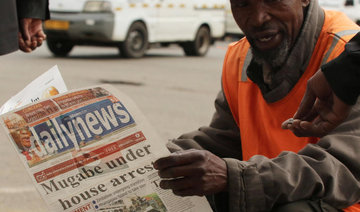
The huge turnout came after an unprecedented week in which the military seized power and put Mugabe under house arrest in response to his sacking of vice president Emmerson Mnangagwa.
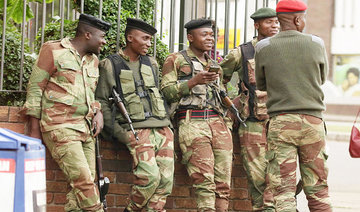
The marches were peaceful, despite a tense stand-off as heavily armed soldiers barred thousands of protesters from reaching Mugabe’s official residence, the State House, in central Harare.

'Best day of my life'
The crowd got within 200 meters (220 yards) of the gates to the complex that has been the nerve center of Mugabe’s authoritarian rule before staging a sit-down protest.
Saturday’s demonstrations, which began to draw down after 1530 GMT, were called by independence war veterans to thank the military, but soon spread to include citizens of all ages, jubilant that Mugabe appeared to be on his way out.
“This is the best day of my life. We are hoping for a new life after Mugabe,” said 38-year-old Sam Sechete at the main rally in Highfield, a working-class suburb of Harare.
A symbolic location, Highfield was where Mugabe gave his first speech after returning from exile in Mozambique ahead of independence in 1980.
Demonstrators, who began arriving around midnight, roared, whistled and chanted, brandishing placards proclaiming: “Not coup — but cool” and “Mugabe must go!“
In central Harare, a group of young men tore down a green metal street sign bearing Robert Mugabe’s name and smashed it repeatedly on the road before trampling it underfoot.
Other groups of protesters headed toward Mugabe’s private Blue Roof residence in the upscale suburb of Borrowdale, where he was initially held under house arrest following the army’s seizure of power.


Major General Sibusiso Moyo, whose faltering delivery of an army statement on state TV marked the completion of the take-over on Wednesday, told journalists at the protests “the people of Zimbabwe are disciplined, orderly and they are unified.”
In Bulawayo, the country’s second-largest city, demonstrators sounded car horns, whistled and blew vuvuzelas as they gathered outside City Hall.

'Violent suppression, economic collapse'
Such an open display of defiance would have been unthinkable just a week ago as dissent was routinely crushed by security forces.
But in a statement released on Friday, the army said it fully supported the protests.
The majority of Zimbabweans have only known life under Mugabe’s rule, which has been defined by violent suppression, economic collapse and international isolation.
“I went to university but here I am selling bananas to earn a living. If it wasn’t for Mugabe, I would be doing something else,” said one protester, street vendor Abel Kapodogo, 34.
Protesters were also cheering soldiers and stopping to shake their hands.
Mugabe enraged many Zimbabweans when he did not resign following talks with the army’s leaders on Thursday, with sources suggesting he was “buying time” to negotiate a favorable end to his 37-year reign.
He appeared publicly for the first time on Friday for a slated appearance at a graduation ceremony in Harare, further stoking speculation about his talks with General Constantino Chiwenga, who led the military power grab.


Later on Friday, eight of the 10 regional branches of Mugabe’s ruling ZANU-PF took to state television to call for him to go — yet another serious blow to his authority.
“Yes we are meeting (Sunday) to endorse the decisions of the nine provinces,” said a national party official who confirmed that a further region had called on Mugabe to go since Friday night’s announcement.
A government MP, who also requested anonymity, confirmed that the party’s executive committee would meet on Sunday to discuss Mugabe’s future.
It is unclear whether the body has the power to force Mugabe out, but a resolution to remove his as party leader and head of state would heap pressure on the already embattled nonogenarian.
Zimbabwe’s military chiefs, meanwhile, have said their operation to round up “criminals” in Mugabe’s government was continuing.

Ambitious wife
The army seizure of power appeared to be the climax of a dispute over who would succeed the veteran leader.
Before being pushed out as vice president, Mnangagwa had clashed repeatedly with Mugabe’s wife Grace, 52.
Both had been seen as leading contenders to replace Mugabe, but Mnangagwa had the tacit support of the armed forces, which viewed Grace — a political novice — with derision.
The international community including the African Union, Britain and the United States has called for Zimbabwe’s army to quickly relinquish power.
Starmer and Xi call for deeper UK-China ties as Trump shakes up global relations

Updated 3 sec ago
Follow

Starmer and Xi call for deeper UK-China ties as Trump shakes up global relations

  • Neither Prime Minister Keir Starmer nor President Xi Jinping publicly mentioned Donald Trump
  • But the US president’s challenge to the post-Cold War order was clearly on their minds

BEIJING: The leaders of Britain and China called Thursday for a “strategic partnership” to deepen ties between their nations at a time of growing global turbulence as they sought to thaw relations after years of chill.

Neither Prime Minister Keir Starmer nor President Xi Jinping publicly mentioned Donald Trump, but the US president’s challenge to the post-Cold War order was clearly on their minds.

“I think that working together on issues like climate change, global stability during challenging times for the world is precisely what we should be doing as we build this relationship in the way that I’ve described,” Starmer told Xi at the start of their meeting in Beijing.

The two met for 80 minutes — double the scheduled time — in the Great Hall of the People as their nations try to improve relations after several years of acrimony. Relations have deteriorated over allegations of Chinese spying in Britain, China’s support for Russia in the Ukraine war and the crackdown on freedoms in Hong Kong, the former British colony that was returned to China in 1997. Starmer is the first British prime minister to visit in eight years.

Xi said that “China-UK relations experienced twists and turns in previous years, which was not in the interests of either country.”

“In the current turbulent and ever-changing international situation ... China and the UK need to strengthen dialogue and cooperation to maintain world peace and stability,” he said.

Chinese state broadcaster CCTV said Xi had stressed, without mentioning the US directly, that “major powers” must adhere to international law or the world would regress into a “jungle.”

Relationship is in ‘a good place’

Starmer’s Downing Street office said Britain wanted “a consistent, long-term, and strategic partnership that will benefit both countries.”

After the meeting, Starmer said the leaders had made “really good progress” on issues including slashing Chinese tariffs on Scotch whisky and introducing visa-free travel for British visitors.

“The relationship is in a good place, a strong place,” the British leader said.

Xi appeared to acknowledge the criticism that Starmer has faced for reaching out to China despite national security and human rights concerns. The UK recently approved controversial plans for a huge Chinese Embassy in London, removing a sticking point in relations but also overriding fears that the “mega-embassy” would make it easier for China to conduct espionage and intimidate dissidents.

“Good things often come with difficulties,” Xi said. “As long as it is the right thing to do in accordance with the fundamental interests of the country and its people, leaders will not shy away from difficulties and will forge ahead bravely.”

Starmer’s visit comes less than two months after a Hong Kong court convicted Jimmy Lai, a former newspaper publisher and British citizen, under a national security law that Beijing imposed on the territory after massive pro-democracy protests in 2019.

Starmer said he raised human rights issues with Xi and the two men had a “respectful discussion.”

Starmer, who was elected in July 2024, has said he will protect national security while keeping up diplomatic dialogue and economic cooperation with China. He told Xi that it has “been far too long” since a UK prime minister visited.

“I made a promise 18 months ago when we were elected into government, that I would make Britain face outward again,” the leader of the center-left Labour Party said. “Because as we all know, events abroad affect everything that happens back in our home countries, from prices on the supermarket shelves to how secure we feel.”

Starmer’s government has struggled to deliver the economic growth it promised and ease a cost-of-living crisis for millions of households and he sees China as a potential source of growth.

More than 50 UK business executives have joined him on the trip, along with the leaders of major cultural organizations, as he seeks to expand opportunities for British companies in China and secure Chinese investment in the UK

Trump tariffs spur new trade talks

The disruption to global trade under Trump has made expanding trade and investment more imperative for many governments. Vietnam and the European Union upgraded ties to a comprehensive strategic partnership Thursday, two days after the EU and India announced a free trade accord.

“At a moment when the international rules-based order is under threat from multiple sides, we need to stand side by side as reliable and predictable partners,” European Council President Antonio Costa said in Hanoi, Vietnam.

Starmer is the fourth leader of a US ally to visit Beijing this month, following those of South Korea, Canada and Finland. The German chancellor is expected to visit next month.

The UK leader also met Thursday with Zhao Leji, the chairman of China’s legislature, the National People’s Congress, and Premier Li Qiang, who told Starmer his efforts to improve relations had been “widely welcomed” in both countries.

The two countries were expected to sign a number of agreements. One will try to disrupt the trade in Chinese boat engines used by smugglers to bring people across the English Channel to Britain. More than half the engines come from China, the British government said. Under the agreement, U.K law enforcement agencies will work with Chinese authorities and manufacturers to prevent engines from ending up in the hands of criminal gangs.