HAWTHORNE, California: Tesla on Thursday unveiled a prototype electric big-rig truck, throwing itself into a new market even as it struggles to roll out an affordable sedan on which the company’s future depends.
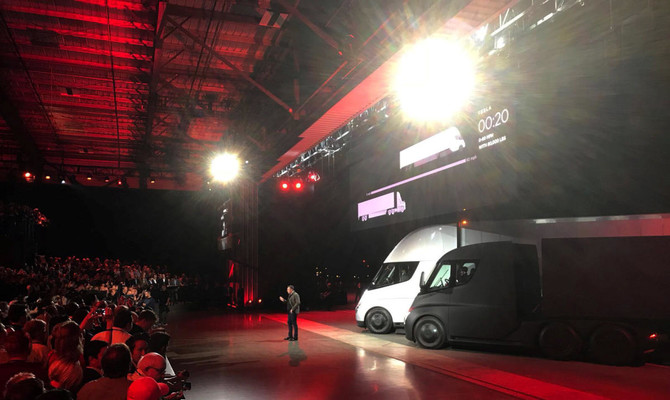
Chief Executive Elon Musk unveiled the big rig, dubbed the Tesla Semi, by riding the truck into an airport hangar near Los Angeles in front of an invited crowd of what Tesla said were potential truck buyers and Tesla car owners.
Musk has described electric trucks as Tesla’s next effort to move the economy away from fossil fuels through projects including electric cars, solar roofs and power storage.
Some analysts fear the truck will be an expensive distraction for Tesla, which is burning cash, has never posted an annual profit, and is in self-described “manufacturing hell” starting up production of the $35,000 Model 3 sedan.
Tesla also has to convince the trucking community that it can build an affordable electric big rig with the range and cargo capacity to compete with relatively low-cost, time-tested diesel trucks. The heavy batteries eat into the weight of cargo an electric truck can haul.
The truck can go up to 500 miles (800 km) at maximum weight at highway speed, Musk said.
Diesel trucks are capable of traveling up to 1,000 miles (1,600 km) on a single tank of fuel.
The Tesla Semi can also go from 0 to 60 miles per hour (100 km per hour) in five seconds without cargo or reach 60 mph in 20 seconds at the maximum weight allowed on US highways of 80,000 pounds (36,300 kg).
“I can drive this thing and I have no idea how to drive a semi,” Musk joked.
Ahead of the unveiling, Tesla executives showed off the Class 8 truck to journalists, describing it as “trailer agnostic,” or capable of hauling any type of freight. Class 8 is the heaviest weight classification on trucks.
The day cab — which is not a sleeper — has a less prominent nose than on a classic truck, and the battery is built into the chassis. It has four motors, one for each rear wheel. Tesla designed the cab with a roomy feel and a center seat for better visibility, executives said. Two touch screens flank the driver.
The truck has Tesla’s latest semi-autonomous driving system, designed to keep a vehicle in its lane without drifting, change lanes on command, and transition from one freeway to another with no human intervention. Reuters reported in August that Tesla was discussing self-driving trucks with regulators in Nevada and California, but the company did not mention full autonomy in a release on the new vehicle.
Old Dominion Freight Line Inc, the fourth-largest US less-than-truckload carrier, which consolidates smaller freight loads onto a single truck, said it would not use the Tesla truck.
“We met with Tesla and at this time we do not see a fit with their product and our fleet,” Dave Bates, senior vice president of operations, said in an email, without elaborating.
Earlier this week Musk tweeted that the truck would “blow your mind clear out of your skull,” joking, “It can transform into a robot, fight aliens and make one hell of a latte.”
Tesla faces a much more crowded field for electric trucks than it did when it introduced its electric cars.
Manufacturers such as Daimler AG, Navistar International Corp. and Volkswagen AG are joining a host of start-ups racing to overcome the challenges of substituting batteries for diesel engines as regulators crack down on carbon dioxide and soot pollution.
Still, manufacturers are mostly focused on medium-duty trucks, not the heavy big rig market Tesla is after.
Tesla would need to invest substantially to create a factory for those trucks. The company is currently spending about $1 billion per quarter, largely to set up the Model 3 factory, and is contemplating a factory in China to build cars.
Charging and maintaining electric trucks that crisscross the country could be expensive and complex.
Tesla said the truck can charge 30 minutes and then travel 400 miles.


![]()
Tesla unveils electric big-rig truck in midst of Model 3 factory ‘hell’
Tesla unveils electric big-rig truck in midst of Model 3 factory ‘hell’
Latest updates





Recommended


© 2026 SAUDI RESEARCH & PUBLISHING COMPANY, All Rights Reserved And subject to Terms of Use Agreement.