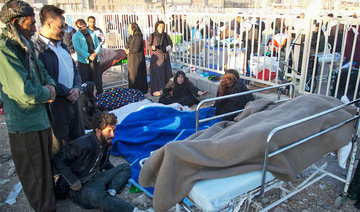
KOUIK: Iranian survivors of a powerful earthquake that killed more than 400 people pleaded Wednesday for water, tents and other emergency supplies as aid trickled into remote villages near the Iraqi border.
The government ordered rescuers to keep searching for people trapped under the rubble following the 7.3-magnitude quake which struck the mountainous region late Sunday, toppling buildings and leaving thousands homeless.
At least 432 people were killed in Iran, all in the western province of Kermanshah, and eight in Iraq, according to authorities in the two countries.
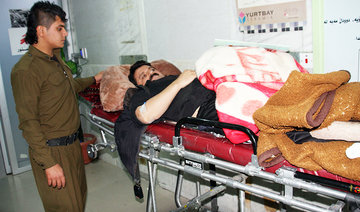
In total, nearly 8,200 people were reported to have been injured.
In villages north of the badly hit city of Sar-e Pol-e Zahab, a convoy of about 20 ambulances arrived with medicine while Red Crescent teams brought tents, water, food, and blankets.
But much of the assistance came from ordinary Iranians, some of whom traveled more than 100 km from a neighboring province.
“God bless them!” resident Abdol Gaderi, 45, said of the volunteers, but “we need running water, electricity, and mobile toilets.”
Villagers voiced fears of disease breaking out because of the corpses of animals under the rubble.
In Ghaleh Bahadori, where around 30 Red Crescent tents had been provided, residents pleaded for more help.
“This is not enough,” said Tooraj Mohammadi, adding that most families in the village had been left homeless.
“Thirty people died here. We buried them ourselves in coordination with the police,” he said.
In Iran alone, the quake is estimated to have caused damage of 26,000 billion Iranian rials (about $6.3 billion), Kermanshah provincial Deputy Gov. Mojtaba Nikkerdar said, quoted by the ISNA news agency.
That is equivalent to about 1.5 percent of the Iranian gross domestic product (GDP) which the International Monetary Fund (IMF) has forecast for 2017.
In total, about 30,000 homes were damaged or destroyed, according to the Iranian authorities.
Severe damage to social housing blocks in Sar-e Pol-e Zahab built under a scheme championed by former President Mahmoud Ahmadinejad sparked indignation on social media.
President Hassan Rouhani said those responsible would be held to account.
“The fact that houses built by individuals ... are intact while buildings erected by the state are seriously damaged shows that there has been corruption,” he said, according to his official website.
Speaking a day earlier on the same subject, Rouhani had said that it was necessary to “look for the guilty parties and present them to the population.”
Interior Minister Abdolreza Rahmani Fazli told lawmakers that the authorities had sent 36,000 tents and another 10,000 would follow for families too fearful of aftershocks to sleep in their own homes, ISNA reported.
While residents, particularly in Kouik, complained emergency aid was being stolen by people from outside the region, the minister said there was “no particular problem of public security” in the quake-hit regions.
The Cabinet approved a series of measures including interest-free loans and donations to affected households to replace their destroyed furniture or other belongings.
On Tuesday, Iran marked a day of mourning, with a black banner adorning the corner of images of the disaster broadcast by state television.
Israel offered aid for the quake victims, with Prime Minister Benjamin Netanyahu insisting his country has “no quarrel with the people of Iran.”
Iran sees frequent seismic activity.


![]()

Aid slow to reach quake-hit Iranian villages
Aid slow to reach quake-hit Iranian villages

Latest updates




© 2026 SAUDI RESEARCH & PUBLISHING COMPANY, All Rights Reserved And subject to Terms of Use Agreement.