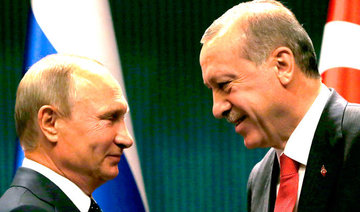
ANKARA: Turkish President Recep Tayyip Erdogan and his Russian counterpart Vladimir Putin held a closed meeting on Tuesday for about four hours, with a focus on deepening their relations and the latest developments in Syria.
It was the sixth time the two leaders had met, and this year Erdogan visited Russia three times.
“Turkey and Russia agreed that grounds have emerged for political resolution in Syria,” Erdogan said during a joint press conference at the presidential residence in Russia’s Black Sea coastal city of Sochi.
Parallel to UN-backed negotiations in Geneva, Turkey, Russia and Iran are the guarantor countries of the Astana deal, and have begun implementing “de-escalation zones” and cease-fire monitoring missions in northern Syria.
During the press conference, Putin said the meetings with Turkey about the Syrian crisis had contributed to decreasing the level of violence.
But before departing for his meeting with Putin, Erdogan criticized a consensus between the Russian and US presidents that “no military solution is possible” in Syria.
“I’m having difficulty understanding these comments. If a military solution is out of the question, then those who say this should pull their troops out,” Erdogan said.
“If a military method isn’t a solution, one should apply to the political method and find ways to go to elections as soon as possible.”
At the end of the meeting, Putin and Erdogan agreed to focus on a political solution.
Nursin Atesoglu Guney, dean of the faculty of economics, administrative and social sciences at Bahcesehir Cyprus University, told Arab News: “During this meeting, both leaders showed a willingness to continue their… partnership in Syria.”
She said: “Russia would like to balance the US weight in the region... Ankara also wants to play a delicate balancing game regarding the big actors in the region, because Syria is currently at the epicenter of global fault lines.”
A point of contention between Moscow and Ankara is the participation of the Kurdish-led Democratic Union Party (PYD) in the Russia-sponsored Syrian Congress on National Dialogue.
No statement was made about it during the press conference, though Moscow recently denied Turkish claims that the Congress had been postponed.
Ankara strongly objects to inviting the PYD, and experts do not expect the issue to be resolved soon.
Moscow does not consider the PYD a terrorist group, and is trying to give it a diplomatic platform.
But Ankara sees it as an extension of the Kurdistan Workers’ Party (PKK), which is designated a terrorist organization by Turkey, the US and EU. Ankara vetoed the PYD’s participation in previous peace talks on Syria.
Emre Ersen, a Syria analyst at Marmara University in Istanbul, said although Moscow views Ankara as a very important regional actor in resolving the Syrian crisis, it believes the PYD and its military wing, the People’s Protection Units (YPG), can play a significant role in Syria’s political future.
“Considering the close political and military ties between the PYD/YPG and Washington, it’s important for Moscow to use its developing relations with the PYD/YPG as a potential card at its disposal vis-a-vis the US,” Ersen told Arab News.
Ankara has expressed concerns over military links between Russia and the PYD/YPG in the Afrin region of Syria, he said.
The main motive for Turkey in cooperating with Russia and Iran in the de-escalation zone in Idlib province is the expectation that this cooperation can be extended to Afrin, in which Ankara has stated its intention to launch a military operation against the PYD/YPG, he added.
“At the same time, however, Ankara and Tehran are closely watching Moscow’s dealings with Washington,” Ersen said.
“As indicated by the latest meeting between the Russian and US presidents, the agenda of the two global powers differs significantly from that of the regional powers,” he added.
“Since both Washington and Moscow enjoy close relations with the PYD/YPG, Ankara’s reservations on this issue can be ignored, which might be detrimental to Turkey’s interests in Syria.”


![]()
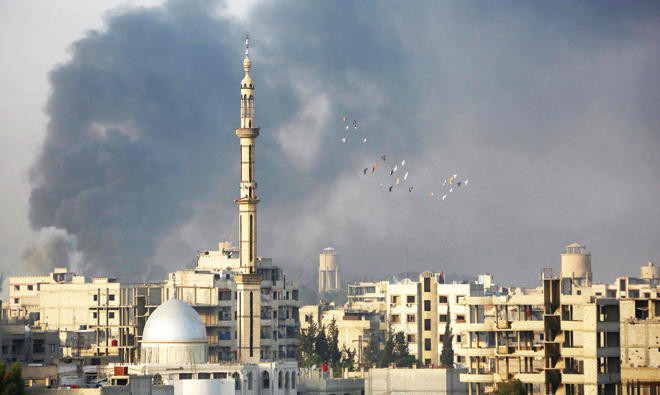
Turkey, Russia cooperate in Syria despite differences
Turkey, Russia cooperate in Syria despite differences
Latest updates


© 2026 SAUDI RESEARCH & PUBLISHING COMPANY, All Rights Reserved And subject to Terms of Use Agreement.