Rubio plans to update Netanyahu on US-Iran talks in Israel next week, officials say

Iran has agreed to draw up a written proposal to address US concerns that were raised during this week’s Geneva talks. (FILE/AFP)
Short Url
Updated 19 February 2026
Follow

Rubio plans to update Netanyahu on US-Iran talks in Israel next week, officials say

  • Trump is weighing whether to take military action against Tehran as the administration surges military resources to the region
  • Dozens of US fighter jets, including F-35s, F-22s and F-16s, have left bases in the US and Europe in recent days to head to the Middle East

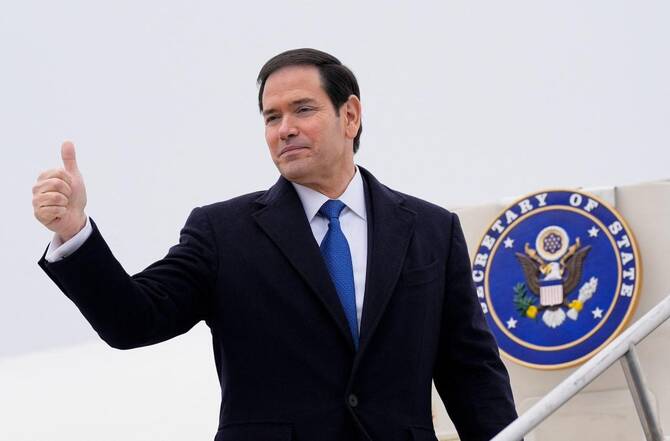
WASHINGTON: Secretary of State Marco Rubio plans to travel to Israel next week to update Israeli Prime Minister Benjamin Netanyahu on the US-Iran nuclear talks, two Trump administration officials said.
Rubio is expected to meet with Netanyahu on Feb. 28, according to the officials, who spoke Wednesday on condition of anonymity to detail travel plans that have not yet been announced.
The US and Iran recently have held two rounds of indirect talks over the Islamic Republic’s nuclear program.
Iran has agreed to draw up a written proposal to address US concerns that were raised during this week’s Geneva talks, according to another senior US official who was not authorized to comment publicly and spoke on the condition of anonymity.
That official said top national security officials gathered Wednesday in the White House Situation Room to discuss Iran, and were briefed that the “full forces” needed to carry out potential military action are expected to be in place by mid-March. The official did not provide a timeline for when Iran is expected to deliver its written response.
Officials from both the US and Iran had publicly offered some muted optimism about progress this week, with Iranian Foreign Minister Abbas Araghchi even saying that “a new window has opened” for reaching an agreement.
“In some ways, it went well,” US Vice President JD Vance said about the talks in an interview Tuesday with Fox News Channel. “But in other ways, it was very clear that the president has set some red lines that the Iranians are not yet willing to actually acknowledge and work through.”
Netanyahu visited the White House last week to urge President Donald Trump to ensure that any deal about Iran’s nuclear program also include steps to neutralize Iran’s ballistic missile program and end its funding for proxy groups such as Hamas and Hezbollah.
Trump is weighing whether to take military action against Tehran as the administration surges military resources to the region, raising concerns that any attack could spiral into a larger conflict in the Middle East.
On Friday, Trump told reporters that a change in power in Iran “seems like that would be the best thing that could happen.” He added, “For 47 years, they’ve been talking and talking and talking.”
The Trump administration has dispatched the USS Gerald R. Ford, the world’s largest aircraft carrier, from the Caribbean Sea to the Mideast to join a second carrier as well as other warships and military assets that the US has built up in the region.
Dozens of US fighter jets, including F-35s, F-22s and F-16s, have left bases in the US and Europe in recent days to head to the Middle East, according to the Military Air Tracking Alliance, a team of about 30 open-source analysts that routinely analyzes military and government flight activity.
The team says it’s also tracked more than 85 fuel tankers and over 170 cargo planes heading into the region.
Steffan Watkins, a researcher based in Canada and a member of the MATA, said he also has spotted support aircraft like six of the military’s early-warning E-3 aircraft head to a base in Saudi Arabia.
Those aircraft are key for coordinating operations with a large number of aircraft. He says they were pulled from bases in Japan, Germany and Hawaii.


Battered by Gaza war, Israel’s tech sector in recovery mode

Updated 21 February 2026
Follow

Battered by Gaza war, Israel’s tech sector in recovery mode

  • “High-tech companies had to overcome massive staffing cuts, because 15 to 20 percent of employees, and sometimes more, were called up” to the front as reservists, IIA director Dror Bin told

JERUSALEM: Israel’s vital tech sector, dragged down by the war in Gaza, is showing early signs of recovery, buoyed by a surge in defense innovation and fresh investment momentum.
Cutting-edge technologies represent 17 percent of the country’s GDP, 11.5 percent of jobs and 57 percent of exports, according to the latest available data from the Israel Innovation Authority (IIA), published in September 2025.
But like the rest of the economy, the sector was not spared the knock-on effects of the war, which began in October 2023 and led to staffing shortages and skittishness from would-be backers.
Now, with a ceasefire largely holding in Gaza since October, Israel’s appeal is gradually returning, as illustrated in mid-December, when US chip giant Nvidia announced it would create a massive research and development center in the north that could host up to 10,000 employees.
“Investors are coming to Israel nonstop,” Prime Minister Benjamin Netanyahu said at the time.
After the war, the recovery can’t come soon enough.
“High-tech companies had to overcome massive staffing cuts, because 15 to 20 percent of employees, and sometimes more, were called up” to the front as reservists, IIA director Dror Bin told AFP.
To make matters worse, in late 2023 and 2024, “air traffic, a crucial element of this globalized sector, was suspended, and foreign investors froze everything while waiting to see what would happen,” he added.
The war also sparked a brain drain in Israel.
Between October 2023 and July 2024, about 8,300 employees in advanced technologies left the country for a year or more, according to an IIA report published in April 2025.
The figure represents around 2.1 percent of the sector’s workforce.
The report did not specify how many employees left Israel to work for foreign companies versus Israeli firms based abroad, or how many have since returned to Israel.

- Rise in defense startups -

In 2023, the tech sector far outpaced GDP growth, increasing by 13.7 percent compared to 1.8 percent for GDP.
But the sector’s output stagnated in 2024 and 2025, according to IIA figures.
Industry professionals now believe the industry is turning a corner.
Israeli high-tech companies raised $15.6 billion in private funding in 2025, up from $12.2 billion in 2024, according to preliminary figures published in December by Startup Nation Central (SNC), a non-profit organization that promotes Israeli innovation.
Deep tech — innovation based on major scientific or engineering advances such as artificial intelligence, biotech and quantum computing — returned in 2025 to its pre-2021 levels, according to the IIA.
The year 2021 is considered a historic peak for Israeli tech.
The past two years have also seen a surge in Israeli defense technologies, with the military engaged on several fronts from Lebanon and Syria to Iran, Yemen, Gaza and the occupied West Bank.
Between July 2024 and April 2025, the number of startups in the defense sector nearly doubled, from 160 to 312, according to SNC.
Of the more than 300 emerging companies collaborating with the research and development department of Israel’s defense ministry, “over 130 joined our operations during the war,” Director General Amir Baram said in December.
Until then, the ministry had primarily sourced from Israel’s large defense firms, said Menahem Landau, head of Caveret Ventures, a defense tech investment company.
But he said the war pushed the ministry “to accept products that were not necessarily fully finished and tested, coming from startups.”
“Defense-related technologies have replaced cybersecurity as the most in-demand high-tech sector,” the reserve lieutenant colonel explained.
“Not only in Israel but worldwide, due to the war between Russia and Ukraine and tensions with China.”