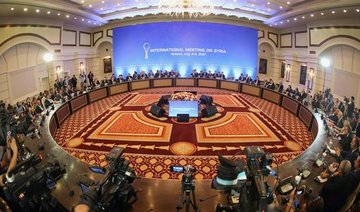
ANKARA: Turkey’s objections to Russia’s decision to invite Syria’s main Kurdish political party to the proposed peace-talk congress scheduled for Nov. 18 in Sochi has led to the congress’ postponement. Russia has also reportedly ceded to Turkey’s demands that the Kurdish-led Democratic Union Party (PYD), and its armed affiliate, People’s Protection Units (YPG), take no part in the congress.
Turkey sees the PYD as an offshoot of the Kurdistan Workers Party, which it views as a terrorist organization for its decades-long insurgency in Turkey and Iraq.
Turkey’s presidential spokesperson Ibrahim Kalin announced on Sunday in an interview with Turkish broadcaster NTV that Turkey may send an observer to the talks as well.
“It’s not certain yet. But what Russia has informed us is that the meeting has been postponed and the PYD will not be invited,” he said.
Russia, Turkey and Iran are the three guarantor countries of the Russian-led Syria peace talks which have been running in tandem with UN-led peace talks in Geneva.
Oytun Orhan, an expert on Syria at Ankara-based think tank ORSAM, believes Iran and Syria may also have voiced concerns about the PYD taking part in the congress.
“As the fight with Daesh in Syria is approaching an end, the visions of Russia and regional countries over Syria’s future are diverging from each other,” Orhan told Arab News.
“Russia supports federalism in Syria, and claims the PYD should be included in the political settlement process. However, federalism is a red line for the three regional countries, and that might have pushed Russia to delay the congress,” he added. “The joint position of Turkey, Iran and Syria on the PYD and federalism might oblige Russia to shift closer to their stances.”
In October, Turkey launched a military operation in Syria’s Idlib province, which is largely controlled by HTS, a former Al-Qaeda affiliate. Turkish military set up observation points in Idlib under the Astana deal, brokered with Russia and Iran.
Turkey is desperate to ensure that its border with Syria — which runs from Afrin, next to Idlib, to the Mediterranean — is free from threats. Afrin is currently under the control of Kurdish YPG forces. And Russia currently has observer forces deployed in Afrin to ensure security.
Orhan says this situation could also be the cause of tension between Turkey and Russia.
“Turkey expects Russia to lift its protection over the YPG in Afrin, while Russia doesn’t wish to withdraw its support of Syrian Kurdish militias until Idlib is completely free of radical elements,” he said.
Russia, though, needs Turkish support on the ground to stabilize the situation in Idlib province, where the threat of attacks by militant groups still exists.
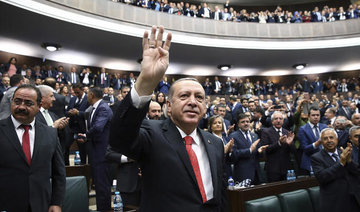
Turkish President Recep Tayyip Erdogan will travel to Russia on Nov. 13, and is expected to meet his counterpart Vladimir Putin.
“Before this meeting, both parties can take steps to strengthen their bargaining power,” Orhan said. “However, as their mutual needs continue, they will have to abstain from taking steps that would end their cooperation.”

Turkish pressure sees Russia rescind PYD’s invitation to Syria talks
Sudan defense minister dismisses ‘intelligence document’ as fabrication after convoy strike
- Gen. Hassan Kabroun tells Arab News claims that army hid weapons in aid convoy are “completely false”
RIYADH: Sudan’s defense minister has firmly denied reports attributed to Sudanese intelligence alleging that a convoy targeted in North Kordofan was secretly transporting weapons under the cover of humanitarian aid.
Gen. Hassan Kabroun described the claims as “false” and an attempt to distract from what he called a militia crime.
The controversy erupted after news reports emerged that a document attributed to Sudan’s General Intelligence Service claimed the convoy struck in Al-Rahad on Friday was not a purely humanitarian mission, but was instead carrying “high-quality weapons and ammunition” destined for Sudanese Armed Forces units operating in the state.
The report further alleged that the convoy had been outwardly classified as humanitarian in order to secure safe passage through conflict zones, and that the Rapid Support Forces had destroyed it after gathering intelligence on its route and cargo.
Kabroun categorically rejected the narrative.
“First of all, we would like to stress the fact that this news is false,” he told Arab News. “Even the headline that talks about the security of the regions, such as Al-Dabbah, is not a headline the army would use.”
He described the document as fabricated and politically motivated, saying it was designed to “cover up the heinous crime they committed.”
The minister affirmed that the area targeted by drones is under full control of the Sudanese Armed Forces and does not require any covert military transport.
“Second, we confirm that the region that was targeted by drones is controlled by the army and very safe,” Kabroun said. “It does not require transporting any military equipment using aid convoys as decoys because it is a safe area controlled by the army, which has significant capabilities to transport humanitarian aid.”
According to the minister, the Sudanese military has both the logistical capacity and secure routes necessary to move equipment openly when needed.
“The army is professional and does not need to deliver anything to Kadugli or Dalang on board aid convoys,” he said. “The road between Dalang and Kadugli is open. The Sudanese forces used that road to enter and take control of the region. The road is open and whenever military trucks need to deliver anything, they can do so without resorting to any form of camouflage.”
Kabroun further rejected any suggestion that the military uses humanitarian operations as cover.
“Aid is transported by dedicated relief vehicles to the areas in need of this assistance,” he said. “Aid is not transported by the army. The army and security apparatus do not interfere with relief efforts at all, and do not even accompany the convoys.”
He stressed that the Sudanese Armed Forces maintains a clear institutional separation between military operations and humanitarian work, particularly amid the country’s crisis.
“These are false claims,” he said. “This fake news wanted to cover up the heinous crime they committed.”
Sudan has been gripped by conflict since April 2023, when fighting broke out between the Sudanese Armed Forces and the Rapid Support Forces, plunging the country into what the United Nations has described as one of the world’s worst humanitarian disasters.
The latest dispute over the convoy comes amid intensified fighting in South Kordofan, a strategically sensitive region linking central Sudan with the contested areas of Darfur and Blue Nile.
The false report suggested that intelligence monitoring had enabled the RSF to strike what it described as a military convoy disguised as humanitarian aid. But Kabroun dismissed that version outright.
“The intelligence agency is well aware of its duties,” he said. “The Sudanese Army has enough weapons and equipment to use in the areas of operations. These claims are completely false.”
He argued that the narrative being circulated seeks to shift blame for attacks on civilian infrastructure and humanitarian movements.
“This shows that they are trying to cover up the atrocities,” he added, referring to the militia.
Kabroun maintained that the army has regained momentum on multiple fronts and remains fully capable of sustaining its operations without resorting to deception.
“The region is secure, the roads are open, and the army does not need camouflage,” he said. “We are operating professionally and transparently.”
“These claims are completely false,” Kabroun said. “The Sudanese Army does not use humanitarian convoys for military purposes.”