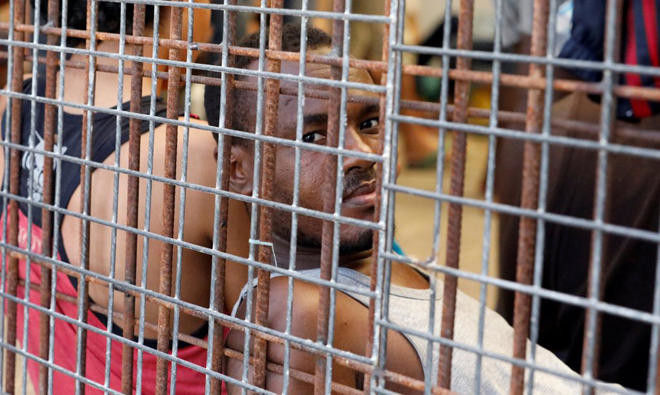
GENEVA: The EU’s policy of helping the Libyan authorities intercept migrants in the Mediterranean and return them to “horrific” prisons in Libya is “inhuman,” the UN said Tuesday.
“The suffering of migrants detained in Libya is an outrage to the conscience of humanity,” the UN human rights chief Zeid Ra’ad Al-Hussein said in a statement.
“The European Union’s policy of assisting the Libyan Coast Guard to intercept and return migrants in the Mediterranean (is) inhuman,” he said.
Chaos-ridden Libya has long been a major transit hub for migrants trying to reach Europe, and many refugees and migrants have fallen prey to serious abuse there at the hands of human traffickers and others.
Zeid warned Tuesday that “the detention system for migrants in Libya is broken beyond repair.”
“The international community cannot continue to turn a blind eye to the unimaginable horrors endured by migrants in Libya, and pretend that the situation can be remedied only by improving conditions in detention.”
Zeid’s comments came after ministers from 13 European and African countries on Monday pledged steps aimed at easing the migrant crisis around the Mediterranean, vowing especially to help improve conditions for migrants held in Libya.
At a meeting in Bern of the contact group on the crisis along the so-called Central Mediterranean migration route, the ministers also reiterated a pledge to strengthen Libya’s coast guard.
Italy, with the support of the EU, has since the summer been training the Libyan coast guard to intercept boat migrants as part of a controversial deal that has sent migrant arrivals to Italy down nearly 70 percent since July.
The UN rights office criticized European countries for ignoring warnings that the deal could condemn more migrants to detention, exposing them to torture, rape, forced labor and extortion.
“Those detained have no possibility to challenge the legality of their detention, and no access to legal aid,” it said.
Zeid called for the decriminalization of irregular migration, insisting that “only alternatives to detention can save migrants’ lives and physical security, preserve their dignity and protect them from further atrocities.”
According to Libya’s Department of Combatting Illegal Migration (DCIM), 19,900 people were being held in facilities under its control in early November, up from about 7,000 in mid-September.
The huge hike came after authorities detained thousands of migrants previously held by smugglers in the Libya’s people-trafficking hub Sabratha, to the west of Tripoli.
“The increasing interventions of the EU and its member states have done nothing so far to reduce the level of abuses suffered by migrants,” Zeid said, adding that instead there appeared to be “a fast deterioration in their situation in Libya.”
He said staff members had visited four DCIM facilities earlier this month and were “shocked” by what they saw.
There were “thousands of emaciated and traumatized men, women and children piled on top of each other, locked up in hangars with no access to the most basic necessities, and stripped of their human dignity,” he said.
Migrants, including children, described horrific beatings by guards at detention centers, while many women said they faced rape and other sexual violence at the hands of smugglers and guards.
One woman told UN staff she was gang-raped by three men, including a DCIM guard, while another woman said four armed men gang-raped her during her journey, when she was pregnant.
“I bled profusely, and I think I lost the baby. I haven’t seen a doctor yet,” she said.
The UN urged Libyan authorities to take concrete steps to halt violations and abuses in the detention centers, and to stop detaining migrants.
“We cannot be a silent witness to modern-day slavery, rape and other sexual violence, and unlawful killings in the name of managing migration and preventing desperate and traumatized people from reaching Europe’s shores,” Zeid said.


![]()
EU-Libya cooperation to stem migrant flow ‘inhuman,’ says UN
EU-Libya cooperation to stem migrant flow ‘inhuman,’ says UN


Latest updates


© 2026 SAUDI RESEARCH & PUBLISHING COMPANY, All Rights Reserved And subject to Terms of Use Agreement.