EU sticks to Libya strategy on migrants, despite human rights concerns

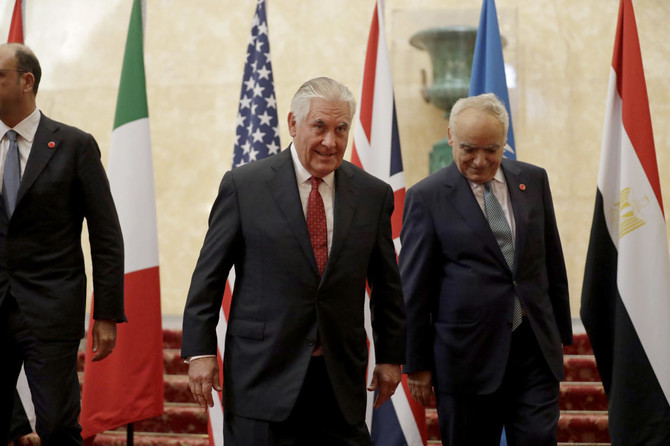
US Secretary of State Rex Tillerson with UN Special Representative Ghassan Salame during their meeting on Libya in London on Thursday. (AP)
Updated 14 September 2017
Follow

EU sticks to Libya strategy on migrants, despite human rights concerns

BRUSSELS: The EU is determined to go on preventing migrants setting off from the coast of Libya, interior ministers said on Thursday, despite criticism from rights advocates who say the strategy is aggravating human suffering.
After more than two years struggling to stem the flow of refugees and migrants from the Middle East and Africa, the EU is cautiously hopeful it is finally in control.
A 2016 deal with Turkey effectively closed one major migratory route and this year Italy has led the EU’s efforts to curb sea crossings from Libya, supplying money, equipment and training for Libya’s border and coast guard and striking deals with local groups in control on the ground in a country still largely lawless after the 2011 death of Muammar Qaddafi.
Mediterranean crossings have dropped from nearly 28,000 people in June to below 10,000 in August, according to UN data. Sources told Reuters late last month a new armed group on Libya’s coast was stopping migrant boats from leaving.
Human rights groups decry the EU’s support for Libya’s Prime Minister Fayez Seraj and allied militias who run migrant detention centers they have compared to concentration camps.
The top UN human rights official said the EU strategy was “very thin on the protection of the human rights of migrants inside Libya and on the boats, and silent on the urgent need for alternatives to the arbitrary detention of vulnerable people.”
To offset that, the bloc has stepped up financing for the UN agencies for migration (IOM) and refugees (UNHCR) to have them try to improve conditions for migrants inside Libya. But it is not changing tack on trying to keep them there.
“If we look at the flows of migrants across the Mediterranean a few months ago and now, the decrease in illegal migration has been big in numbers,” Estonia’s Interior Minister Andres Anvelt said ahead of talks in Brussels with his EU peers.
“We’ll have a discussion about how to have this success story going on.”
Germany’s Thomas de Maiziere told reporters: “I’m happy that the number of people sent across the Mediterranean by the smugglers to Italy has really fallen in the last two months ... These developments need to be carried on.”
“We really need to work to ensure that many people simply do not make the trip across the desert to Libya. The neighborhood policy with Africa is very important for a sustainable decline in migrants coming to Italy.”
After struggling to come up with a strategy on Libya, the EU has increasingly let Italy, Libya’s former colonial power, take the lead.
Interior Minister Marco Minniti has led those efforts, curbing the sea operations of non-governmental aid groups and striking deals with Libyan mayors to fight people-trafficking, among other moves.
Rome has also played a central role in training the Libyan coast guard, which has been accused of abuses, including shooting at aid workers trying to rescue migrants.
The EU has denied that any of its funding goes to the militia in the coastal city of Sabratha, which has often prevented migrants from departing for Europe by locking them up.
But a senior EU diplomat said the EU’s strategy was complex.
“It is hard to know exactly what is going on in Libya. We have increasingly entrusted Italy with doing the job there, we give them money. There would never be any proof of EU money going directly to some armed group somewhere,” the person said.
“Some of the methods may seem controversial. But there is also preventing loss of life at the sea and political stability in Italy to consider. We shouldn’t be too judgmental.”


Israel to partially reopen Gaza’s Rafah crossing

Updated 01 February 2026
Follow

Israel to partially reopen Gaza’s Rafah crossing

  • Reopening comes amid ongoing violence in the Palestinian territory
  • Gaza’s civil defense agency says dozens killed in Israeli attacks on Saturday

RAFAH, Palestinian Territories: Israel is set to partially reopen the Rafah crossing between the war-devastated Gaza Strip and Egypt on Sunday, following months of urging from humanitarian organizations, though access will be limited to the movement of people.

The reopening comes amid ongoing violence in the Palestinian territory, with Gaza’s civil defense agency reporting dozens killed in Israeli attacks on Saturday, while the Israeli military said it was retaliating against ceasefire violations.

The Rafah crossing is a vital gateway for both civilians and aid, but has remained closed since Israeli forces seized control of it in May 2024 during the war with Hamas, aside from a brief and limited reopening in early 2025.

Israel had previously said it would not reopen the crossing until the remains of Ran Gvili — the last Israeli hostage held in Gaza — were returned.

His remains were recovered days ago and he was laid to rest in Israel on Wednesday.

“The Rafah Crossing will open this coming Sunday (February 1st) in both directions, for limited movement of people only,” COGAT, an Israeli defense ministry body overseeing civil affairs in the occupied Palestinian territories, said on Friday.

Entry and exit “will be permitted in coordination with Egypt, following prior security clearance of individuals by Israel, and under the supervision of the European Union mission,” it added.

However, key details remain unclear, including how many people will be allowed to cross and whether those seeking to return to Gaza will be permitted entry.

A source at the border told AFP that Sunday would be largely devoted to preparations and logistical arrangements.

The crossing is set to open on Sunday on a trial basis to allow the passage of wounded individuals, ahead of a regular reopening scheduled for Monday, three sources at the crossing said.

However, no agreement has yet been reached on the number of Palestinians permitted to enter or exit, the sources added, noting that Egypt plans to admit “all Palestinians whom Israel authorizes to leave” the territory.

“Every day that passes drains my life and worsens my condition,” said Mohammed Shamiya, 33, who suffers from kidney disease and requires dialysis treatment abroad.

“I’m waiting every moment for the opening of the Rafah land crossing.”

Anxious wait

Safa Al-Hawajri, who has received a scholarship to study overseas, is also eagerly awaiting the reopening on Sunday.

“I’m waiting in the hope of fulfilling my ambition, which is tied to the reopening of the crossing,” said Hawajri, 18.

“I hope to be able to travel as soon as it opens.”

Located on Gaza’s southern border with Egypt, Rafah is the only crossing into and out of the territory that does not pass through Israel.

The crossing lies in an area held by Israeli forces following their withdrawal behind the so-called “Yellow Line” under the terms of a US-brokered ceasefire that came into effect on October 10.

Israeli troops still control more than half of Gaza, while the rest remains under Hamas authority.

The ceasefire has now entered its second phase and calls for reopening the crossing following the release or return of all Israeli hostages held by Palestinian militants.

Hamas had called for its full reopening in both directions after the remains of Gvili were brought back to Israel.

The reopening is expected to facilitate the entry of a 15-member Palestinian technocratic body, the National Committee for the Administration of Gaza (NCAG), established to oversee the day-to-day governance of the territory’s 2.2 million residents.

The committee is to operate under the supervision of the so-called “Board of Peace” chaired by US President Donald Trump.

The NCAG, headed by former Palestinian Authority deputy minister Ali Shaath, is expected to enter the Gaza Strip once the Rafah crossing reopens.

Violence continued ahead of the crossing’s reopening.

At least 32 people, including children, were killed on Saturday in Israeli air strikes in Gaza, reported the civil defense agency, which operates as a rescue force under the Hamas authority.

Israel’s military said the strikes were retaliation for an incident on Friday in which eight Palestinian fighters exited a tunnel in the city of Rafah, which it said violated the ceasefire.