UNITED NATIONS: North Korea warned Monday that the unprecedented deployment of three US aircraft carrier groups “taking up a strike posture” around the Korean peninsula is making it impossible to predict when nuclear war will break out.
North Korea’s UN Ambassador Ja Song Nam said in a letter to Secretary-General Antonio Gutteres Monday that the joint military exercises with South Korea are creating “the worst ever situation prevailing in and around the Korean peninsula.”
Along with the three carrier groups, he said the US has reactivated round-the-clock sorties with nuclear-capable B-52 strategic bombers “which existed during the Cold War times.”
He also said the US is maintaining “a surprise strike posture with frequent flight of B-1B and B-2 formations to the airspace of South Korea.”
“The large-scale nuclear war exercises and blackmails, which the US staged for a whole year without a break in collaboration with its followers to stifle our republic, make one conclude that the option we have taken was the right one and we should go along the way to the last,” Ja said.
He didn’t elaborate on what “the last” might be, but North Korea has launched ballistic missiles that have the potential to strike the US mainland, and it recently conducted its largest-ever underground nuclear explosion. It has also threatened to explode another nuclear bomb above the Pacific Ocean.
The four-day joint naval exercises by the US and South Korea, which began Saturday in waters off the South’s eastern coast, were described by military officials as a clear warning to North Korea. They involve the carrier battle groups of the USS Ronald Reagan, Theodore Roosevelt and Nimitz, which include 11 US Aegis ships that can track missiles, and seven South Korean naval vessels.
Seoul’s military said in a statement that the exercises aim to enhance the combined US and South Korean operational and aerial strike capabilities and to display “strong will and firm military readiness to defeat any provocation by North Korea with dominant force in the event of crisis.”
According to the US Navy’s 7th Fleet, it is the first time since a 2007 exercise near Guam that three US carrier strike groups are operating together in the Western Pacific.
The military drills come amid US President Donald Trump’s visit to South Korea and Asia, which has been dominated by discussions over the North Korean nuclear threat.
Ja accused the UN Security Council in Monday’s letter of repeatedly “turning a blind eye to the nuclear war exercises of the United States, who is hell bent on bringing a catastrophic disaster to humanity.” He said the exercises raise serious concern about “the double standard” of the UN’s most powerful body.
He also referenced Trump’s September speech to the UN General Assembly in which the president said that if the US is “forced to defend itself or its allies, we will have no choice but to totally destroy North Korea.”
Trump tweeted soon after making the speech that Korea’s leadership “won’t be around much longer” if it continued its provocations, a declaration that led the North’s foreign minister to assert that Trump had “declared war on our country.”
Ja said Monday the US “is now running amok for war exercises by introducing nuclear war equipment in and around the Korean peninsula, thereby proving that the US itself is the major offender of the escalation of tension and undermining of the peace.”
Ja asked Guterres to circulate the letter to the Security Council and the General Assembly, and also asked him to use his power under Article 99 of the UN Charter to bring to the Security Council’s attention “the danger being posed by the US nuclear war exercises which are clearly threats to international peace and security.”


![]()
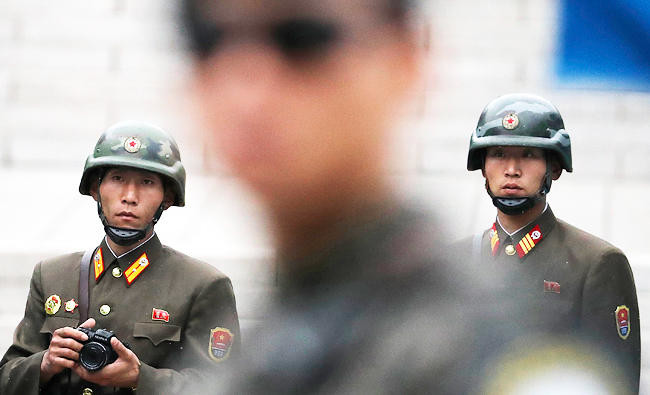
North Korea says US carrier groups raise nuclear war threat
North Korea says US carrier groups raise nuclear war threat


Latest updates


© 2026 SAUDI RESEARCH & PUBLISHING COMPANY, All Rights Reserved And subject to Terms of Use Agreement.