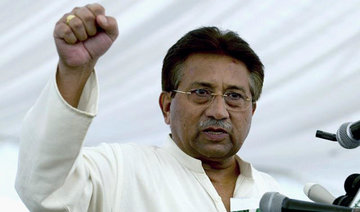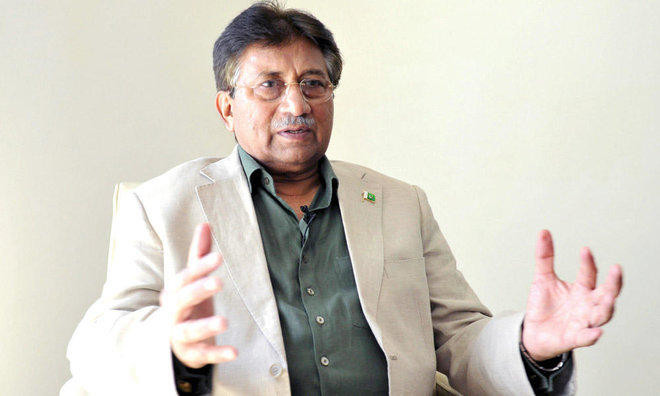
ISLAMABAD: Pakistan’s former president and army chief, Gen. Pervez Musharraf, is already facing setbacks in his ambitious plan to break the status quo of the country’s dominant political parties.
On Friday, Musharraf announced a “grand alliance” of 23 parties under the banner Pakistan Awami Ittehad (PAI) to challenge the main parties at next year’s polls, but the very next day there was serious doubt cast on the legitimacy of Musharraf’s claims when Pakistan Awami Tehrik (PAT) and Majlis Wahdat-e-Muslimeen (MWM), both of which Musharraf had named in his alliance, denied all association with it.
“No one has consulted us about an alliance, nor have any of our leaders attended meetings of any political or electoral alliance," MWM spokesman Allama Mukhtar Imami told The News.
Musharraf claimed the alliance consisted of his own All Pakistan Muslim League (APML), the PAT, the Sunni Ittehad Council, the MWM, Pakistan Sunni Tehreek, Muslim Conference (Kashmir), PML-Junejo, PML-Council, PML- National, Awami League, Pak Muslim Alliance, Pakistan Mazdoor Ittehad, Conservative Party, Muhajir Ittehad Tehreek, Pakistan Insani Huqooq Party, Millat Party, Jamiat Ulma Pakistan (Niazi Group), Aam Loug Party, Aam Admi Party, Pakistan Masawat Party, Pakistan Minority Party, Jamiat Mashaikh Pakistan, Social Justice Democratic Party.
Sunni Ittehad Council Chairman Sahibzada Hamid Raza said that his party's alliance with Awami Ittehad “is not meant for the election” and that his party would campaign on a separate platform. But he did not say his party was not part of the alliance, nor did he explain why it had joined the alliance if it intended to campaign separately.
Musharraf, 74, announced the alliance via a video-link from Dubai, where he has resided for most of the past year, after his name was removed from Pakistan’s exit control list following a stalled treason trial.
The ruling Pakistan Muslim League-Nawaz party impeached Musharraf under Article 6 for twice abrogating the Constitution — a charge of treason punishable by death — by imposing martial law in 1999 and a state of emergency in 2007 in an effort to curtail the growing power of the judiciary and consolidate his power.
Musharraf claimed that all parties had given him their mandate to chair the PAI, and that Iqbal Dar had been appointed as the party’s Secretary General. Musharraf also extended invitations to join the alliance to Pakistan Muslim League-Quaid (PML-Q) and Pakistan Tehreek-e-Insaf (PTI). The latter is led by cricket legend-turned-politician, Imran Khan, and is thought to pose a serious threat to the ruling PML-N in next year’s election.
Some analysts believe the military establishment is backing Musharraf’s alliance, in the hope of dividing the ruling party’s vote bank, particularly in Punjab. The formation of a coalition government would better serve the establishment’s interests than a single party consolidating power, they say.
“Musharraf’s alliance has been formed by the establishment to counter the PML-N in Punjab where 60 percent of seats are allocated,” said political analyst Shiraz Khan. He told Arab News that the province is “the battlefield” for political parties, and that whoever wins in Punjab “wins Pakistan.”
But analyst Abdul Wadood Qureshi said the alliance posed no threat to the status quo "and will have no impact on the elections."
“These parties can’t even get a hundred votes,” he told Arab News. “They are nobodies in the political arena and their party workers couldn’t even become district counselors, let alone MPs.”
APML Secretary-General Dr. Mohammed Ajmal announced that the alliance would hold a convention in Lahore, followed by a “huge rally” in the southern port city of Karachi where the Pakistan People’s Party (PPP) and the once-powerful Muttahida Qaumi Movement (MQM) wield considerable influence. He added that if the MQM and its offshoot, the Pak Sarzameen Party (PSP) were to join the alliance, then Musharraf would support and lead them.
The ouster of former Prime Minister Nawaz Sharif has apparently emboldened Musharraf, who promised to return to Pakistan at “an appropriate time” that would not interfere with “the accountability process” which Sharif, some members of his family, and Finance Minister Ishaq Dar currently face over allegations of corruption stemming from the Panama Papers leak.
Musharraf said that since the country’s courts are not “under Nawaz Sharif’s control anymore,” he was willing to return to the country and face the charges against him, displaying surprising faith in the judicial system he set about dismantling during his presidency.
Those charges include involvement in the assassination of former Prime Minister Benazir Bhutto in 2007. In August, a special court declared Musharraf a fugitive for his failure to appear in court in that case.
Qureshi, for one, doubts the former president will return to Pakistan.
“He is unlikely to come back due to the court cases,” he told Arab News. “The army doesn’t want Musharraf to return out of fear that he could be imprisoned. This is all (an act). The army won’t let him return.”
But political analyst Khan warns that nothing is set in stone when it comes to the country’s complex political arena. “The history of Pakistan shows that anything is possible with the passage of time,” he said.