DANANG, Vietnam: The leaders of the US and China, the world’s two largest economies, are expected to lay out competing visions for the future of global trade Friday in closely watched speeches to Asia-Pacific leaders gathered in Vietnam.
President Donald Trump is likely to wield his “America First” doctrine when he addresses CEOs ahead of the Asia Pacific Economic Cooperation (APEC) forum at the Vietnamese resort of Danang.
In a day mixing big hitters of politics and business, Trump will share the venue with world leaders including Russia’s Vladimir Putin, Japan’s Shinzo Abe and China’s Xi Jinping, who is casting his country as the new architect of global free trade.
Trump arrives fresh from trips to Tokyo, Seoul and Beijing, where he sought to build a consensus against North Korea’s nuclear ambitions and repeated his disquiet with “unfair” trade conditions that he says are siphoning off American jobs.
In China he was gushing in his praise of Xi, calling his a host “a very special man” in a trip rich with photo ops but lacking concrete outcomes on tackling both North Korea and the trade imbalance that vexes the US leader.
Xi touches down in Danang on Friday afternoon carrying a divergent message.
He is likely to double down on his commitment, delivered at the recent Communist Party Congress, that China is ready and able to step into the role of global free trade leader vacated by America.
As the US retreats behind “economic nationalism,” China will take a stride forward, said Ian Bremmer of the political consultancy Eurasia.
“It’s very clear that the comparative vacuum that you experience in the world, especially in China’s back yard right here with APEC, is something that Xi Jinping sees as an opportunity,” he said.
Trump’s ascent to the White House risks unpicking decades of US-led economic diplomacy that webbed global economies together with free trade and low tariff pacts.
He has pledged to wring a better deal from countries the US has large trade deficits with — including China — and bring jobs back to the hollowed out industrial heartland that voted for him.
But proponents of free trade, including many allies, have looked on aghast as Trump tears up the rule book and anti-globalization arguments ricochet through the US and Europe.
Trump has already pulled Washington’s support from the sprawling 12 nation Trans Pacific Partnership (TPP) trade pact and vowed to renegotiate NAFTA, a trade deal between the US, Canada and Mexico.
On Friday, Asia-Pacific ministers were struggling to salvage the sprawling TPP deal, with Canada refuting reports an agreement had been struck among the remaining 11 members to press ahead without the US.
The annual APEC summit is one of the largest gatherings on the annual diplomatic calendar, bringing together scores of world leaders and more than 2,000 CEOs.
APEC represents 21 Pacific Rim economies, the equivalent of 60 percent of global GDP and covering nearly three billion people, and has pushed for freer trade since its inception in 1989.
Any meeting between Trump and Putin will be a box office event with Russia accused of interfering in the US election last year that brought the billionaire one-time reality TV star to power.
Mystery cloaked the question of a meeting between the pair, with top diplomat Rex Tillerson knocking down a Russian report on Thursday that talks have been scheduled.
Trump election campaign aides are under intense legal scrutiny in the US over possible links to the Kremlin.
Facebook’s chief operating officer Sheryl Sandberg is also among those speaking at APEC.
Facebook and its fellow social media giants Google and Twitter are under intense pressure after Russian-paid content spread discord and fake news ahead of last year’s presidential election in the US.


![]()
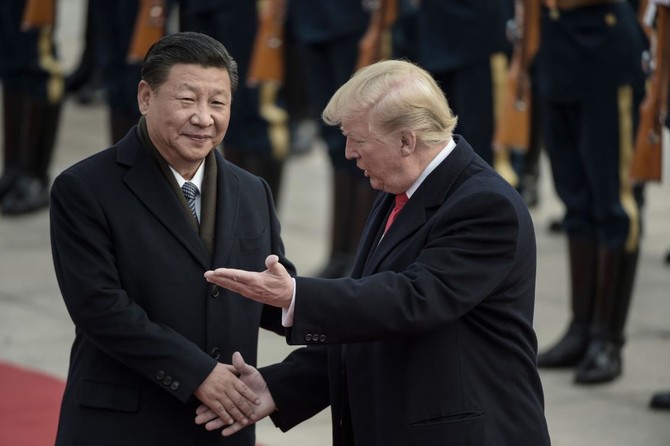
Trump and Xi to set out competing trade visions at APEC
Trump and Xi to set out competing trade visions at APEC

Latest updates


© 2026 SAUDI RESEARCH & PUBLISHING COMPANY, All Rights Reserved And subject to Terms of Use Agreement.