NAIROBI: A militant faction loyal to Daesh has increased its following in northern Somalia from a few dozen last year to up to 200 this year, a UN report said, days after the group came under US air attack for the first time.
The increase in strength of the Daesh spin-off group has attracted attention because some security officials fear it could offer a safe haven for Daesh terrorists fleeing military defeat in Syria or Iraq.
“The Islamic State of Iraq and the Levant (ISIL) faction loyal to Sheikh Abdulqader Mumin — estimated...in 2016 to number not more than a few dozen..., has growing significantly in strength, and (now) consists of as many as 200 fighters,” said the report by a panel of UN experts obtained by Reuters.
“Even a few hundred armed fighters could destabilize the whole region,” said a regional diplomatic security source. “It(air strikes) is a recognition from the US that the situation in terms of the (Daesh) faction in Puntland is becoming increasingly critical.”
Somalia has been riven by civil war and Islamist militancy, though more in the south than in the north where the Puntland region is located, since 1991 when clan warlords overthrew a dictator before turning on each other.
Friday’s air strikes failed to kill Mumin, the security source said. But Abdirizak Ise Hussein, director of semi-autonomous Puntland’s spy service, said the strikes killed about 20 militants, including a Sudanese fighter and two Arabs.
Almost all Mumin’s fighters are Somali, the UN report said, though the group is believed to include a Sudanese man sanctioned by the US. The group also has contacts in Yemen. It was unclear if the Sudanese man under US sanctions was the same one reported killed in the air strike.
“The number of IS (Daesh) fighters in Puntland has increased. Mostly they come from southern Somalia and a few, including foreigners, come from Yemen,” said Col. Abdirahman Saiid, a military officer in Puntland.
The UN report said defectors from Mumin’s faction reported the group had received money and orders from Iraq and Syria, and one member said he had seen Mumin and another leader using TrueCrypt software to communicate with them. The UN could not independently verify those claims.
Mumin’s group has been slowing increasing its activity over the past year. In late 2016, it occupied the port of Qandala in Puntland, a semi-autonomous region, for a month.
Earlier this year, it carried out its first attacks. Its fighters killed four guards at a hotel in Bosasso, the economic capital of Puntland, in February. The same month, the group beheaded three men it had kidnapped.
Somalia’s main Islamist insurgent group, Al-Shabab, is aligned with Al-Qaeda and is most active in the Horn of Africa country’s south. It has repeatedly clashed with the Daesh-aligned faction in the north.


![]()
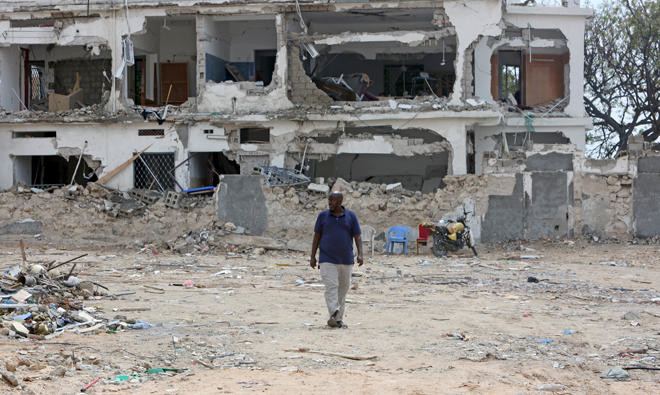
Daesh’s footprint spreading in northern Somalia
Daesh’s footprint spreading in northern Somalia
Latest updates


© 2026 SAUDI RESEARCH & PUBLISHING COMPANY, All Rights Reserved And subject to Terms of Use Agreement.