

Delhi restricts vehicles as smog envelopes India and Pakistan

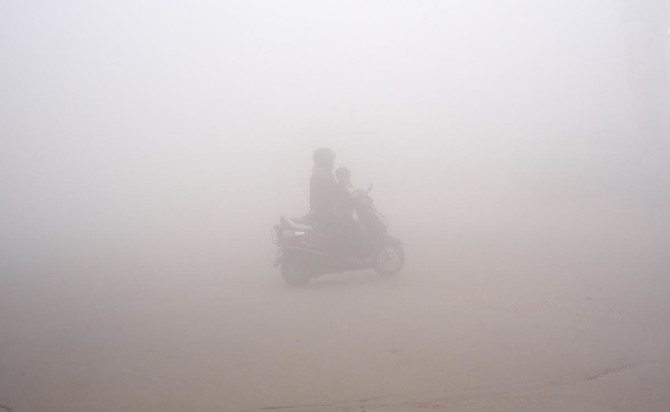
A woman drives a scooter through the morning fog to drop off a child to school in Greater Noida, near New Delhi, India, on Thursday, November 9, 2017. (AP)
Updated 09 November 2017
Follow

Delhi restricts vehicles as smog envelopes India and Pakistan

NEW DELHI: India's capital banned all construction, barred lorries from entering the city and announced stringent restrictions on private car use on Thursday, seeking to combat a massive spike in pollution across large swathes of India and Pakistan.
Tens of thousands of schools in Delhi and surrounding states remained closed as a hazardous fog of toxic pollution cloaked the region for a third day, bringing growing calls for urgent government action to tackle what doctors are calling a public health emergency.
“The situation in Delhi is so bad and if the pollution can be brought down in any way, we will do it,” the city’s transport minister Kailash Gahlot told reporters as he announced plans to limit private car use to alternate days from next Monday.
Authorities in the city had earlier ordered a ban on all construction work and barred lorries from entering the city as public pressure on the government mounted.
Around 50,000 mostly diesel-fueled lorries pass through India’s capital every night and they are a major contributor to the pollution plaguing the city.
Air quality typically worsens before the onset of winter as cooler air traps pollutants near the ground and prevents them from dispersing into the atmosphere, a phenomenon known as inversion.
Low winds and the annual post-harvest burning of crop stubble in the northern farming states of Punjab and Hariyana have caused the levels of dangerous pollutants in the air to spike to many times the levels considered safe.


Figures on the US embassy website showed levels of PM2.5 — the smallest particulates that cause most damage to health — spiked at over 1,000 on Wednesday afternoon in Delhi, though by Thursday afternoon they had fallen to 400.
The World Health Organization’s guidelines say 25 is the maximum level of PM2.5 anyone can safely be exposed to over a 24-hour period.
Doctors say the microscopic particles can penetrate deep into the lungs, increasing the risk of heart attacks and strokes.
“Delhi once again has become a veritable gas chamber with denizens finding it difficult to breathe,” The Times of India said Thursday, joining growing calls for government action to curb the chronic pollution, which the Indian Medical Association this week termed a public health emergency.
“Air pollution during winter months has become a catastrophe for large parts of north India,” the country’s most read English-language newspaper said in an editorial blaming “political apathy.”
In neighboring Pakistan’s second largest city Lahore, near the Indian border, hundreds flocked to hospitals seeking treatment for respiratory illnesses and eye infections caused by the pollution.
The PakAirQuality network, which publishes unofficial air reports on social media, said the concentration of PM 2.5 in the city had topped 300.
Motorcycle riders wore green face masks and goggles as they tried to cope with the smog, but for some the protection was not enough.
“I am feeling burning in my eyes,” said laborer Zawar Hussain. “I will visit a doctor in the evening.”
It is the second year running that Delhi — now the world’s most polluted capital with air quality worse than Beijing — has faced such high levels of PM2.5.
Media reports said the thick smog had also led to a series of road accidents in north India.
Eight students were killed late Wednesday when a truck plowed into them as they waited for a bus on a roadside in Punjab.
Since 2014, when WHO figures showed the extent of the crisis, authorities in Delhi have closed power plants temporarily and experimented with taking some cars off the road.
But the temporary measures have had little effect.
Under pressure to respond, Delhi’s Chief Minister Arvind Kejriwal on Thursday sought to blame stubble burning by farmers in neighboring states.
“We we will continue facing this every year until the neighboring state governments resolve the issue of crop burning,” he told reporters in Delhi.
The practice of burning crop stubble remains commonplace in north India despite an official ban.

‘People will vote for us’: Bangladesh’s Tarique Rahman confident of win in landmark election

Updated 5 sec ago
Follow

‘People will vote for us’: Bangladesh’s Tarique Rahman confident of win in landmark election

  • In first 180 days, Tarique Rahman plans democratic reform, restoring law and order, focusing on job creation
  • He says he admires Vision 2030, wants to visit Kingdom as one of the first countries and perform Umrah

DHAKA: After almost two decades in self-exile, Tarique Rahman, the leader of the Bangladesh Nationalist Party, is expecting victory in Thursday’s election following a change in regime that for years restricted his supporters’ voting rights.

Rahman left Bangladesh in 2008 and settled in London, facing various convictions brought against him by the administration of Sheikh Hasina, the BNP’s archenemy who led the country until mid-2024, when she was toppled in a student-led uprising.

He returned in late December, received by millions of people who lined his route from the airport to the center of Dhaka. He believes they will back his party at the polls.

“BNP is the most popular party in the country. We have been struggling for the people’s voting rights for more than 17 years. We represent the people’s expectations and aspirations,” he told Arab News in Dhaka on Tuesday.

“I believe the people will vote for us and, inshallah, we will achieve a landslide victory.”

Rahman, 60, is the son of BNP’s founder, Ziaur Rahman, a 1971 Liberation War hero, who became president in 1977. After his assassination in 1981, Rahman’s mother, Khaleda Zia, took over the party’s helm and in 1991 became the country’s first woman prime minister.

Rahman assumed the BNP’s chairmanship following her death from a prolonged illness, just days after his return to Bangladesh.

In Thursday’s election, the BNP will race against another 50 parties, including Bangladesh Jamaat-e-Islami, which is forecast to emerge as the main opposition party in the next government. The Awami League, led by the ousted premier Hasina, has been banned from contesting, following deadly unrest that led to the party’s removal from power in August 2024.

An interim administration led by Nobel laureate Muhammad Yunus, which has been tasked with preparing the general election, banned Awami League’s activities, citing national security and a war crimes investigation against the party’s top leadership.

The UN Human Rights Office has accused the former government and its security apparatus of systematic rights violations to suppress the student-led protests between July 15 and Aug. 5, 2024. An estimated 1,400 people were killed.

If Rahman wins the election, he wants his administration to pursue accountability for the former leadership and meet the political and economic expectations of the youth movement that brought about the change.

Bangladesh Nationalist Party chairman Tarique Rahman speaks to Arab News in Dhaka on Feb. 10, 2026. (AN Photo)

In the first six months, his party’s immediate priorities include restoring law and order, democratic reform and creating a business-friendly environment.

“Our 180-day program includes development plans across key sectors, including employment for 10 million people,” he said.

“We will also accelerate private sector growth, ensure employment-oriented economic recovery and develop the blue economy. We will focus heavily on the ICT sector and AI-driven technological innovation.”

In international cooperation, he will prioritize partnerships with Gulf Cooperation Council countries, especially Saudi Arabia — home to more than 3 million Bangladeshis — with whom strong commercial relations were established during his father’s rule, and which is likely to be one of the first countries he would visit if he becomes prime minister.

“The highest number of Bangladeshi migrant workers are employed in Saudi Arabia, and the remittances they send significantly contribute to our economy,” he said.

“I admire the Saudi Vision 2030, and I am sincerely looking forward to working with the leadership of the Kingdom of Saudi Arabia ... I would definitely like to visit Saudi Arabia early in my term. Personally, I also wish to visit the holy mosque, Al-Masjid Al-Haram, Makkah, to perform Umrah.”

In relations with other countries, especially the regional powers India and Pakistan, the BNP government’s policy would be guided by national interest, which “is not about any specific country,” Rahman said.

“We want good relations with all our foreign friends, particularly our neighbors. We are committed to building relations of equality, cooperation and friendship with our neighbors. The foundation of that relationship will be mutual respect and understanding, which will ensure our collective progress.”

Exchanges with Pakistan, from which Bangladesh gained independence in 1971, have improved following Hasina’s removal — after decades of unease. At the same time, ties with India, where the former premier fled after the 2024 unrest, have since deteriorated.

In November, a special tribunal in Dhaka convicted the former prime minister of crimes against humanity, and Bangladesh requested that the Indian government extradite her.

“We want to establish justice in the country,” Rahman said. “No one is above the law. Anyone who has committed crimes must face trial. This is not about any specific political party; it is about justice and rule of law.”

During Hasina’s time in office, Rahman faced multiple corruption cases — allegations he has denied, saying they were politically motivated.

“There were so many false charges filed against me, and the situation in the country was not stable in terms of law and order,” he said. “Despite all the odds — as I have committed and communicated to my countrymen and women — I have returned back to my beloved Bangladesh before the historic national election and (I am) looking forward to it eagerly.”