New Delhi declares emergency as toxic smog thickens by the hour

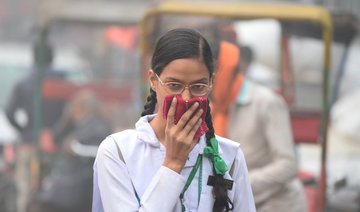
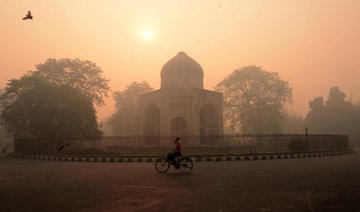
Residents walk along a road amid heavy smog in New Delhi. The Indian capital declared a pollution emergency and banned the entry of trucks and construction activity. (AFP)
Updated 09 November 2017
Follow

New Delhi declares emergency as toxic smog thickens by the hour

NEW DELHI: The Indian capital declared a pollution emergency and banned the entry of trucks and construction activity as a toxic smog hung over the city for a third day on Thursday and air quality worsened by the hour.
Illegal crop burning in the farm states surrounding New Delhi, vehicle exhaust emissions in a city with limited public transport and swirling construction dust have caused the crisis, which arises every year.
The problem has been compounded this year by still conditions, the weather office said.
A US embassy measure of tiny particulate matter PM 2.5 showed a reading of 608 at 10 am when the safe limit is 50.
An hour before it was 591.
PM 2.5 is particulate matter about 30 times finer than a human hair. The particles can be inhaled deep into the lungs, causing heart attacks, strokes, lung cancer and respiratory diseases.
Residents complained of headaches, coughs and smarting eyes. Many stayed home and restaurants in some of the city’s most crowded parts were deserted.
“I’d like to assure people that the central government shall do everything possible to bring about improvement in air quality in Delhi and the Nation Capital Region,” federal environment minister Harsh Vardhan said as authorities faced criticism for failing to take steps to fight a problem that erupts every year.
The haze covered India Gate, a war memorial in the center of the city where Britain’s Prince Charles and his wife Camilla were due to pay respects in a two-day trip ending on Thursday.
Schools have been shut for the week and late on Wednesday the city administration announced a set of measures to try to clean up the air.
Commercial trucks have been banned from the city unless they are transporting essential commodities, all construction has been stopped and car parking charges raised four times to force residents to use public transport.
The Delhi transport department said it would take a decision later in the day on whether to introduce an “odd-even” scheme under which cars with license plates ending in an odd number are allowed one day and even-numbered cars the next.
But experts said these measures were unlikely to bring immediate relief.
“There is such a cloud over us that you probably need artificial rain or some such to clear this,” said Dr. Vivek Nangia, a pulmonologist at Delhi’s Fortis hospital.
Video images shot by ANI, a Reuters affiliate, showed farmers illegally burning crop stubble in Rohtak, about 65 km from Delhi.
Farmers in Haryana, where Rohtak is located, and Punjab, the two big agrarian states surrounding Delhi, burn millions of tons of crop waste around October every year before sowing the winter crop of wheat.
State authorities say it is hard to enforce the ban unless farmers, a powerful political constituency, are given funds to buy machinery to clear their land.
Punjab Chief Minister Amarinder Singh said in a Twitter post: “Situation is serious but Punjab helpless as problem is widespread & state has no money to compensate farmers for stubble management.”


Pakistan killed over 80 militants in strikes on TTP camps in Afghanistan — official

Updated 5 sec ago
Follow

Pakistan killed over 80 militants in strikes on TTP camps in Afghanistan — official

  • Saturday’s airstrikes followed a series of attacks inside Pakistan amid a surge in militancy
  • The Afghan Taliban authorities accuse Pakistani forces of killing civilians in the airstrikes

ISLAMABAD: Pakistan’s airstrikes in Afghanistan destroyed seven Tehreek-e-Taliban Pakistan (TTP) camps and killed over 80 militants, a Pakistani security official said on Sunday, with the Afghan Taliban accusing Pakistani forces of killing civilians in the assault.

Saturday’s airstrikes followed a series of attacks inside Pakistan amid a surge in militancy. Authorities say the attacks, particularly in Khyber Pakhtunkhwa province and the Pakistani capital of Islamabad, were carried out by the TTP and allied groups that Islamabad alleges are operating from sanctuaries in Afghanistan. Kabul denies this.

According to Pakistan’s information ministry, recent incidents included a suicide bombing at a Shiite mosque in Islamabad, separate attacks in Bajaur and Bannu, and another recent incident in Bannu during the holy month of Ramadan, which started earlier this week. The government said it had “conclusive evidence” linking the attacks to militants directed by leadership based in Afghanistan.

“Last night, Pakistan’s intelligence-based air strikes destroyed seven centers of Fitna Al-Khawarij TTP in three provinces of Nangarhar, Paktika and Khost, in which more than eighty Khawarij (TTP militants) have been confirmed killed, while more are expected,” a Pakistani security official, who spoke on condition of anonymity, told Arab News.

An earlier statement from Pakistan’s information ministry said the targets included a camp of a Daesh regional affiliate, the Islamic State Khorasan Province (ISKP), which claimed a suicide bombing at an Islamabad Shiite mosque that killed 32 people this month.

In an X post, Afghan government spokesperson Zabihullah Mujahid said Pakistani forces had violated Afghan territory.

“Pakistani special military circles have once again trespassed into Afghan territory,” Mujahid said. “Last night, they bombed our civilian compatriots in Nangarhar and Paktika provinces, martyring and wounding dozens of people, including women and children.”

 The Afghan Taliban’s claims of civilian casualties could not be independently verified. Pakistan did not immediately comment on the allegation that civilians had been killed in the strikes.

In a post on X, Afghanistan’s foreign ministry said it had summoned Pakistan’s charge d’affaires to Afghanistan Ubaid-ur-Rehman Nizamani and lodged protest through a formal démarche in response to the Pakistani military strikes.

“IEA-MoFA (The Islamic Emirate of Afghanistan’s Ministry of Foreign Affairs) vehemently condemns the violation of Afghanistan’s airspace and the targeting of civilians, describing it as a flagrant breach of Afghanistan’s territorial integrity & a provocative action,” it said in a statement.

“The Pakistani side was also categorically informed that safeguarding Afghanistan’s territorial integrity is the religious responsibility of the Islamic Emirate of Afghanistan; henceforth, the responsibility for any adverse consequences of such actions will rest with the opposing side.”

Tensions between Islamabad and Kabul have escalated since the Afghan Taliban returned to power in 2021. Pakistan says cross-border militant attacks have increased since then and has accused the Taliban of failing to honor commitments under the 2020 Doha Agreement to prevent Afghan soil from being used for attacks against other countries. The Taliban deny allowing such activity and have previously rejected similar accusations.

Saturday’s exchange of accusations marks one of the most direct confrontations between the two neighbors in recent months and risks further straining already fragile ties along the volatile border.