KHARTOUM: Sudanese President Omar Bashir said Monday it was time to shut camps hosting hundreds of thousands of displaced people from the conflict in Darfur as the war in the region had ended.
Bashir, wanted by The Hague-based International Criminal Court for genocide and war crimes related to the Darfur conflict, said internally displaced people (IDP) should return to their villages and not stay in camps anymore.
“Darfur has now recovered, and the next step is to empty the IDP camps as we don’t want any more IDPs,” Bashir said in a speech at a youth convention in Khartoum.
“IDPs and refugees have to return to their villages. We will provide security and services to their villages.”
Bashir alleged that the IDP camps had become business ventures for foreign aid groups.
“They come and offer humanitarian aid, take pictures of our people to get donations and then take 80 percent of these donations themselves,” he said, without naming any aid organization.
“They are investing in the suffering of our people and doing business in the name of helping IDPs.”
Bashir has regularly criticized foreign aid organizations, and in 2009 he expelled several that were operating in Darfur.
The UN said in October that about 3 million people in Darfur needed aid, of whom nearly 1.6 million lived in 60 camps.
“A lack of basic services and infrastructure in addition to insecurity in some areas continues to prevent the return of displaced people to their areas of origin,” the UN Office for the Coordination of Humanitarian Affairs, or OCHA, said in a recent report.
Sudanese officials including Bashir say that the war in Darfur has ended, and have consistently demanded that the UN peacekeeping force deployed in the region be disbanded.
Earlier this year, the UN Security Council approved a reduction in the number of peacekeeping forces, citing an overall fall in violence in Darfur.
Although there has been a significant reduction in violence, deadly tribal clashes still occur in Darfur, a region the size of France.
The conflict in Darfur broke out in 2003 when ethnic minority rebels took up arms against Bashir’s Arab-dominated government, accusing it of marginalizing the region economically and politically.
The UN says the conflict has killed about 300,000 people and displaced more than 2.5 million, most of whom still live in large camps.
Bashir steadfastly denies committing war crimes and genocide in Darfur.


![]()
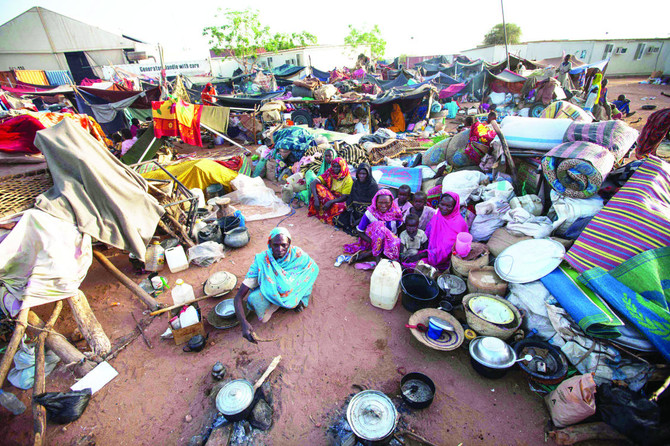
Bashir says time to empty camps of Darfur displaced
Bashir says time to empty camps of Darfur displaced


Latest updates


Recommended


© 2026 SAUDI RESEARCH & PUBLISHING COMPANY, All Rights Reserved And subject to Terms of Use Agreement.