5 dead after migrant boat sinks off Libya

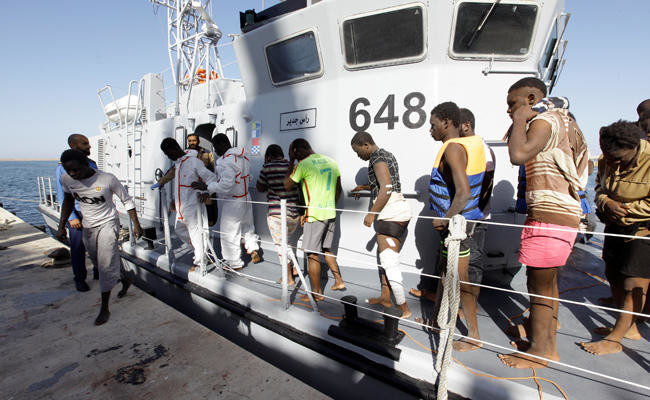
Migrants arrive at a naval base after they were rescued by Libyan coastal guards in Tripoli, Libya, on November 6, 2017. (REUTERS/Ismail Zitouny)
Updated 07 November 2017
Follow

5 dead after migrant boat sinks off Libya

TRIPOLI: At least five migrants died and an unknown number were feared missing after their boat capsized off western Libya on Monday, Libyan coast guard officials and a charity said.
The rubber boat was carrying about 140 people when it overturned close to the border between Libyan and international waters, Libyan officials said. The Libyan coast guard rescued 45 survivors and brought them back to Tripoli harbor.
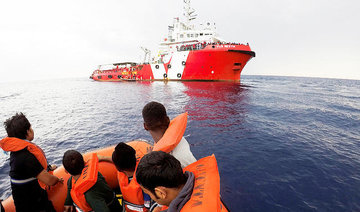
Seawatch, a German non-governmental organization that has a rescue vessel in the Mediterranean, said at least five migrants had died including a toddler. Seawatch rescued 58 people, the group said in a statement.
The survivors brought to Tripoli were from West African countries including Nigeria and Senegal.
On Sunday, the UN refugee agency said the bodies of 26 female migrants who apparently drowned have arrived at the Italian port of Salerno as rescues intensified on the Mediterranean Sea.
The bodies were transferred to the Italian mainland aboard a Spanish naval ship carrying another 400 migrants rescued during four operations in the central Mediterranean.
Twenty-three of the dead women were on a rubber dinghy that sank off Libya two days ago, Marco Rotunno, a spokesman in Italy for the UN High Commissioner for Refugees spokesman, said. Another 60 people were pulled to safety, but more may have perished at sea, Rotunno said. The other three women died in a separate shipwreck.
Humanitarian groups say some 2,500 migrants were picked up at sea in recent days, making it the most intense period for rescues on the Mediterranean since Italy reached a deal with Libya this summer to slow departures of smugglers’ boats carrying migrants.
The number of migrants arriving in Italy so far this year is 30 percent lower than last year, 111,716 through Friday compared to nearly 160,000 in the same period of 2016, according to Interior Ministry figures.
The UN’s International Organization for Migration put the number of dead in the center Mediterranean route from Libya to Italy at over 2,600 through Nov. 1.


Fledgling radio station aims to be ‘voice of the people’ in Gaza

Updated 15 February 2026
Follow

Fledgling radio station aims to be ‘voice of the people’ in Gaza

  • The electricity crisis is one of the most serious and difficult problems in the Gaza Strip, says Shereen Khalifa Broadcaster

DEIR EL-BALAH: From a small studio in the central city of Deir El-Balah, Sylvia Hassan’s voice echoes across the Gaza Strip, broadcast on one of the Palestinian territory’s first radio stations to hit the airwaves after two years of war.

Hassan, a radio host on fledgling station “Here Gaza,” delivers her broadcast from a well-lit room, as members of the technical team check levels and mix backing tracks on a sound deck. “This radio station was a dream we worked to achieve for many long months and sometimes without sleep,” Hassan said.

“It was a challenge for us, and a story of resilience.”

Hassan said the station would focus on social issues and the humanitarian situation in Gaza, which remains grave in the territory despite a US-brokered ceasefire between Israel and Hamas since October.

“The radio station’s goal is to be the voice of the people in the Gaza Strip and to express their problems and suffering, especially after the war,” said Shereen Khalifa, part of the broadcasting team.

“There are many issues that people need to voice.” Most of Gaza’s population of more than 2 million people were displaced at least once during the gruelling war.

Many still live in tents with little or no sanitation.

The war also decimated Gaza’s telecommunications and electricity infrastructure, compounding the challenges in reviving the territory’s local media landscape. “The electricity problem is one of the most serious and difficult problems in the Gaza Strip,” said Khalifa.

“We have solar power, but sometimes it doesn’t work well, so we have to rely on an external generator,” she added.

The station’s launch is funded by the EU and overseen by Filastiniyat, an organization that supports Palestinian women journalists, and the media center at the An-Najah National University in Nablus, in the occupied West Bank.

The station plans to broadcast for two hours per day from Gaza and for longer from Nablus. It is available on FM and online.

Khalifa said that stable internet access had been one of the biggest obstacles in setting up the station, but that it was now broadcasting uninterrupted audio.

The Gaza Strip, a tiny territory surrounded by Israel, Egypt, and the Mediterranean Sea, has been under Israeli blockade even before the attack on Oct. 7, 2023, which sparked the war. Despite the ceasefire, Israel continues to strictly control the entry of all goods and people to the territory.

“Under the siege, it is natural that modern equipment necessary for radio broadcasting cannot enter, so we have made the most of what is available,” she said.