BEIRUT: The parliamentary bloc of the Future Movement, to which Prime Minister Saad Al-Hariri belongs, on Saturday declined to comment on the internal political turmoil caused by the unexpected resignation of Al-Hariri.
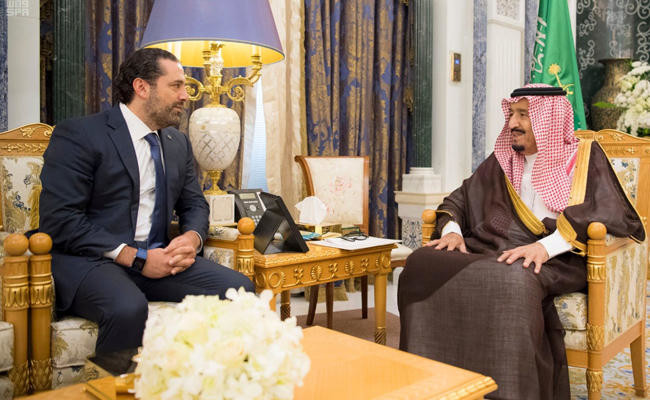
The bloc’s sources told Arab News that they had decided to wait for the outcome of Al-Hariri’s meeting with King Salman in Riyadh on Monday.
After the meeting, Al-Hariri shared a photo of him with King Salman on Twitter and tweeted: “I was honored to visit Custodian of the Two Holy Mosques King Salman bin Abdulaziz, in his office at Al-Yamama Palace.” The Saudi Press Agency stated that the meeting discussed the “recent developments in Lebanon.”
The meeting was attended by Saudi Interior Minister Prince Abdul Aziz bin Saud, Foreign Minister Adel Al-Jubeir, Minister of State for Arab Gulf Affairs Thamer Al-Sabhan and Minister of State and Cabinet member Musaed Al-Aiban, the official Saudi Press Agency said.
“We will not accept Lebanon to be in any way a platform for terrorism. It is up to its leaders to choose whether it is a state of terrorism or a state of peace,” Al-Sabhan said.
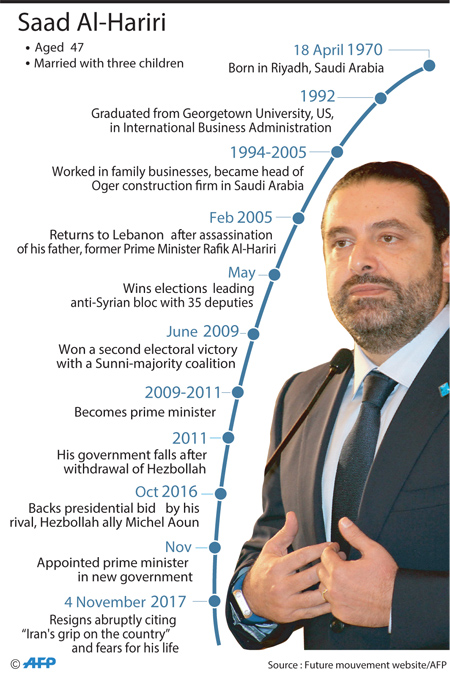
President Michel Aoun has not yet commented on Al-Hariri’s resignation, nor has he taken any constitutional step about it. The presidential palace has witnessed many meetings in which security and economic matters were discussed, aimed at preventing the repercussions of this recent unexpected political step.
“We understood from President Aoun that things are clear for him but he refuses to take any decision before meeting with Al-Hariri,” Salim Jreissati, minister of justice, said after a security meeting.
In a media statement after the Lebanese president’s meeting with security and judicial officials, Aoun said: “National unity remains the main pillar for maintaining security and political stability in Lebanon, and all efforts must be focused on preserving it, especially during this critical situation.”
Aoun told security officials to stay alert and ready for any development, especially in the pursuit of rumor makers who have been very active in the past few days in order to cause chaos. He also urged the media to refrain from circulating rumors and all that disrupts national unity and public safety.
Jreissati pointed out that “security officials have submitted promising reports, which did not show any unusual security incident in the last few hours and days.” He pointed out that Aoun stressed that “political, security, financial and economic stability in Lebanon are a ‘red-line’.”
Dar Al-Fatwa remains the main destination for political leaders in Lebanon, especially Sunni leaders. After his meeting with Grand Mufti Sheikh Abdul Latif Deryan, Interior Minister Nohad Al-Machnouk highlighted the importance of taking hold of the security situation to prevent any incident that may disturb the country’s stability.
“The Lebanese authorities did not have any information about the attempt to assassinate Prime Minister Saad Al-Hariri, but a Western body might have communicated it directly to Al-Hariri,” Machnouk added, pointing out that “the meeting between King Salman and Al-Hariri has thwarted the rumors and Al-Hariri might come back to Lebanon any time soon.
“We should wait for Al-Hariri’s return to answer all these questions,” he said, adding that the Lebanese president “has made a bold and wise step. He managed to maintain stability despite the void caused by Al-Hariri’s resignation.”
Al-Arabiya television reported on Monday that “the technical interference that Hariri’s convoy encountered in Beirut was carried out with Iranian-made equipment, days before his resignation.”


![]()
Lebanon politicians await outcome of Saudi king’s meeting with Al-Hariri
Lebanon politicians await outcome of Saudi king’s meeting with Al-Hariri
Latest updates


© 2026 SAUDI RESEARCH & PUBLISHING COMPANY, All Rights Reserved And subject to Terms of Use Agreement.