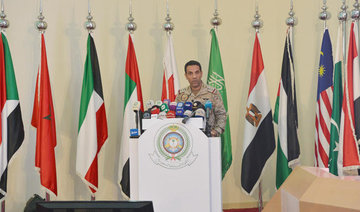
JEDDAH: The Saudi-led coalition supporting Yemen’s UN-recognized government on Sunday said it was temporarily closing all land, sea and air ports in Yemen to stop Iranian weapons from reaching Shiite Houthi insurgents.
A press statement by the coalition’s command said the decision was made after experts ascertained that the ballistic missiles being fired by Houthis from Yemen toward Saudi Arabia, including the one intercepted over Riyadh on Saturday night, were manufactured in Iran.
“A thorough examination of the debris of these missiles, including the missile launched on July 22, 2017, has confirmed the role of Iran’s regime in manufacturing these missiles and smuggling them to the Houthi militias in Yemen for the purpose of attacking the Kingdom, its people, and vital interests,” said the statement carried by the Saudi Press Agency (SPA).
Saudi air defense forces shot down the ballistic missile before it could hit the airport in the national capital on Saturday night.
“The coalition’s command considers the Iranian regime’s action in supplying the Houthi militias that it commands with these missiles to be a blatant violation of the United Nations Security Council (UNSC) resolutions that prohibit nations from arming these militias, specifically UNSC Resolution 2216,” the statement said.
It also said it considers “Iran’s role and its direct command of its Houthi proxy” a “blatant act of military aggression by the Iranian regime, and could be considered as an act of war against the Kingdom of Saudi Arabia.”
While closing all points of entry to Yemen, the coalition command said it will “take into consideration the continuation of the entry and exit of humanitarian supplies and crews in accordance with the coalition’s updated procedures.”
It urged Yemeni civilian and humanitarian crews and diplomatic missions to avoid areas of combat operations; areas populated by armed militias; and Houthi smuggling routes and missile launch sites.
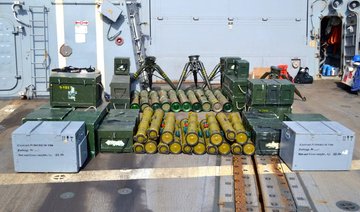
Western analysts have said the smuggling of Iranian weapons to Houthi insurgents have continued despite efforts to stop them since the coalition sent forces to Yemen to restore the government of President Abed Rabbo Mansour Hadi in March 2015.
A Reuters report on March 23, 2017, had said that from September 2015 until March 2016, “the French and Australian navies frequently intercepted weapons which officials said were most likely bound for the Houthis.”
It also quoted a US defense official as saying Iranian weapons smuggling to the Houthis had continued since March 2016, and that the equipment included “long-range ballistic missiles capable of reaching deep into Saudi Arabia.”
Nic Jenzen-Jones, a military arms specialist and director of Armament Research Services, which has tracked Iranian equipment ending up in Yemen, also said quantities had increased, the same report said.
Conflict Armament Research (CAR) also said in a study that it had evidence showing that the Qasef-1 UAV drone that Houthis claimed to have made were actually traced to Iran.
Flights canceled
Yemen’s national airline said Monday it has canceled all flights to the country’s only two functioning airports after the Saudi-led coalition battling Houthi rebels announced the closure of all land, air and sea ports, reported The Associated Press (AP).
Yemenia airlines said that the coalition, which controls Yemen’s airspace, had denied permission to fly out of Aden and Sayoun, both in areas of southern Yemen controlled by coalition allies.