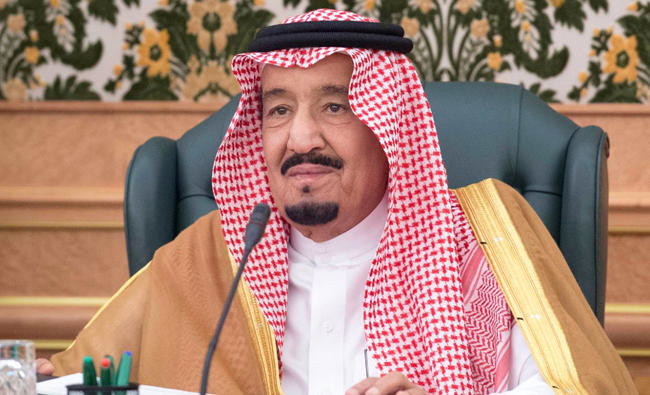
JEDDAH: King Salman announced two key changes in the Saudi Cabinet and ordered the formation of a super committee to combat corruption. The committee is to be headed by Crown Prince Mohammed bin Salman.
In its first decision, the committee ordered the arrests of a number of princes and big businessmen for their involvement in corruption in different cases.
The two key changes in the Cabinet were that of National Guard Minister Miteb bin Abdullah, who was replaced by Prince Khaled bin Ayyaf, and Economy Minister Adel Fakieh, who was replaced by Mohammed Al-Tuwaijri.
Commander of the Navy, Abdullah Al-Sultan, was relieved of his position and has been replaced by Adm. Fahad Al-Ghofaili.
Besides the crown prince, the committee comprises heads of the Anti-Corruption Commission (Nazaha), Public Security, General Prosecutor and the Investigation Authority.
The job of the new anti-corruption committee will be to “identify offenses, crimes, persons and entities involved in cases of public corruption,” the royal decree said.
The committee is empowered to investigate, issue arrest warrants and travel bans, order financial disclosure and the freezing of accounts and portfolios, track funds and assets and prevent their remittance or transfer by persons and entities.
“The committee has the right to take any precautionary measures it sees fit, until they are referred to the investigating authorities or judicial bodies,” said the decree.
“It may take whatever measures deemed necessary to deal with those involved in public corruption cases and take what it considers to be the right of persons, entities, funds, fixed and movable assets, at home and abroad, return funds to the state treasury and register property and assets in the name of state property.”

Cabinet reshuffle, crackdown on corruption in Saudi Arabia
Saudi Arabia led green building performance regionally in 2025: Report
- Saudi Arabia achieved the highest regional score of 76.31 points and certified more than 1.03 million sq. meters of sustainable building space
- Results reflect measurable efficiency gains across 6,662 projects completed since 2010, marking a new regional benchmark for measurable sustainability progress
RIYADH: Saudi Arabia led the region in sustainable building performance and environmental impact in 2025, according to the Saaf index developed by the Saudi Green Building Forum.
Saudi Arabia achieved the highest regional score of 76.31 points and certified more than 1.03 million sq. meters of sustainable building space, the Saudi Press Agency reported on Wednesday.
These results reflect measurable efficiency gains across 6,662 projects completed since 2010, marking a new regional benchmark for measurable sustainability progress and institutional excellence.
The achievement underscores Saudi Arabia’s growing influence in advancing sustainable construction across the Middle East and supports the Kingdom’s Vision 2030 objectives for cleaner growth, resource efficiency and climate resilience through data‑driven environmental performance.
Faisal Al‑Fadl, secretary‑general of SGBF, said that 2025 represented a major turning point toward a measurable, institutional sustainability strategy that united policy, technology and practice.
He added that the approach extended beyond renewable energy, clean water and eco‑friendly materials to embed sustainability in economic planning and public development programs, made possible through integrated efforts with regional governments and public institutions.
The Saaf index provides a specialized regional framework for measuring efficiency and resilience through the Sufficiency and Resilience Composite Index, or SCI, enabling precise performance assessments.
Findings show that the sector has evolved into a cohesive strategy integrating project delivery, professional capacity building, market innovation and climate action.
According to the SGBF review, Saudi Arabia’s achievements reflect its ability to combine quality implementation, institutional maturity and scale.
Environmentally, green building projects achieved an estimated 62,800 tonnes of carbon‑equivalent annual reduction and earned 29 professional recognitions, reinforcing growing international acknowledgment of Saudi leadership in sustainability.
The data also underscore SGBF’s role as a professional partner in advancing methodologies, applications and impact measurement within non‑governmental frameworks that link policy and practical execution.
More than 7,300 professionals across 22 Arab countries engaged with the Saaf platform in 2025, alongside numerous business‑driven initiatives expanding the region’s sustainable‑development footprint.
Al‑Fadl said that the period from 2025 to 2026 would act as a bridge toward Vision 2030, strengthening a model in which sustainable buildings were managed by impact, measured through indicators and implemented via lasting partnerships.
SGBF serves as the Kingdom’s leading platform for advancing sustainable construction and green design. It unites experts, innovators and practitioners dedicated to building environmentally responsible and high‑performance structures.
Through continuous education, certification and collaboration, SGBF drives the transformation of Saudi Arabia’s building sector — minimizing environmental impact, promoting resource efficiency and improving overall quality of life for communities nationwide.